Author: KarenTsugawa

  • Stewarding Memories: Caring for People, Trees, and Land

    Stewarding Memories: Caring for People, Trees, and Land

    “We will never forget.”  After September 11 (2001), this claim was made in countless political speeches, memorial eulogies, bumper stickers, carved stones, tattoos, and tee-shirts.

    But we do forget.  Time rolls on.  We age.  New people are born who have no lived experience of the tragic occurrences of that day.  So too, does the landscape change.  New buildings rise, trees grow, roads are built.  We exist in an on-going cycle of disturbance and recovery.  As such, our lives and our landscapes are constantly shifting in new and different ways.

    So what happens to the places that were purposively set-aside as spaces of remembrance?  How do they change or persist?  What role do they play in the lives of their creators, their stewards, and their users as we move further in time away from a particular event?  These are the questions that we are exploring as we re-visit sites associated with the Living Memorials Project.  These sites are community-based memorials that use nature (from single tree plantings, to park dedications, to forest restoration projects, to labyrinths, to community gardens) to commemorate September 11, 2001.

    Living memorials exist all across the country, but are concentrated in the areas surrounding the crash sites: the New York City metropolitan area, the Washington, D.C.-Virginia area, and near Shanksville, PA.  Many of them were created in the immediate days and months following September 11, on much quicker timelines than the formal, state-led built memorials that are now dedicated and open to the public at these sites.  The Living Memorials Project was funded by the USDA Forest Service to provide community grants to stewardship groups and conduct research to understand changes in the use of the landscape post-September 11.  In many cases, the creation and maintenance of these sites was led by civic groups—from informal groups of friends to formalized nonprofits—who sought to create a more immediate, accessible, and local response to the event.  (To search a list of these sites, visit the National Registry.  To read 12 journeys through these Living Memorials, visit Land-Markings.  To learn more about the social meanings of community-based memorials in the ‘pre-memorial period, read this article.)  So, unlike the Gettysburg Battlefield or the built monuments on the National Mall that are meant to remain in perpetuity in a fixed image, these sites may be more malleable in response to local changes and needs—both because of their physical form as nature-based sites and because of their governance as often civic-led spaces.
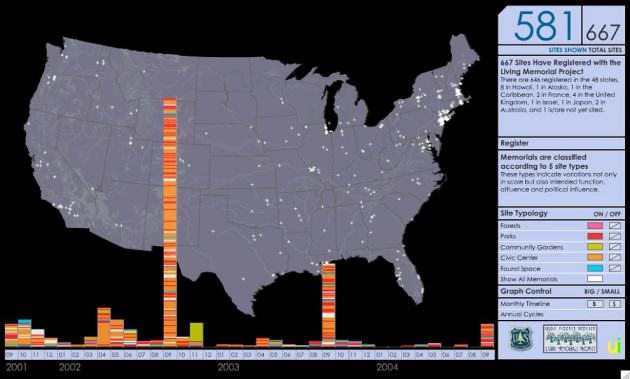
    The Living Memorials Project national map shows the spatio-temporal patterns of memorials across the country and over time, from 2002-2006. Map created by Urban Interface and the US Forest Service.

    Starting next year, we plan to systematically return to a sample of the 113 stewardship groups that we interviewed and the nearly 700 sites that we documented nationwide.  We began that process earlier this summer at the request of documentary filmmaker, Scott Elliott, who is creating a film called The Trees.  In seeking to tell the story of the memorial forest at the World Trade Center, Scott learned of the hundreds of community-based sites that use trees, plants, and nature to memorialize the event and wanted to visit a few.  So we selected two sites in the New York City area that we hadn’t formally interviewed or interacted with since 2006, not knowing what we would find.

    The trip inspired us as researchers about the power of these sites and reinforced some important lessons about community stewardship as it persists over time.  In particular, our visits to two sites have reinforced our appreciation for the persistence, responsiveness, and adaptability of civic stewardship.  We see that community-managed spaces can be sustained throughout the passage of time, changes in leadership, changes in the economy, and even changes in climate.  We’d like to share some reflections….

    Tribute Park, Rockaway, NY

    One common concern about community-led stewardship is that it is temporary or fleeting—as many informal groups are small in terms of staff and budgets, are volunteer-powered, and lack the institutional authority of government.  Yet, Tribute Park shows the persistence of community stewardship even in the face of leadership transitions and major disasters.

    The site was created, starting in 2002, by the local Chamber of Commerce.  It was a vacant, waterfront lot, on the Jamaica Bay side of the Rockaway Peninsula.  Just blocks from the busy, public beach on the Atlantic Ocean side, the Bay side of the Peninsula always offered a more quiet space for interacting with nature through viewing, fishing, and crabbing.  On September 11, members of the public gathered along the bay, including at the vacant lot, to view the smoldering World Trade Center (WTC) towers.  The Chamber of Commerce envisioned a contemplative space that would reflect the seaside character of the Rockaways and would uniquely commemorate the victims of the Rockaways.  The peninsula lost a number of residents that day—including many members of the uniformed services—as well as downtown workers in New York City’s financial district.
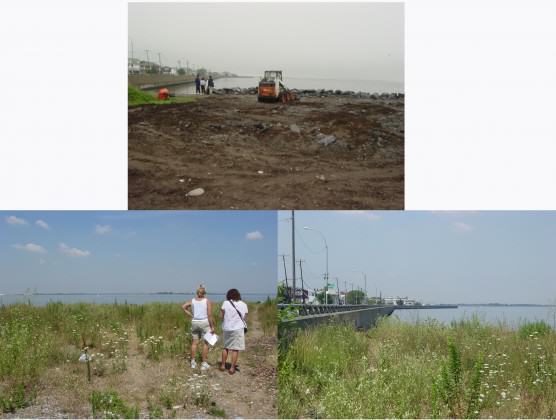
    Tribute Park site in 2002-2003. Credit: Living Memorials Project National Registry.

    Since then, a new group has emerged to tend the site—The Friends of Tribute Park.  Still powered by volunteers, many of whom are retired residents of the Rockaways, the care for the site is clear.  They have added new elements to the park—including a piece of WTC steel that they had to go to court in order to secure and install.  Every Tuesday morning, from 8:30-10:00am—in remembrance of when the planes struck the WTC towers, they hold volunteer stewardship days, where anyone from the public can come and help take care of the site.  Bernie Coburn of Friends of Tribute Park called the site a “hands on park” that will keep changing over time as the group works to “maintain beauty with a personal touch.”  When asked whether he considers the site a sacred space, he said that it was, because it is “a living project—I live for it.”  Clearly, the ongoing stewardship and maintenance of the site—perhaps more so than the physical form or the symbolism or design—makes the site sacred.
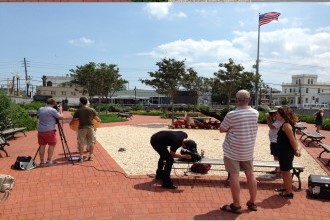
    Tribute Park in 2014, with members of Friends of Tribute Park, the documentary film crew for The Trees, and the Fire Department of New York. Credit: Living Memorials Project National Registry.

    The site also endured and persisted through Hurricane Sandy, which inundated the entire peninsula of the Rockaways.  While many residents were struggling to rebuild their homes and restore their lives, stewards also took the time to help restore Tribute Park—because they knew that the site was an important gathering space and community resource that merited rebuilding.  In addition, the NYC Parks Department provided crucial personnel and heavy equipment, showing that civic stewardship does not work in the absence of government support.  Indeed, the volunteers told us that NYC Parks’ crews visit the site weekly to assist with maintenance of the site.  While the initial creation of the park was civic-led—with civic stewards operating as a unique form of “first responder” to the 9/11 tragedy, they still work in partnership with state through grant funding, regulatory compliance, and general maintenance.  We see that these public-private partnerships exist at many scales and in many contexts.  Just as the flagship parks of Central Park and Prospect Park have their prominent private partners—the Central Park Conservancy and the Prospect Park Alliance, so too does this tiny, 30,000 square foot site have the Friends of Tribute Park, which ensures its care and upkeep.

    New Jersey’s Grove of Remembrance, Liberty State Park, Jersey City, NJ

    Community-based stewardship is often expressed in vacant lots and community gardens—sites that are outside the reach or care of the state or the market or that are deliberately managed via community control.  Discussing the case of the North Brooklyn post-industrial waterfront in the 1990s, Daniel Campos writes about these moments in time and space as an “Accidental Playground”—where members of the public have the ability and autonomy to create, shape, and manage the use of space.  Once the state and the market come back in, even in a case where a formal park is designated as it was in North Brooklyn—the role for the public tends to shift from creator/steward/manager to “user”.  The Liberty State Park memorial, however, is a unique example of ongoing civic stewardship within a designated state park.
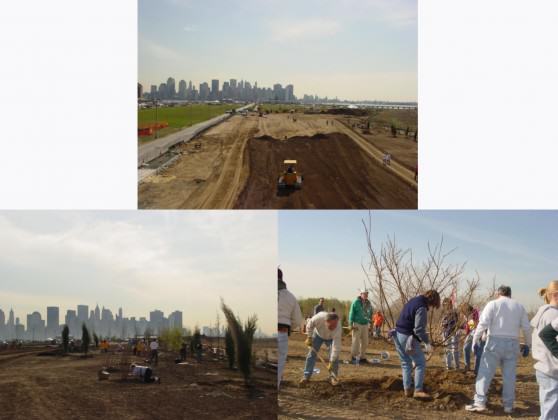
    Liberty State Park planting day in 2003. Credit: Living Memorials Project National Registry.

    When community stewardship occurs on parkland, it can range from one-time, large-scale volunteer tree planting days to decades long dedication by ‘friends of the park’ groups, alliances and coalitions. The Grove of Remembrance at Liberty State Park was born out of the spirit of long-time community stewardship and created via hundreds of volunteer arborists, 9/11 family members, New Jersey residents, and Friends of Liberty State Park who came together to help plant this 10 acre former brownfield site with 691 trees (to honor all of the New Jersey victims who perished).  These volunteer events are filled with the excitement and energy of getting hands dirty and “doing something.”  Indeed, both authors participated in the planting of this site, and we feel materially and physically connected to its creation.

    The ongoing care and attention of the nonprofit New Jersey Tree Foundation (NJTF) over the past 10 years has created opportunities for the public to continue to be involved.   NJTF is primarily responsible for the maintenance of the site, though it is on state land, so we see an example of hybrid governance at work.  Thus NJTF uses its own staff and its partnerships with civic, private, and school groups to help maintain the site.  For example, NJTF has worked with area schools to use the grove as a space for environmental education.  Area students learn about the life cycle of trees and plants, starting seedlings in their classroom, and then coming to the grove to engage in planting and maintenance.

    Another pattern we see repeated with these sacred sites of social meaning: people go above and beyond their traditional professional roles and see their engagement with sites as a form of ‘giving back’ voluntarily. Working via NJTF, the professional arborist and forestry community in New Jersey has effectively “adopted” the site—donating thousands of hours of services, labor, and expertise. Like Tribute Park, the waterfront Grove of Remembrance was also flooded and heavily affected by Hurricane Sandy.  The site is directly adjacent to a marina and after the storm, entire boats were found stranded and overturned inside the grove.  Heavy equipment was required to remove the boats, remove the downed trees that could not be saved, and right the trees that could be saved.  Volunteer arborists were involved in all stages of the Sandy recovery of the grove, making tree assessments, removals, and continuing to monitor the site over time.

    What is even more unique is when we see signs of individual acts of stewardship and care that occur outside the frame of these formal events and programs.  The ability to embrace these acts as healthy and productive forms of engagement, rather than intrusion into the authorities of the land manager, requires an ethos that is open to community action, voice, and power.  Lisa Simms of the NJTF showed us examples of “guerrilla plantings” that occurred in the grove—people have brought bushes and flowers and are planting in the understory to complete the grove through their individual acts.  Lisa pointed out the flowers that she, herself, planted from her home garden.  These are examples of the public intimately engaging with the space, adopting it, and transforming it.  This type of engagement, regardless of whether it deviates from the master plan, is welcome in places like this as stewards are more interested in cultivating an attachment to place rather than viewing a ‘pristine’ ecological restoration site.
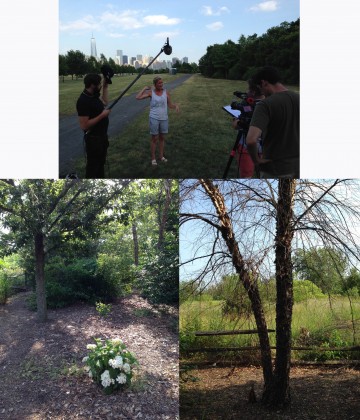
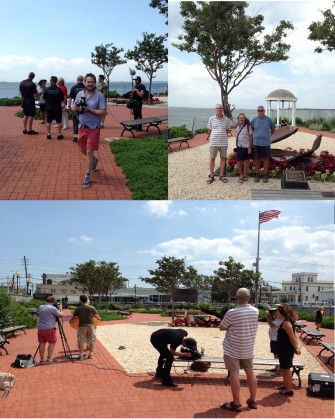
    Liberty State Park in 2014. Top: Lisa Simms of New Jersey Tree Foundation speaks to the filmmakers. Bottom, left: guerrilla planting in the understory. Bottom, right: trees that sustained damage during Sandy. Credit: Living Memorials Project National Registry.

    Through these visits, we can see the crucial connection between the need for unplanned space, the role for community stewards, and the ability for neighborhoods (people and places) to cope with change.  Thus, stewardship can be understood as a mechanism for cultivating social-ecological resilience.  While there are many forms of community stewardship in community gardens, street trees, waterways, and vacant lots—we know that these living memorials are special and even sacred places.  They are imbued with the memories and intentions of their creators who sought to set aside land for remembrance, healing, and community cohesion.

    One issue to explore in our ongoing longitudinal research is whether this persistence and adaptability is a broad-based trend.  It is entirely possible that the need for and meaning of some sites is temporary and short-lived.  Thus far, our investigations have found the opposite.  Instead, we found a dedicated cadre of neighbors and friends keeping vigil in a waterfront park in Queens and a forest growing across the river from the former World Trade Center site.  Finally, a key question is whether and how this sense of deep attachment to place and people can be cultivated, expressed, and celebrated outside of the context of disturbance and tragedy?   What can we take from the horribly singular experience of 9/11 that translates to how we care for the land and its people every day? 

    Lindsay K. Campbell and Erika S. Svendsen
    New York City
    On The Nature of Cities 

  • Rock, Tree, Human

    Rock, Tree, Human

    As a Brooklyn (New York) resident for over 15 years, I’ve never thought much about whether or not I was living on high ground, within a floodplain or an evacuation zone, or how I might secure my windows during a storm. Recent hurricanes in my city have changed my perception of where I live and, ultimately, the places that have meaning in my community.

    As friends and neighbors gathered in my Carroll Gardens apartment to shelter in place during last October’s Hurricane Sandy, we enjoyed conversation and good food. Our children, delighted by the novelty of the event, made up endless games and watched more than their typical allotment of YouTube videos. Around midnight, a friend stopped by our apartment on her way home from her job in Manhattan. I used this excuse to go outside to check on the large London Plane trees that have long surrounded my neighborhood park. Despite the wind and rain, I could see the large, ominous forms of trees on the ground.  I retreated back upstairs.

    The next morning, my friends returned to their house in Red Hook to survey damages. I took the kids out for much-needed fresh air. The park was filled with similar groups of slightly bedraggled parents alongside energetic youngsters eager to return to outdoor play.

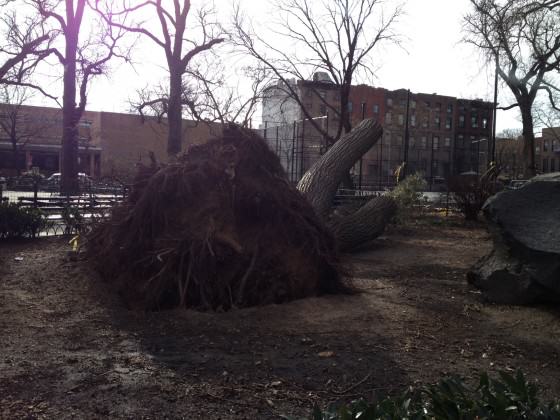
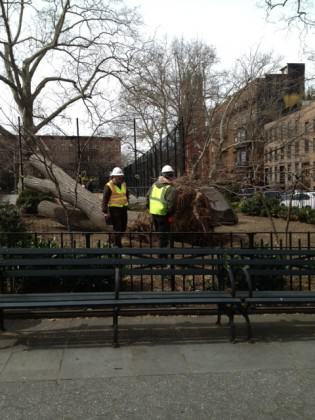
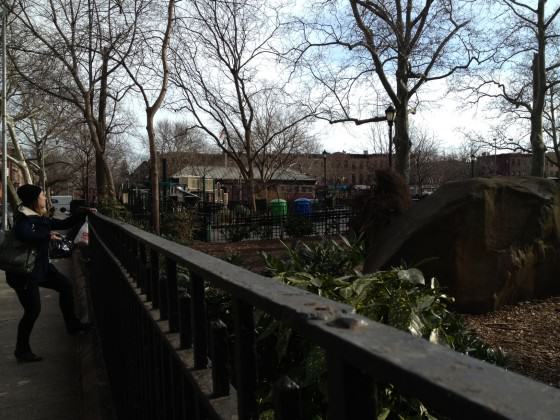
    Things in the park had changed. It was strewn with tree limbs and there was significant damage to the play courts. Several old trees had crashed to the ground. Wrought-iron and chain link fencing was crushed. As we followed the length of one downed tree, it led us out of the park and across Carroll Street where its upper trunk came to rest on a parked car and its canopy blocked the entrance to a stately brownstone. There were several people surveying the damage. I was struck by their silence.  Suddenly, one of my young charges squeezed through the line of onlookers, inspected the remains of what was once a fancy, red sports car, and proclaimed loudly, “Sheesh, I’m glad that wasn’t our car!”  Laughter ensued. We continued along what was clearly a spontaneous pilgrimage to all of the fallen trees in the area. Street trees. Park trees.

    And then we come upon one of the most significant sites of tree loss.

    For decades, this stately little leaf linden tree stood in a corner of the park, in a small gated area ringed by flowering shrubs. It stood in an area adjacent to basketball courts, benches and a water fountain. The tree’s presence, next to a large boulder, invited a different experience for the park user: one that was more peaceful.  Young parents brought their toddlers here to quietly sit upon the shaded rock. Groups of school-aged children often scrambled atop the rock to share secrets or engage in free play in the slightly more subdued place. At dusk, teenagers typically positioned themselves here to look out for friends or spend time talking. Early risers have used this spot to stretch, meditate and greet the morning sun.

    At the base of this fallen giant, someone left a bouquet of flowers still encased in plastic wrap from a corner deli. I wondered whether this was the same bouquet I noticed over the weekend at the base of a temporary memorial in the park. Perhaps the wind had blown this small offering around and another person had decidedly placed it at the base of the fallen park tree? Or were the flowers meant only to commemorate the tree?

    What seemed to matter most was the connectivity between the two events. Humans use nature as symbols—typically rocks, trees and gardens—to celebrate life and to mourn death. We convene around these symbols to mark the passage of time.  Here, the tree, or perhaps this former union of rock, tree, and human, was the object of our memorialization.

    Amidst the grave destruction of human life and property, someone paused to mark the tree’s death.

    Working for the U.S. Forest Service, I have become acutely aware of cycles of disturbance and resilience.  When a forest burns, there are winners and losers among the flora and fauna.  Some creatures lose nests or burrows, feeding or breeding grounds.  Others flourish as they gain space, light and air.  Disturbance is part of life in the woods and, ultimately, we never walk the same forest twice.  The quality of resilience often depends upon time and conditions before any disturbance.  Having worked as an urban forester and now a researcher of the urban forest, I revere the way in which individuals and groups often embrace nature after a significant disturbance.

    In many cases, ‘nature’ was the very thing that destroyed lives, homes and communities. Hurricanes. Ice Storms. Tornados. Floods.  After each of these disturbances, there is recovery.  Consider your own experience with such events.  After the emergency responders have moved on, someone inevitably calls for the need to plant a tree, build a garden, or reclaim a piece of the shoreline.  Often, these humble expressions have served to remind us that the most vulnerable people often live in the most fragile places, made worse by social segregation and environmental degradation. And even after ‘not-so-natural’ disasters, as in the case of the September 11th terrorist attacks, we’ve witnessed hundreds of individuals and groups decide to plant trees and create living memorials that stand not only in remembrance of those killed, but of the universal bonds between loved ones and communities.

    For decades, we have seen this same, patterned response of emergent stewardship from people living in urban areas where populations have declined, housing has deteriorated, and employment has waned. In these forlorn places, we have seen the rise of vibrant community gardens, pocket parks, window boxes, tree lots and the like.  It has been my experience as a researcher delving into human motivations of urban stewards, that many of these acts evoke the spirit of the forest. No matter how humble or small, these efforts loom large in the cycle of disturbance and resilience.

    At some point along the path of recovery, we can lose sight of the importance of these actions. We tend to focus on more instrumental or utilitarian questions such as: What can nature do for us? How much is a tree worth?  How much can our wetlands and green streets absorb to save our homes and businesses from flooding?

    This type of thinking is entirely reasonable when one realizes that yes, as humans we are part of nature. And, as humans, we are the only species that can rise to a level of abstraction to actually do anything about the long-term stewardship of our ecosystems. Thankfully, there are researchers, policy-makers and citizens working hard to help address these questions but we might consider there are some answers that are quite clear.

    Earlier this spring, I had the honor to introduce a special lecture on ‘The Benefits of Urban Trees,’ by U.S. Forest Service scientist, Dr. David Nowak.  The lecture was part of a series to celebrate the release of a vibrant, new book of photography by Benjamin Swett, entitled “New York City of Trees.”  As I prepared my introduction, I found it remarkable that both scientist and artist had found profound, but strikingly different ways to value and understand the urban forest.

    Dr. Nowak’s i-Tree model has been used by hundreds of cities throughout the world to quantify the environmental benefits of urban trees.  These benefits include cooler air temperatures, air pollution removal, carbon storage and household energy savings.  Mr. Swett, on the other hand, presents the urban tree as a ‘keeper of the city’s past.’  He depicts trees as part of the collective memory through a mix of personal stories, historical events and artistry.  In one account of a massive Eastern Cottonwood in a corner lot on Staten Island, the reader learns this tree has meaning that spans generations in the community.  The tree’s great expanse triggers memories of a parent, a grandparent, a house.  Memory continues to shape place and purpose.  I was reminded through these two distinct works how fortunate we are to have both artist and scientist value the urban forest, creating varied lenses to understand the essential relationship between rock, trees and humans.

    As the audience awaited Dr. Nowak’s top benefit of the urban forest with great anticipation—(Hint: think temperature)—I was pondering the number two benefit of our urban trees: aesthetics and social benefits.  Nearly all of the benefits, including temperature, had certain values listed.  But why were aesthetics and social benefits marked ‘uncertain’?  Isn’t this value universally known?  Hasn’t it stood the test of time?

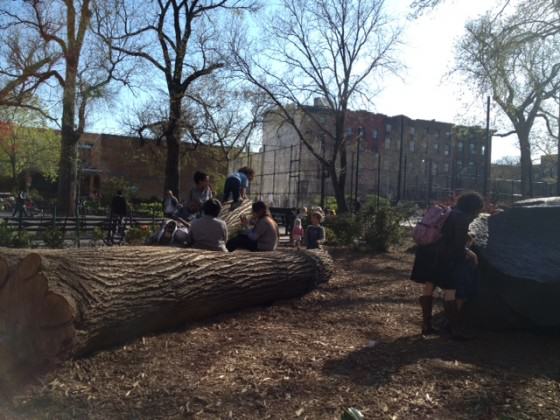
    I think it’s fair to surmise that when my neighborhood tree fell down in Carroll Park, residents did not immediately mourn the loss of a few dollars in home heating and cooling bills.  Nor is it likely that they lamented its capacity to absorb water and carbon.  It is not to suggest that these benefits are not important, but only to have us reflect on the idea that quantifying and qualifying the loss of this tree is dependent upon one’s frame of reference.  At the scale of an energetic five-year-old and a parent wanting to escape the confines of an average sized, two-bedroom, Brooklyn apartment, we mourn the shade this tree provided as children spent endless hours climbing the rock beneath its branches and playing with twigs near its base.  We’ll miss the cool haven it provided during the hot summer months.  I know that many will recall the dappled sunlight and the brilliant, colorful turn of its leaves each fall.  And we will be forced to find another way for rock, tree and humans to interact to create a seemingly ordinary but decidedly sacred space.

    In this way, we know what this tree was worth in terms of social benefits to the surrounding community.

    When we look to the long arc of history, we can understand social value even further.  In the writings of our greatest philosophers and work of acclaimed artists of all kinds, we find inspiration from nature.  In the speeches of world leaders, we hear language that acknowledges the interplay between nature and the quality of human life.  In the actions of those engaged in social movements and acts of resistance, tree planting and reclaiming nature has become an effective ‘weapon of the weak’.  We tend to reduce these acts to gestures, moments, stories or fleeting shouts in the street.  But they are more than that.  When we discover the true value of urban nature it is social and it is transformative.  It becomes the place from where we may set a course of change and discovery.

    Do we need to quantify what exists before our own eyes?

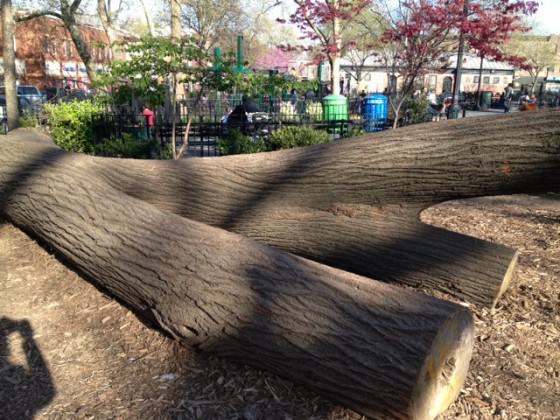
    Back in Carroll Park, there is an active group of park volunteers.  The storm’s aftermath has sparked a great deal of activity in terms of clean ups and repair.  I’m not certain who led the decision to leave a significant portion of our downed tree alongside the rock or even what exactly they had in mind in doing so.  I do know that many of my neighbors have whispered in passing, “I hope they leave it on the ground.”  In my own wanderings around the park, I’ve observed a wide range of people, young and old, pause to admire the downed tree.  Neighborhood children delight in touching it, climbing it and being in the company of this old friend.

    We never experience same forest twice, as both people and place are constantly evolving. Carroll Park is different, post-storm.  My perception of it has changed, as I have changed, deepening my understanding of public space and human agency in the recovery process.  Somehow park volunteers and managers did more than repair the park, but improved it as they created opportunities for the public to experience the reciprocity of nature.  In a dynamic and ever-changing urban environment, they sustained and strengthened a place of social meaning.

    Not unlike our vast wilderness areas in the American West, our urban forests have much to teach us not only about disturbance, but about what constitutes resilience.

    Erika Svendsen
    New York City

    On The Nature of Cities

    I’d like to acknowledge the dedication and care of the Friends of Carroll Park in their stewardship of a precious community resource.  I’d like to thank Mary Northridge, Sara Metcalf, and Denise Hoffman Brandt for their recent conversations that have inspired many of these ideas. And thanks to my young friend, Shane.

    All photos are by Erika S. Svendsen.