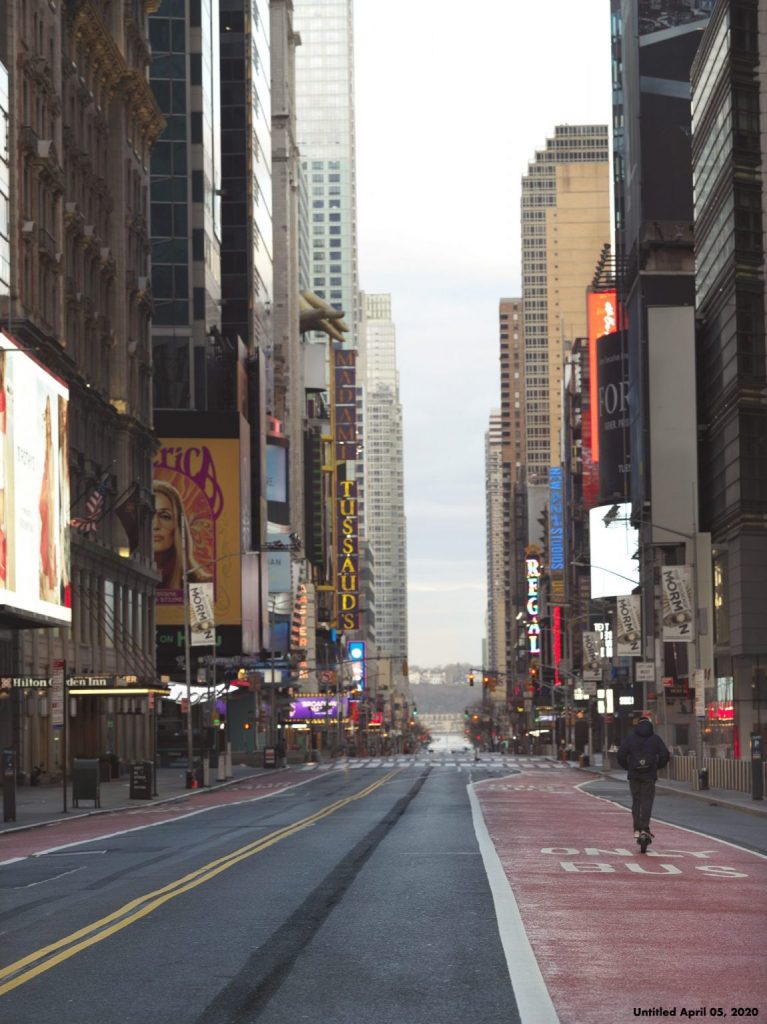
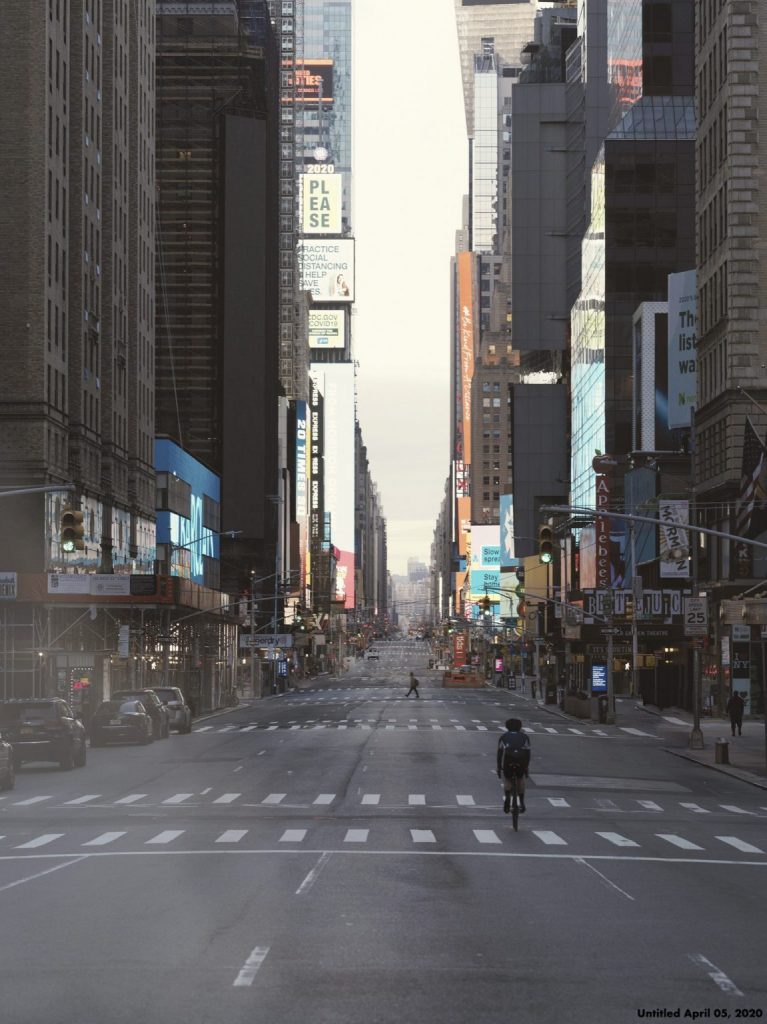
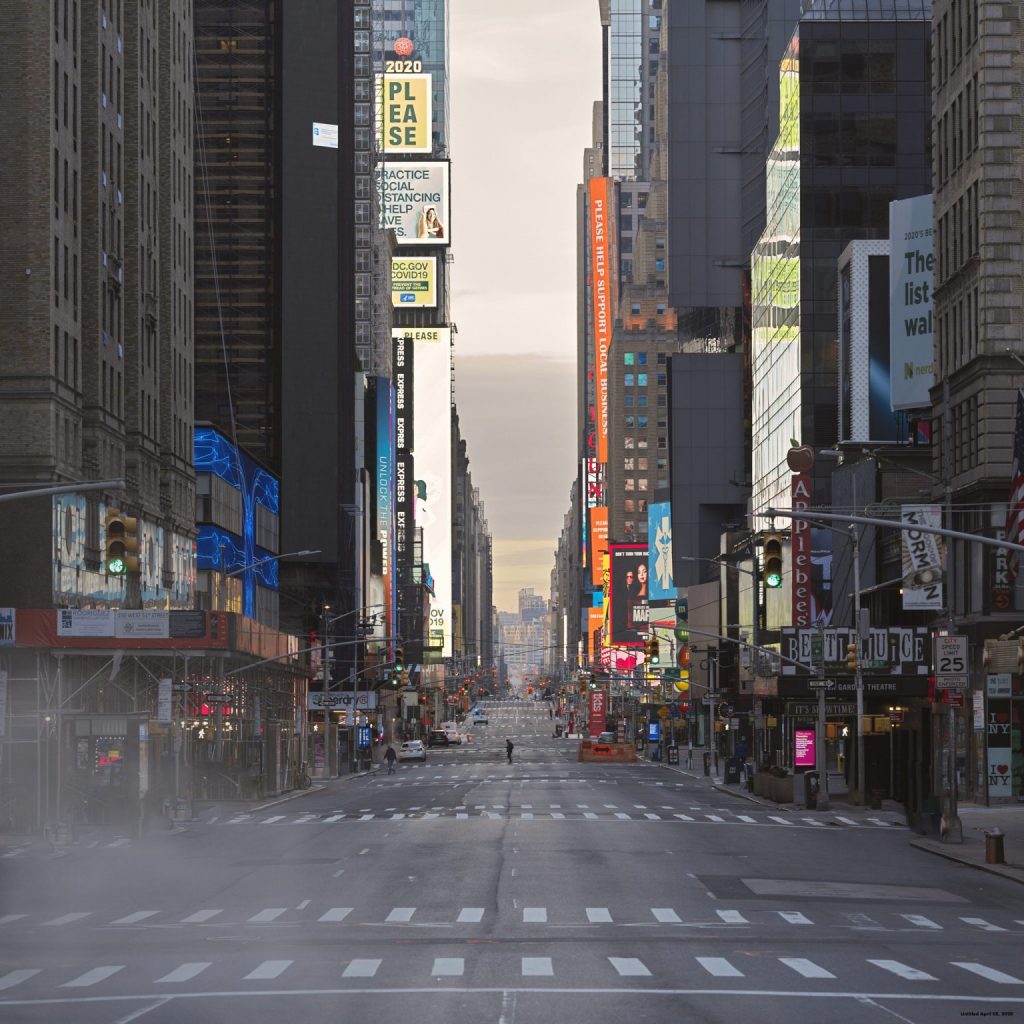
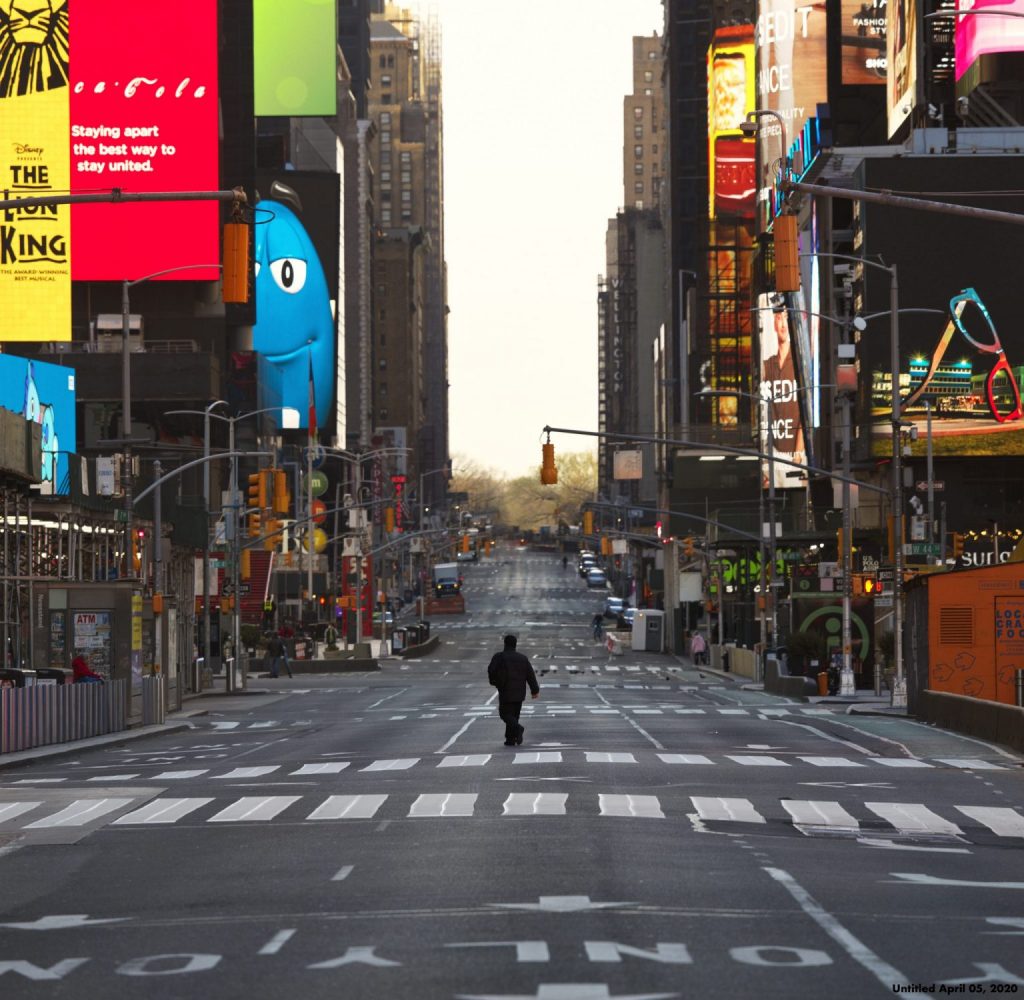
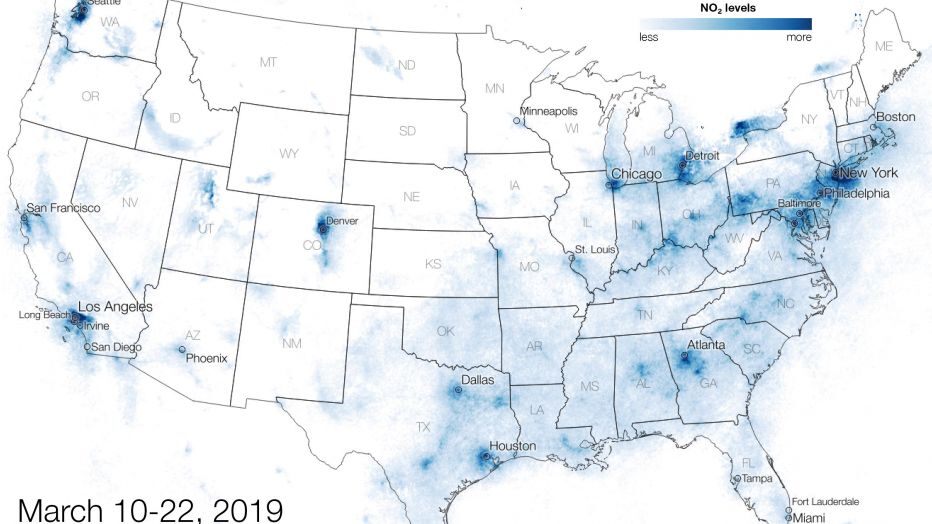
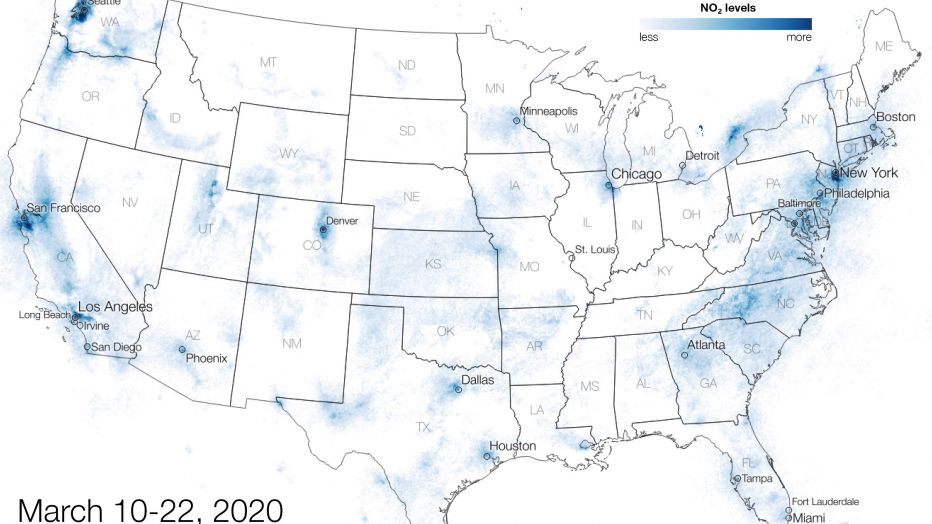
How do you conduct social science research about people’s relationship to place and the environment during shelter-in-place? Many are turning to big data—scraping social media, tracking cell phone use and movements, and these aggregated, digital data streams are providing key insights about mobility, vulnerability, and spatial patterns of the virus and its impacts across the landscape. These data provide evidence that green spaces—including large natural areas—are key destinations with frequent and increased visitation rates.
But there remains a crucial need to understand how these changing relationships to nature, society, and the public realm are affecting us individually and as a society. As such, we need qualitative approaches to document our lived experiences, with all their emotion, affect, embodiment—and dis-embodiment. We need to walk, talk, observe, write, and draw as living, sensing beings in order to understand how the pandemic takes place. We need to remember the head-spinning disorientation of the past three months, to reflect on how it unfolded over time and continues to unfold. Since 13 March 2020, we have been keeping a small group journal with our set of experiences of our communities—both our local communities of place and the virtual communities of which we are part. We have observed these experiences to change over time, from the initial days in early March to now; as we struggle to make sense of things, it is abundantly clear that the pandemic experience is not singular. We are four white women who all share an enormous amount of privilege to be home, salaried, and working remotely. For essential workers, the experience is entirely different as they leave home to interact with transit, workplaces, and all the risk and potential exposure that comes along with those interactions. For low income families living in shared housing or for the unhoused, home is not necessarily a safe space either. For people of color, there is a heightened risk of exposure, sickness, and death from COVID-19 that is now clear from the nation’s own accounting of this crisis.
Despite our shared experience of racial and economic privilege, each of us is sheltering in a different NYC neighborhood across Brooklyn and Queens, and we also all have different family configurations, risk factors, community networks, and local open spaces and built environments available to us that inevitably shape our experience of place and the pandemic. Out of our collective journaling—separate but together—have emerged some shared patterns and individual insights. We are mindful and reflexive that we are just four people out of the billions experiencing this global crisis- and therein lies the rub, the desire to zoom back out to aggregated pictures. But we need both focal lengths- the macro and the micro, the bird’s eye and the worm’s eye view. So in sharing these reflections we do not mean to universalize, but rather to offer—to ask—does this resonate with your experience of nature and community in the time of COVID-19? Why or why not? We invite others to document their lived experiences of COVID-19—as we need this collective reflection now more than ever.
We offer our reflections below in four thematic parts alternating among each of us. We are cognizant that the crisis continues to unfold and are humble that our particular stories are not really the ones that need to be told the most right now. But if we inspire someone else to write, to reflect, to talk, to share, then we have achieved our aims.
I. Sirens, Birdsong, and Social Media: Soundscapes and Digital Connections
Shelter-in-place, stay home, wear a mask, do not gather, maintain social distance: all of the basic steps that are involved in flattening the curve and slowing the spread of the virus also have the impact of isolating and atomizing us into our household units—whether we live entirely alone, with partners or roommates, or our families. We find ourselves spending more time in our homes and personal spaces than perhaps any other time in history. But of course we are not alone, we are separate together, hyper-connected via the digital realm and the mediasphere. In fact, it is hard to disconnect. In an interview with author and artist Jenny Odell on an Ezra Klein podcast, she discussed how the only distinction now between her work life, social life, personal time, or family time is now in her mind—it is all happening compressed into a single space—and this resonated with our experiences. This lack of physical space and separation of activities is mentally fatiguing. So our minds rattle between stressors and the mundane—the dire news of the day, the work tasks to complete, the groceries to purchase, the friend who was ill, and those who passed. We remain ever-mindful that this sort of fatigue is a luxury, compared to the physical, mental, and emotional exhaustion faced by frontline and essential workers.
While digital connections feel like the most omnipresent and obvious connection to the “outside world” — other flows permeate our homespaces as well, including some that operate on deeply emotional registers. In particular – sound is able to travel at a distance and can reach our ears and minds even without our directed attention. At the peak of the pandemic in NYC with so much less car and air traffic, the city soundscape was altered. Less of the hum/drum of everyday street noise, but the wail of sirens was unignorable. Daylong conference calls and zoom meetings would pause when the uncomfortable reality of a siren came through someone’s speaker. Polite muting did not remove the painful reminder— thousands are ill, thousands are dying. Yes, this pandemic is happening all around us while we sit, sheltered in our homes, grateful for and worried about those unable to do so.
At the same time, many began to notice the subtle melodies of birdsong—a reminder that nature, life, and diversity are here and present all around us. When the shelter-in-place order started in March, our movement was slowed and outdoor spaces were essentially removed for many of us. At the same time, the world was waking up to spring while we were inside. The space in which we notice things has gotten smaller. Here are some journal snippets around this intimate nearby nature:
Michelle:
20 March 2020. Some of my own reflections on my relationship with the environment right now. I haven’t left my apartment in 2 days. I went to the park on 18 March after work and it was too crowded to feel safe. There was a weird frantic energy in the air. Normally I am a “Leave No Trace” person, but I couldn’t stay 6 feet away from anyone without diverging onto the grass.
I am opening my window every day until it gets too chilly. I can hear my neighbors’ laughter and conversation, but I can also hear the birds. The limited nature soundscape I have is so critical. I am not sleeping well and I can hear when the robin starts singing at 3 or 4 am—well before light. It is only daylight when the house sparrows and starlings start chiming in. That robin is a symbol of spring and hope for me.
8 April 2020. I opened my bathroom window last week and found twigs dropped by a pigeon building its nest. I looked out the window at my other sills and found even more twigs on another sill. Normally, I don’t pay attention to these birds—I am more excited about warblers in the park. But now I have an apartment list instead of a yard list/park list and am birding by sound mostly.
I see on social media that my friends who never birded are becoming birders and my birder friends are becoming backyard birders. I talked with my friends about what if I am still inside when the blackpoll warblers migrate through—at least I can hear them when they will be in the park (usually migrate through later than other birds heading to the Arctic in mid to late May).
24 May 2020. Walking around my neighborhood park, I hear my first blackpoll warbler’s high pitched trill. We are still inside—we have been inside the length of spring migration. Last week my friend texted he heard one in Inwood Park in upper Manhattan, so I knew to be on the lookout for them.
II. Rainbows and Cowbells: Signs of Solidarity and Gratitude
What are the messages that we share with our neighbors and the public during the pandemic? Signs in apartment windows or yard signs on residential lawns are vehicles for messages that we wish to transmit—they cross the threshold from our private sphere to the public realm. Collective messages of solidarity and gratitude literally rung out from the rooftops through the evening cheers that developed over the course of the shelter-in-place. These visual and auditory signs and signals are part of how we navigated this crisis, articulating our shared values and sending the message that we are not in this alone.
Lindsay:
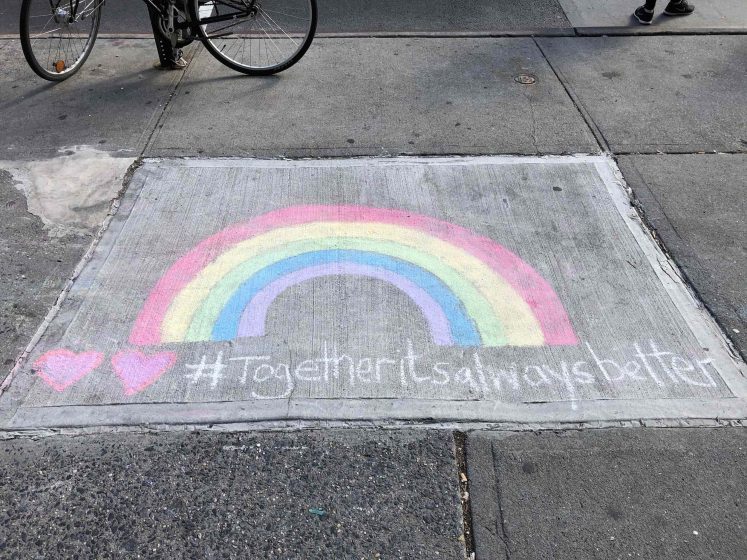
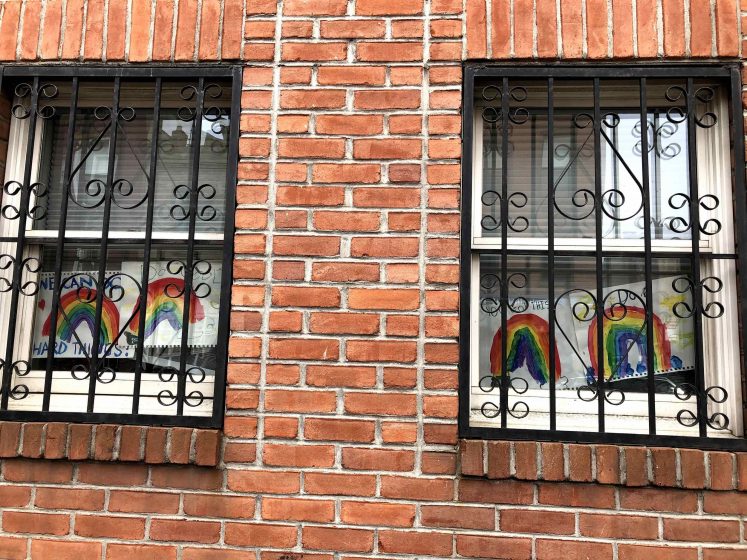
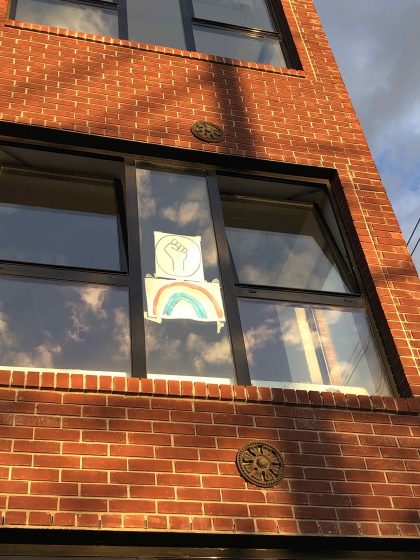
On 17 March, I journaled about window rainbows for the first time. My nieces, sheltering with my parents in suburban Annapolis, Maryland, made a large front-yard rainbow saying “Tutto Va Bene” in reference to the Italian practice of children drawing these messages of hope and putting them in their windows during lockdown. On March 19, someone in my local Facebook mom’s group made mention of a google map of rainbows, so kids could do virtual “scavenger hunts”. Since the group was based one neighborhood over, when I first checked it there were not any rainbows in my neighborhood. We made a point of taking a long family walk with my daughter in a stroller to find and photograph as many rainbows as we could and started a digital photo album just for our “Rainbow Shimmer”. Two months later, that map has spread across the country and world. But we don’t need a map—there are rainbows in almost every window in my neighborhood—as well as chalk drawings and even a street tree festooned with rainbows, but I still find myself taking pictures. The emotion I feel each time is mostly tenderness—I feel cheered by the messages of hope and thanks for essential workers, but I picture the millions of children, sheltering at home with their bewildered parents, and my heart aches and aches.
Rainbows in apartment windows. Photo: Lindsay Campbell
Rainbow chalk drawing on the sidewalk. Photo: Lindsay Campbell
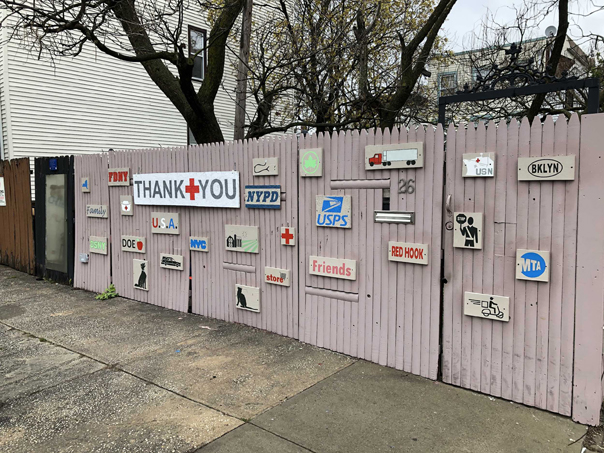
Every night at 7pm, we open up our window and ring a cowbell. My toddler ends this ritual with the phrase I taught her: “Thank you workers, thank you helpers” as we join millions of people around the world in thanking frontline and essential workers. Our neighborhood is relatively quiet, all and all, once in a while we hear a few other bells, pots, pans, and claps, but I have seen videos from other neighborhoods around the city and the world that ring out with song. Who are we thanking? The healthcare workers, of course, but all city agencies keeping us safe: fire department, trash collection, as well as essential workers delivering food, mail, and other goods.
This local street art in my neighborhood captures the broad range of people we need to thank. I make a point not just of ringing my cowbell, but of personally thanking these workers when I see them. I contributed to a fund that was set up to help our postman purchase his own PPE—a necessary, but insufficient step toward protecting an essential worker. Frontline workers themselves have noted and protested that applause is not enough, they need protection.
Street art thanking essential workers. Photo: Lindsay Campbell
Erika:
On 19 April I walked over the big retail chain hardware store near my neighborhood. I was desperate to see if I could find something colorful to grow in planters on my roof. There was a sign thanking emergency responders and a place to sign your name with appreciation. The NYPD, EMS, and the Dept of Sanitation were all listed…and then I saw the logo for the NYC Parks Enforcement Police (known as PEP officers). This was the first time I personally ever noticed NYC Parks acknowledged on a first responder sign. I smiled. Although the gates are locked, each and every day since this all began, there has been a park worker that shows up in the park across from my apartment. This person sweeps, cleans, and keeps order until we can enter again. I am very grateful for her work.
On 21 May: I was on a conference call today and a colleague who runs a citywide stewardship program shared that she was disheartened. “We were denied our spring this year,” she said. Her frustration was because she knows that when people volunteer in the parks they do more than care for the vegetation, they tend to care for and learn more about each other. I was feeling down about that too. We talked about when and how the city might collectively mourn: When would be the right time? What would this look like for parks volunteers? Digging, planting and pulling vines and being in the company of others amidst a nature where life and death cannot be denied.
Lindsay:
On 21 May, the Empire State Building and other NYC landmarks were lit up green to honor and thank park workers, under the campaign #GoingGreenForParkies. Monuments in San Francisco were also lit green that day for the same reason, and I saw some social media traffic about wearing green as far away as Honolulu. This reflects a public recognition of the important work that park workers are doing and have been doing each and every day.
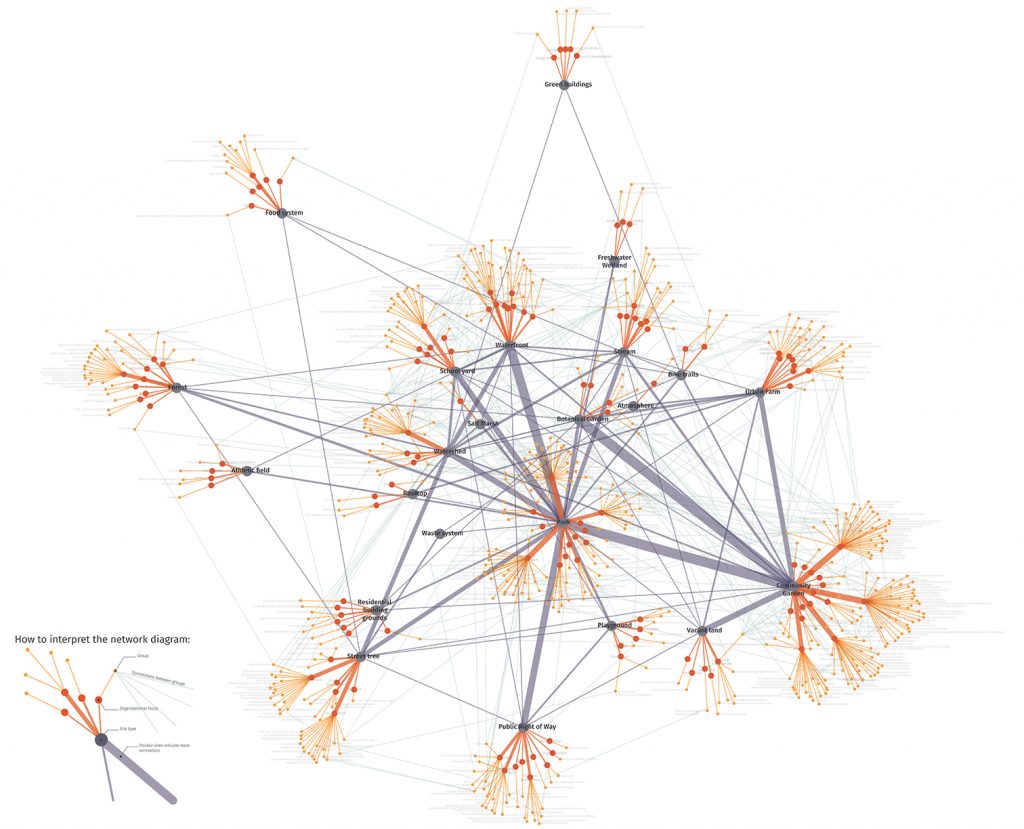
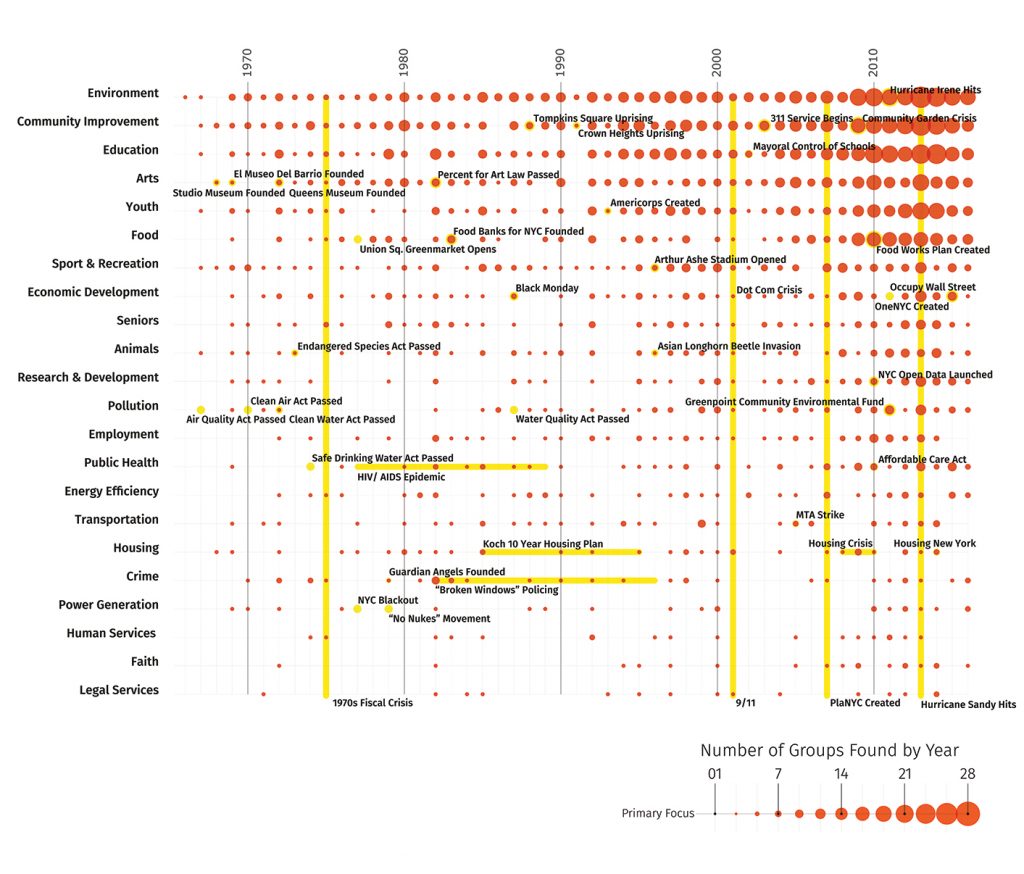
III. Care Work: Mutual Aid and Stewardship Prior to COVID-19, much of our shared research has focused on civic stewardship—acts of care-taking and claims-making on the local environment. With this work, we aim to better visualize and amplify the work of local groups in advocating for, maintaining, and educating the public about the environment. We have also examined the ways in which environmental stewards reorganize and respond to disturbance—be it hurricane, flood, tornado, September 11th, invasive pest, or economic downturn. While the pandemic is unprecedented in its spatial extent and cascading public health, economic, and social impacts, it is another form of disturbance to which these local groups and networks adapt and respond.
Most visibly, we have seen the rise of mutual aid groups—many of them wholly new operations, some of them organized on the heels of prior organizing from Hurricane Sandy, which also build on the organizing of Occupy Wall Street. Even before stay-at-home orders were passed, when it became clear that many New Yorkers would be struggling—physically, emotionally, and financially—as a result of COVID-19, community members came together to prepare. Many have memories of responding to past disasters, from 9/11 to Hurricane Sandy, by activating social networks and coming together to exchange resources and hold space. Without the ability to be together physically, organizing quickly began online and via flyers posted on neighborhood streets. Over time, many became networked and began exchanging ideas on how to do the work of helping neighbors.
Whether initiated by local elected leaders, community based organizations, or residents within a building, most early efforts focused on checking in with older adults and other vulnerable populations. Establishing these social connections, sometimes through something as simple as a phone call making sure a neighbor has enough food for the week, can create a lifeline in a crisis. As the death toll ticked up and unemployment rates increased, it became clear that amidst uncertain fiscal budgets and philanthropic support, local organizing would need to fill longer-term needs. Mutual aid groups across the city are now struggling to figure out how to become more sustainable. In Crown Heights, requests for grocery runs are coming in so quickly that there is a backlog of at least a month. The level of need is high, but is it realistic for a group of neighbors, each with their own personal quarantine challenges, to fill the gaps left by the many closing food pantries and dwindling social services?
Michelle:
Because of health concerns, I have only volunteered virtually. I joined my neighborhood’s mutual aid group in late March and have watched it evolve over time, becoming more organized, networked, and complex, as it responded to more community needs and more volunteers. Seeing the volunteer numbers climb has been inspiring. I have called elderly neighbors to check in on them and, for the month of April, served on the dispatch team. Every week when I signed in to my shift, community needs had expanded, available resources had changed, and the mutual aid group was hard at work with evolving dispatcher guidelines for how to assist neighbors in need. Mutual aid groups were coordinating across neighborhoods, yet I observed that not all neighborhoods in NYC had a specific group. What is the social infrastructure a community needs to be able to establish, maintain, and expand such efforts? My neighborhood already had a strong civic-minded tech community; many of them have volunteered to create systems that have enabled communication and organization for mutual aid.
Laura:
So far all of my volunteering has been virtual. As a healthy, able-bodied young person, I struggle with finding the balance between staying home to protect myself and others and assuming some risk in order to support those who cannot safely go to the store. In the early days of quarantine, I eagerly signed up for any and all opportunities that came through my inbox. I shared my name and phone number with neighbors on a list of potential errand-runners circulating in my building. I also unknowingly signed up to make phone calls to seniors in Chicago, and organizers assured me that my actual location was not important—what does distance even mean anymore? Later, I was matched with three seniors here in Brooklyn, whom I called and connected to various services and resources I hoped would be helpful. The phone conversations I had were brief but pleasant, and everyone seemed to welcome the chance to connect. I have also joined my local mutual aid group’s intake team, responding to requests for groceries and matching them with volunteers who can go to the store and make contact-free deliveries. I recently returned a call to a neighbor who had reached out back in April, but she was still in need of basic food items. Seeing the update that her groceries were delivered felt like a tiny victory. It is moving to see people come together in times of need. Other volunteers in the mutual aid group have expressed a deep appreciation to the online community of responders. The woman who led my intake volunteer training said that since becoming out of work due to COVID-19, this has become her job. But what happens when she goes back to work and neighbors are still going without food? So much more is needed in order to support ongoing community building.
While civic stewardship groups have their usual territories and ecologies that they care for, in the face of crisis and our changing reality—we’ve observed their ability to be nimble and adaptive to meet pressing needs of their community. Updating fieldwork protocols, adjusting workforces, cancelling or changing public events, providing educational content online, and a dire need for resources are just a few of the currently emerging changes. Gowanus Canal Conservancy canceled its public events, but set up socially-distant stewardship supply pick-up with public health guidance on how to safely engage. Other local neighborhood organizations focus on serving their communities in a range of ways that include environmental stewardship and social service provision—we see these groups playing key roles as neighborhood “hubs” in providing access to information, resources, services and programming. United Community Centers in East New York is host to the East New York Farms! Youth agriculture program. While their in-person programming was canceled this spring, they focused on being a conduit to their network—providing information on emergency food relief, connecting to city services, and ensuring that their residents were counted in the 2020 census. Astoria Park Alliance, with a focus on stewarding a particular park, has focused on safe use and access of the park, through signage and online advocacy around road closures.
It is not surprising to find that several well-organized groups are in areas that were hard-hit by Hurricane Sandy, such as Red Hook, Brooklyn and Far Rockaway, Queens. Red Hook Initiative is engaged in local, resident-led response, focusing on the neighborhood’s most vulnerable residents, particularly those in public housing, as well as the youth population of the community. Their services and programs range widely from providing food relief to partnering with the city DOT in hosting an open street on W9th Street. Rockaway Initiative for Sustainability and Equity is adapting its programming to include participating in collective mask-sewing efforts, funding PPE for hospital workers, offering information about gardening and foraging for the public, and collaborating with a regional farm to provide free organic produce for Rockaway families in need.
These groups do not work alone—they organize coalitions, campaigns, and networks. For example, a group of conservancies that work closely with the NYC Parks Department organized a report on the impacts of COVID-19 on their operations and services. This report led directly to the establishment of a Green Relief and Recovery Fund with support from multiple philanthropic organizations as well as the general public. The crowdfunding organization, ioby, quickly established matching funds and resources to tailor their platform for mutual aid and community COVID-19 response. Civic organizations like ioby function as “brokers” that help support local leaders and foster emergent groups. At a neighborhood scale, the Guardians of Flushing Bay is a stewardship group that works near the epicenter of the outbreak—in Flushing and Corona, Queens. They organized a crowdfunding campaign to raise funds for groups providing direct relief in their watershed, showing evidence that these groups are not solely concerned with environmental quality, but are involved in supporting community well-being and quality of life in nimble and collaborative ways.
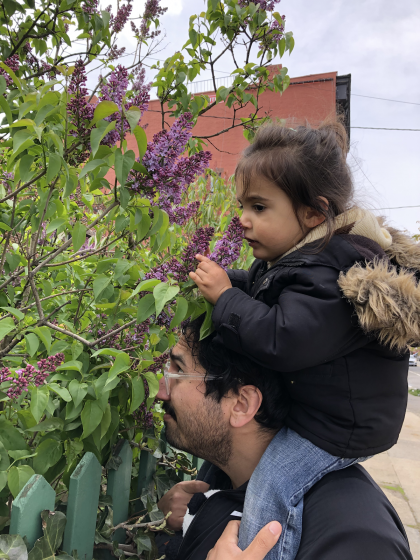
IV. Flowers and sidewalks, backyards and parks: Accessing hyper-local nature As the days passed and the weather warmed, signs of spring became omnipresent. With the luxury of free time, neighborhood walks became a daily or weekly ritual for us. And with this shrunken geographic sphere came a heightened attention—to where the buds had opened, to which front yard had lilacs you could reach from the sidewalk, to which side of the street was warm and sunny for an afternoon walk. The public realm of the street trees and sidewalks is our most immediate access to hyper-local nature. So we notice it all: the lovingly tended flower beds and the unsightly spots where discarded masks and trash accumulate with the decreased street cleaning. Flowers were coming up out of street tree beds—a sign of planning ahead; gloves are left on the street, but the tree beds themselves look cared for. These walks along well-known territory changed over time as leaf out began, as daffodils gave way to tulips and pansies in the street tree beds; at the same time, the people on the street changed, with more people out and about now once there was talk of reopening and nice weather.
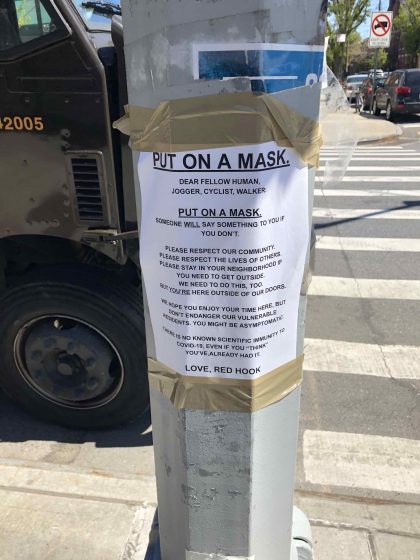
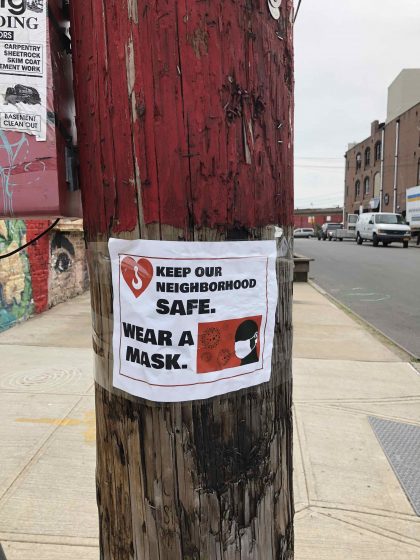
Nobody and everyone “owns” the sidewalks. They became the space where people congregate, alone with a lawn chair, spaced apart with paper-bagged beverages, in family units. Strangely, in this dire time, the public realm comes to life. But they are also spaces of friction, these sites of encounter. Who shoots an ugly glare or a sharp word to an unmasked jogger, Who steps aside for whom into the roadbed? Public shaming and enforcing of norms starts to happen with handmade flyers that appear on fence posts. These signs are messages that set up expectations about how and for whom access to the public realm occurs. In our past research, we look to the messages that the public adds to our shared spaces—like parks and sidewalks—in order to “read the landscape” for these emergent and informal norms. In the time of COVID-19 we are reading the landscape for how we navigate a changing experience with public space in the time of masking, social distancing, and closures of most of our commercial establishments
Beyond the sidewalk are the privately owned public spaces—the front yards, stoops, backyards, and patios. In NYC, only a select few have access to these sorts of oases. Backyards have become a symbol of privilege in the pandemic. The ability for some city dwellers to safely get some fresh air by stepping onto their private balcony, or even to escape to a second or third home to comfortably quarantine is a stark reminder of the many disparities exacerbated by the virus. For those of us with access to shared private spaces, a new kind of negotiation of space is necessary. Sometimes, this means having to formalize previously unstated rules and norms. What in the “before times” might have turned into a moment of socialization between neighbors waiting to use the grill in a shared backyard is now distilled into a list of rules about the number of family units allowed in one place at a time.
And then there are the parks. And they remained open—with the exception of playgrounds that are full of surfaces that could not be cleaned regularly enough to be safe. Open and accessible to all— in theory, but the reality of that access looks very different depending upon a number of factors. Some of the issues around park access depend upon the geographic location, size, design, and programming of parks (see NYC Parks Framework for an Equitable Future; New Yorkers for Parks’ Open Space Index; TPL ParkScore). In the time of COVID-19, playground and recreation courts are considered to invite non-social distancing behaviors, while a larger park with a forest canopy or open meadow is deemed more suitable for solitary or small group activities including hiking or birding. Other factors related to access depend on how safe residents feel using a park given their race, ethnicity, gender, ability, or age (See Finney 2014; Sonti et al. 2020; TPL Parks and the Pandemic). On 2 May 2020, we read news and twitter accounts of disparities in policing between park goers who were white or people of color. On 7 May, Mayor deBlasio denounced the racial disparity in social distancing arrests, and on 8 May the City announced it would limit visitation and apply social distancing measures at Hudson River Park and Domino Park, two crowded parks in largely affluent, white neighborhoods (see images). The critical point here is to plan purposefully for equitable and inclusive access, especially as we move into the summer season with higher temperatures. Public green spaces may offer the only respite for those suffering from stifling summer heat conditions.
Lindsay:
Living in my neighborhood for 14 years, I had never seen my local park more crowded. At the start of the lockdown, the police drove their cars through the park, blaring a loudspeaker message about social distancing. As time wore on, they came out of their cars, walking, mostly carrying masks to give away. It struck me that there was no reason that this particular role necessarily needed to be played solely by the police. I read that NYC Parks is staffing up with a large cadre of social distancing ambassadors. We could imagine an expanded green workforce that is responsible for the care and maintenance of both our parklands and the health and safety of the visiting public.
The 25 May racist incident in which Amy Cooper, a white woman with an off-leash dog, threatened to call the police on Christian Cooper, a black man who was birding in Central Park’s Ramble who asked her to leash her dog, revealed deeply ingrained, systemic racism that shapes who feels safe in parks. The hashtag #birdingwhileblack did not originate with this incident, but shined a light on the ways in which black and brown bodies are surveilled and controlled in the public sphere. Swift responses from Audubon NYC—where Christian Cooper was a board member—as well as Amy Cooper’s employer, revealed that these incidents will not go unseen or silently sanctioned. We are concerned that in the time of COVID-19, as more and more people are seeking use and refuge of parks and natural areas, we will have these encounters of friction and conflict. How will we as a society ensure equitable, safe, and open access for all to these vital natural resources?
Erika:
On 19 May I spoke with the administrator of a large park here in NYC. She wanted to talk with Lindsay and I about issues of race and inclusion and some research we had done in her park a few years ago. She had taken a diversity course from the Central Park Conservancy and was now reading a few academic papers on the subject. She worried that natural resource managers needed conceptual tools and training to address the issues that were coming up. It troubled her to know that certain people of color are not comfortable in their park and because of that, would not benefit from all that nature has to offer us, especially at this time. She told us how her community was severely impacted by COVID-19. She mentioned that many residents were trying to process the death of Ahmaud Arbery. And then came the May 25 incident in Central Park between a bird watcher and a dog walker. She knew that how the park is managed can contribute to inclusion (and exclusion) across differences of age, race, culture and creed. And she knew that this was a key part of her job. When we hung up, I sat there wondering if most people would believe that park administrators are ‘out there’ thinking and worrying about diversity, equity, and inclusion issues in deep and thoughtful ways? So often we might think of managing parkland as caring for trees and mowing the grass, but it is so much more. Such power and potential for transformation lies within our own capacity as green workers and through our public lands.
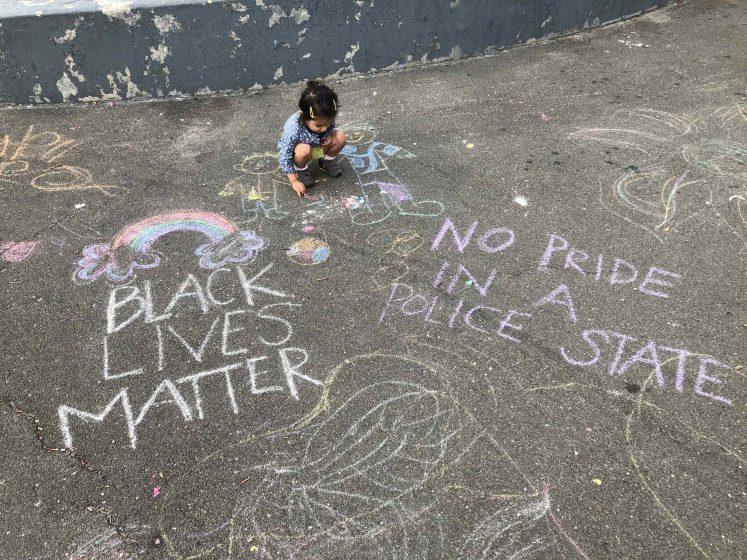
As we are writing this essay, which now feels poignantly dated-in-real time, our streets, sidewalks, and parks in New York City and across the country are erupting in protest over the murder of George Floyd. Our city and country are in anguish over these twinned crises of the pandemic and systemic racism. We know that the public realm has always been a space of assembly and discourse, including violent clashes and disagreements. Even in relatively quiet corners of the city, away from the protest, we see signs of solidarity, anger, and love. We read the landscape for these signs—handmade flyers, chalk drawings, and graffiti asserting that black lives matter—that echo the “shouts in the street”. We read these signs as they are barometers of social meaning and are important to the equitable stewardship of public space.
Chalk drawing stating black lives matter in a public park. Photo: Lindsay Campbell
V. La longue duree What can daily journaling, observing micro-practices and hyper-local geographic terrains tell us about la longue duree (“the long term” arc of history) and the way in which our society might fundamentally shift in response to this pandemic, as well as the way in which that pandemic intersects with our pre-existing inequities and vulnerabilities?
The historian Frank Snowden informs us in his most recent book on epidemics and societies that in addition to the loss of life, pandemics tend to cause painful rifts in our relationships to each other, among family members, friends, and social groups (Snowden 2019; see link). Over the long arc of time, things do eventually change. Snowden reminds us that the Paris School of Medicine emerged from the French Revolution with a turn toward observation and away from depending heavily on Hippocratic theory in managing public health. The motto of the 19th Century Paris School was: Peu lire et beaucoup voir (read little, but see a lot). In that seeing, it is important to consider what and whose narratives are told in the construction of a historic account. A recent article in the Nation posed this very question with respect to journalistic, archival, and historic coverage of this pandemic and the 1918 pandemic in Africa. How can we understand, document and grieve the grave loss of life and hold ourselves, our leaders, and our institutions accountable to change, but also see the creative, vital, sometimes improvisational, emergent adaptations by all of us, as agents that are critical to that change? These are also stories that need to be told—of lives lived with the pandemic—or else they will be forgotten and will not be learned from. We see this as a call to action for more voices to document and teach us from their lived experiences of the pandemic.
As humans and observers of the world, we journal; as researchers we can think critically about our observations. This approach has clarified the key questions and throughlines that we plan to consider in our own environmental stewardship and governance research in the New York City region and as part of a community of practice that includes researchers, natural resource managers, stewards, artists, and educators across a wide range of cities and towns. These include:
How does the pandemic change our relationship with the city, nature, and public lands?
How might we transform the public realm to better adapt to our new reality, in ways that are equitable, safe, supportive, and welcoming for all?
How can our relationship with nature help us restore and strengthen our relations with each other at all scales: individual, group, and societal?
The compound disasters of the coronavirus, racial injustice, and climate change are shifting our relationships to the city and its public spaces. Who will be the transformative agents that can help address these issues? We have seen prior realignments of the way we conceptualize and orchestrate our cities and towns, with goals of achieving the sanitary city, the sustainable city, the resilient city. What does the post-pandemic city look like?
Lindsay K. Campbell, Erika Svendsen, Laura Landau, Michelle Johnson New York
The findings and conclusions in this essay are those of the authors and should not be construed to represent any official USDA or U.S. Government determination or policy
We are all confined to our homes—if we are lucky (more on that later). Which is something, since most of us are “outdoor types”, “people types”, can we find meaning, motivation, and renewed spirit for action in this contemplative but deeply strange time? We find ourselves wondering, doubting, planning our next steps or perhaps second-guessing our last ones. We are trying to keep all the parts of lives still stuck together and not flying apart. Good luck with that. Bonne chance. Buena suerte. In bocca al lupo. सौभाग्य. בהצלחה. Boa sorte. Viel Glück. 頑張れ. Buti na lang. حظا طيبا وفقك الله (Please pardon any clumsy use of Google Translate.)
Perhaps we are somewhat like ascetics in caves, contemplating a potentially perfectible life outside, somewhere else and out of reach. For myself, I have been wondering how we will be changed by this experience: as people with dreams, families, and styles of behavior; and also as urban professionals.
So we, as we tend to do, gave a wide variety of people—artists to architects, scientists to planners—the following prompt: How do you imagine you might be changed by Covid, both professionally, but also personally as you negotiate a new post-virus “normal”?
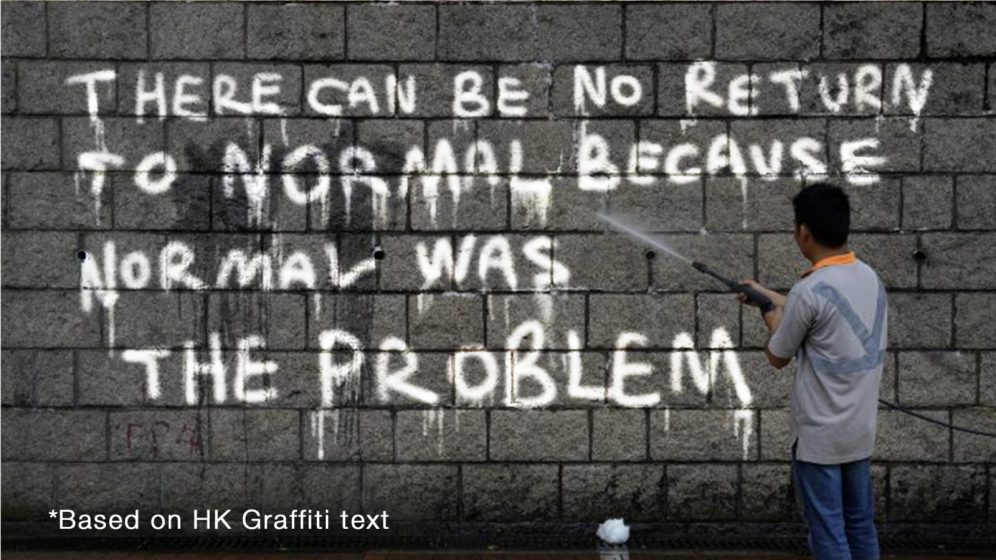
Now that we have seen how our cities around the world truly function at their most vulnerable, what possible excuse do we now have to not emerge solely committed to fixing it? Maybe in searching for a new post-Covid “normal”, we need to act on the idea that the old normal was a big part of the problem.
In this prompt we intended to ask a professional question, but also a deeply personal one. All of us now know people personally who have been sick; many (even all?) of us know people who have died. All of us have had lives upended, lost opportunities, had careers and livelihoods set back or even wrecked.
How do we pick up the pieces? What pieces are even still available to us? Which pieces should we cast aside, and leave on the ash heap?
There are a few key threads in this collection of 58 people from 24 countries, and many hopeful responses:
We see (or can simply hear more clearly) more wildlife. Can we hold on to this and build on momentum for and the dream of greener cities for all?
New modes of communication and teaching have a lot of potential, but are also fraught. Meeting in person has real, intangible, and alchemical value. Not all of our students have the desire to learn online, and not all have the resources to do so.
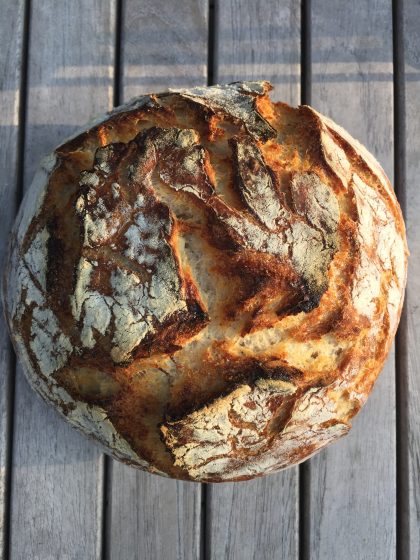
Many of us are slowing down, “smelling the lilacs”, baking more bread, finding new ways to connect to others. Can contemplation and mindfulness be sustained?
Many are amazed at the clean air and reduced consumption. Can a new normal for the fight against climate change and for livability be embedded in our social actions?
Several note that after years of hearing “no you can’t change that”, or “these activities are not optional”, suddenly in a matter of days or weeks we changed fundamental ways of operating. Paraphrasing Diane Pataki below: let’s not take “no” for an answer next time. Or quoting Matt Jensen: “What else is optional” in our lives?
Let’s make sure not be too glib or tin-eared about the joy of greenery and songbirds, wonderful though they are. Most in this collection have jobs at big organizations that continue to pay salaries. Some in this collection work for small organizations or are free-lancers. Their lives are not simply changed by working at home until they go back to the office; life trajectories may be fundamentally altered. Some have lost opportunities that may not exist in the future.
We are lucky to be sheltering at home. Many beyond this collection have to go to work, brave public transportation. Or have no work at all. David Simon in this collection has two children who are emergency room physicians. (Our gratitude to them.) The New York Times and others reported recently that most new Covid cases are people who are working outside the home, such as in grocery stores. They probably don’t have a choice. Covid’s consequences seem to hit hard communities that already are challenged. For example, 70% of Covid deaths in Louisiana are African American. In Kibera, Dharavi, and other slums of the world, who knows?
We are The Nature of Cities—that is, the character of cities that we believe in: green, certainly, but also a thriving mix of communities, and immigrants, and restaurants, and performing arts, and cultural institutions, and civil society, and innovation, and diversity, and opportunities, and … people. I love cities. I fear for their immediate future and the people who live in them. Let’s remain focused on what we can now see are the fault lines and the possibilities for change in cities. As Mary Rowe says below: “now that we have seen how our cities around the world truly function at their most vulnerable, what possible excuse do we now have to not emerge solely committed to fixing it?”
Maybe in searching for a new post-Covid “normal”, we need to act on the idea that the old normal was a big part of the problem. Both personally and professionally, let’s take nothing for granted.
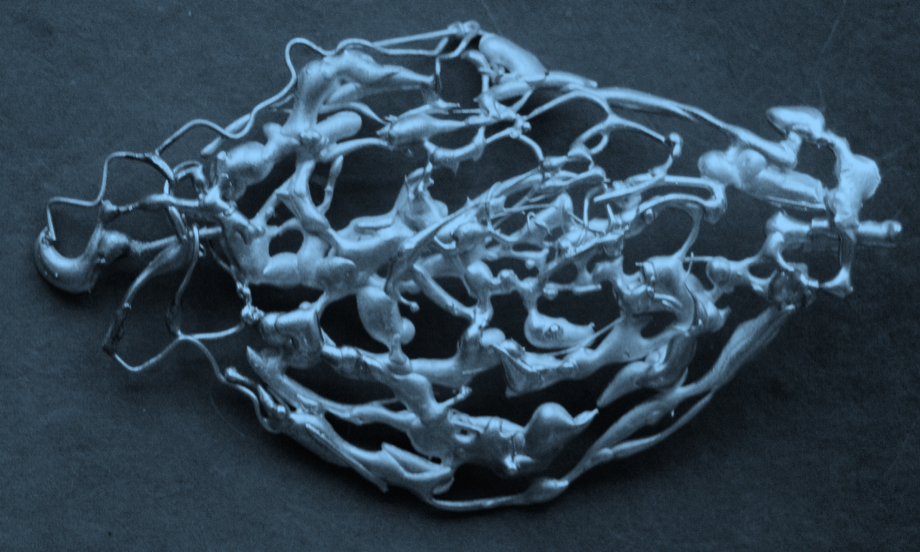
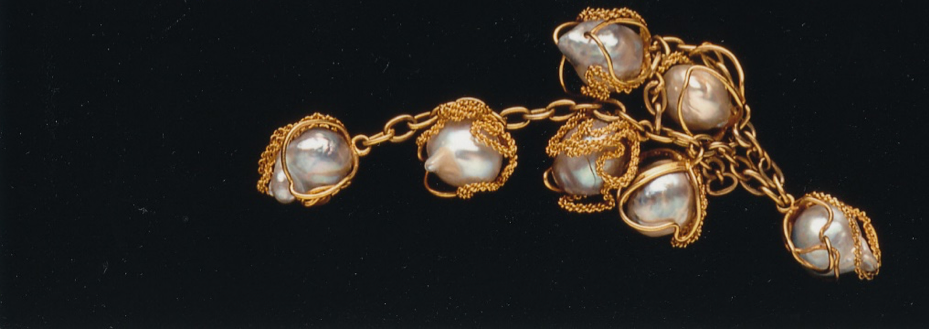
The banner image above is a nested necklace, jewelry by Ligia Ceballos de Wiesner, who happens to be the mother of one of our contributors here, Diana Wiesner Ceballos. (Photo by María José Velasco.) To me the piece symbolizes much of what we discuss in this roundtable: the act of nesting in our homes (our nests) during quarantine, the interconnectedness (the intricate tangle of nests) of communities, and the new life and ideas (eggs) nurtured within nests.
Fadi Hamdan
When it comes to risk, it has become clear that change is all around us. The past is no longer a reliable indicator of the future. Climate change is changing the severity and frequency of hydro-meteorological hazards, where now in many parts of the world we are witnessing successive yearly flash floods and storms of a severity that used to happen once in a decade or even less. Furthermore, the world population is at an unprecedented level, with ever increasing demands for land, food, energy and housing, leading to a continuous encroachment on natural habitat. At the same time, increasing numbers of people are living in cities, and megacities for that matter, for a variety of reasons- leading to a concentration of people, assets and infrastructures. In addition, climate change is leading to rural to urban migration; in particular rural to urban informal settlement migration, leaving people living there more vulnerable to other hazards such as earthquakes and tsunamis. Climate change and rural urban migration is also, in many parts of the world exacerbating poverty, unemployment, youth unemployment and inequality, thereby entrenching socio-economic exclusion where the latter is a main driver of violent extremism.
Concurrently, economically and politically, globalisation is also a game changer. Politically, it has undermined the democratic process in several democratic countries as people voting for certain welfare policies are told that big capital will leave if such policies are funded through additional taxation. It has also removed the bargaining power of organised labour in these countries by shifting production to other hemispheres of the earth. On the other hand, in third world countries it has helped people connect together, to lobby and mobilise for effecting change. Economically, it has led to just-in-time supply chain economics, thereby eliminating redundancy for the case of efficiency—and often at the expense of the environment.
What we need is a value change in order to effect a paradigm shift in the way we produce, consume and live as societies.
The result is a world which is more connected than ever before, more populated than ever before, and where risks are more difficult to understand and more uncertain to predict. We now see systemic risks across connected social, environmental, and economic systems, interlinked at the global spatial level, with implications for the immediate, decadal and longer timelines. We can now talk about systemic failures which will take place if these systemic risks are not addressed.
What Covid-19 did was to move the above scenario from the realm of risk specialist to make it a reality for every citizen on our planet. While this forces us all to recognise and try to deal with uncertainty, it also provides an opportunity for us to mobilise in order to effect change. The old adage that humans prefer short term interests to long term risks is no longer applicable, as the risks of our economic, social, urban and environmental practices have finally caught up with us. This reinforces my belief that the political is the professional which is now the personal, more than ever. In all aspects of our lives, we must strive to effect positive change towards more inclusive and democratic societies that respects the environment and all creatures in it. This should be the post virus “normal”.
Janice Astbury
I arrived in Buenos Aires on March 3rd. That was the day that the first case of Covid-19 was identified here. I came to collaborate with colleagues at the University of Buenos Aires working on green infrastructure in schoolyards, with a goal of reducing the concentration of air pollutants that reach children, and also generating other benefits associated with greening and enhancing nearby nature for children to interact with. I had barely got started when the national quarantine began. Today is day 40.
What we need is a value change in order to effect a paradigm shift in the way we produce, consume and live as societies.
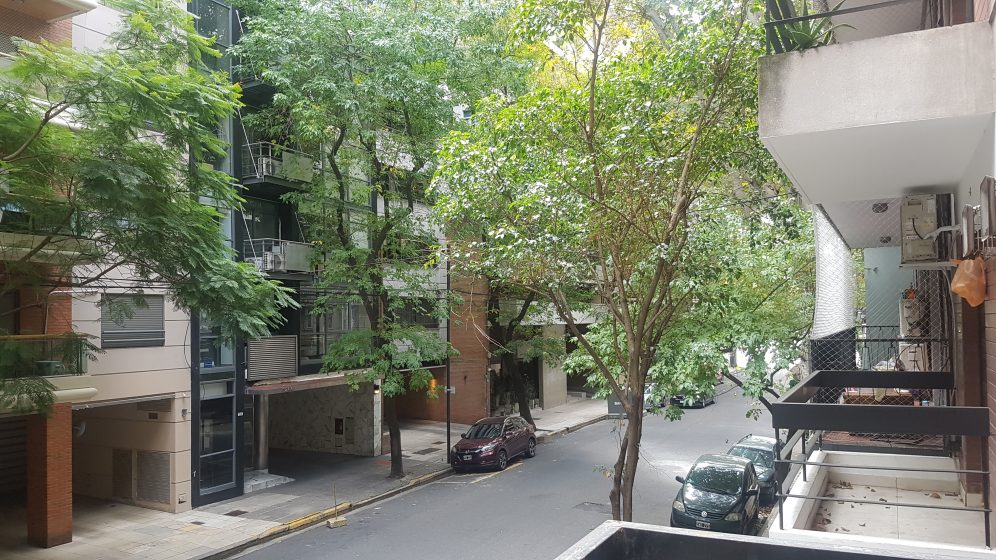
Street trees of Buenos Aires. Photo: Janice Astbury
I was lucky to find somewhere to live in the neighbourhood of Palermo. The first things I noticed were the tall beautiful street trees, the balconies from which people could interact with the street, and the array of small local shops and cafes. The next things I noticed were the high volume of traffic on my residential street, the noise it created, and the exhaust fumes that seemed to flow directly into my second floor apartment. Sitting on my balcony felt like sitting on the side of a motorway and I soon stopped doing it.
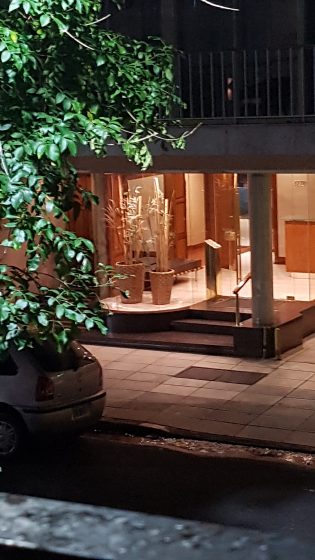
Now I sit on the balcony to work most mornings and enjoy the immersion in the street life, beginning with the custodians of the various apartment buildings chatting to one another and the swish of their wet brooms as they clean the pavement outside their buildings. I think how nice it would be if they were also watering gardens. The high-end buildings across the street feature only a few stalks of bamboo in pots—one arrangement is in a glass case.
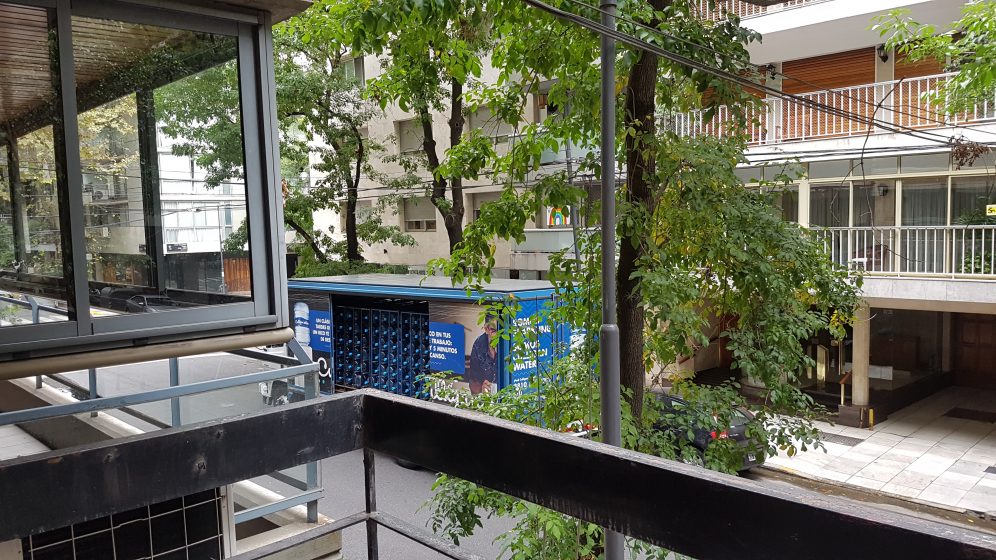
Later come the deliveries, I like the ones from the local shops where staff push shopping carts up the middle of the street. Less appealing is the daily visit from the massive truck delivering bottled water. I’m not sure about this “essential” service in an area with perfectly good tap water. I think one of the important things to come out of this experience is thinking about what’s essential, as governments all over the world deliberate on what should be included in necessities and what special permissions should be allowed. Allowing access to green space and nature is continuing to challenge many countries (including this one) and I am hoping that accessible nature will come to be seen as essential, not only during crises.
Having come here to work on a project with a focus on air quality and its impact on children’s health and development, I am thinking about the widely presumed essentialness of driving. Currently, if people want to drive somewhere, they have to fill in an online declaration stating which of the allowable exceptions justifies their movements during this health emergency.
Post-green planting. Photo: Janice Astury.
By day 9 of the quarantine, air pollution in Buenos Aires was halved. If this can work to confront the Covid-19 health emergency, why shouldn’t it work to combat the greater illness and death caused by air pollution? Some people would still drive in the city but it would be considered exceptional, they would need to justify their travel by car. Rather than being the obvious choice, it would be the last resort. This will involve, among other things, maintaining online work practices, facilitating more active transport, and adapting public transport so that people feel it is safe to use.
I hope that some cities in the world will show the way by applying the sorts of systems they have put in place for the coronavirus pandemic to tackling the air quality and climate change crises. I hope that I myself will continue my work with greater confidence that big, rapid, creative interventions that change urban life for the better are possible. And I hope that many people around the world are enjoying the sounds of voices and birdsong, and the experience of cleaner air flowing into their homes, and will want this to continue.
Notes: [1] Pollution in Buenos Aires went down to half due to the quarantine “La contaminación en Buenos Aires bajó a la mitad por la cuarentena” Clarin, 29 March 2020 [2] In 2016 (last WHO global assessment) 91% of the world population was living in places where the WHO air quality guidelines levels were not met and ambient air pollution was estimated to cause 4.2 million premature deaths worldwide. (WHO, Ambient air pollution: a global assessment of exposure and burden of disease, 2016)
Essential service? Photo: Janice Astury.
Mary Hall Surface
February 1, 2020. Almost 10am. Actors gather for rehearsal. Effusive, affectionate comrades greet, hug, laugh in each other’s faces. They do a quick warm up, their bodies interacting, giving and taking weight, close, dance-like. They circle in and breathe together as their voices send sound across the shared space. Three actors then stand tightly together and move in sync to hoist another high above their heads. She’s flying! Theatre magic.
At its best, theatre is a unique forum where communities can imagine together. We gather and literally align our beating hearts as a story unfolds told by actors who breathe our same air. My nightmare new normal is a Romeo and Juliet who never touch, watched by a masked audience too afraid to believe the story.
When trying to imagine theatre in the new post-virus “normal,” my colleagues tend to focus on audiences. How far apart can we seat people? Do we hand out masks at the door? Take temperatures before taking tickets? These are shattering images. But what keeps me awake at night is picturing a socially distanced rehearsal process that leads to a performance by face-masked actors who never physically connect. My nightmare new normal is a Romeo and Juliet who never touch, watched by an audience too afraid to believe the story.
At its best, theatre is a unique forum where communities can imagine together. We gather and literally align our beating hearts as a story unfolds told by actors who breathe our same air. Theatre can challenge, lead, comfort, and heal. My grief for my shuttered profession is tempered by my knowledge that theatre has always risen from the ashes of past plagues and disasters. But a return to live performances, the kind we treasured only two months ago, is now far in the future.
So what happens between now and then? And what will “then” look like once we live through the journey forward? Will we create vibrant virtual spaces that can fill the role that theatre has played in our cities and communities? What essential aspects of the art form can exist now when what defines it—its in person shared live-ness—is impossible? Theatre companies worldwide are rushing to create on-line content. But can we truly convene on line as we do on stage? Can we collectively think and feel about our humanity, our interconnectedness, our systems and shortfalls on Zoom? If we can, then live theatre will change. When we reach “then,” what kind of rehearsal room will I return to?
April 22, 2020. Almost 10pm. A director/playwright wrestles with her core beliefs about what theatre requires and what it provides. COVID-19 simultaneously erodes and strengthens what she knows to be true. Her next play is in process, under development, with no set opening date. But she has the beginnings of a story line.
Eduardo Guerrero
Pandemic prevention and management needs healthy nature in cities
Global crises as COVID-19 remind us that our cities are intrinsically part of nature, not only social and economically interconnected, but also part of ecologic corridors. So, in addition to social, health, and economic measures, solutions should be also nature-based.
From politics and economic perspectives, we human beings pretend to be apart from nature but, we ourselves, our economic models and our cities are functionally part of nature. If you prefer let’s call urban areas “transformed nature”.
The dilemma for a healthy planet is not: nature or people? The right approach must be people in nature, planning, and building resilient cities following ecological principles. Quoting Garcia Márquez: “I believe it’s not too late to build a utopia that allows us to share an Earth on which solidarity could become a reality”.
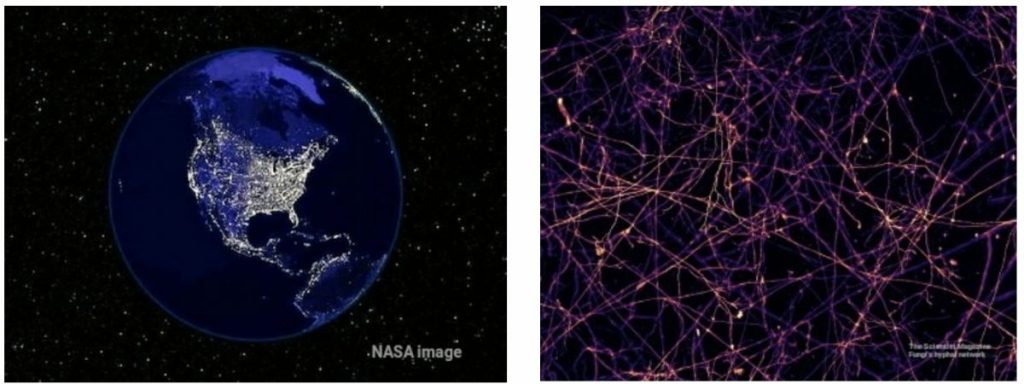
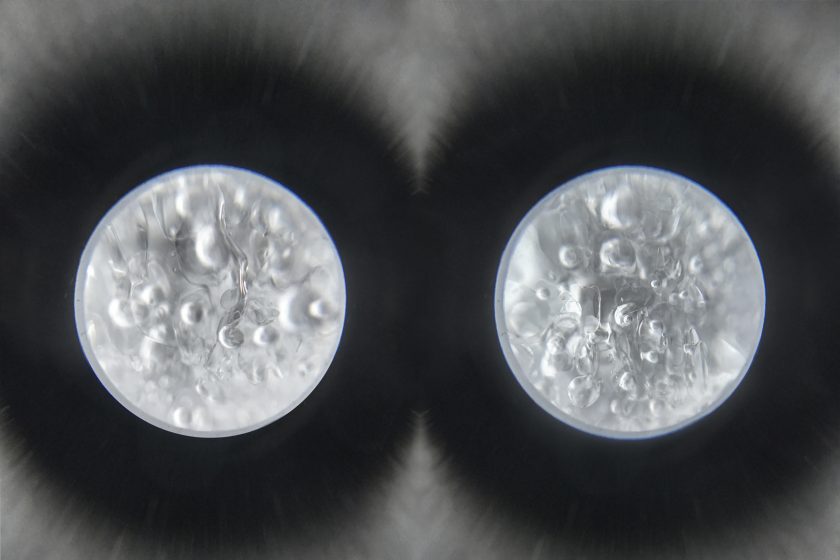
A satellite image of the Earth at night (left image) resembles fungal mycelia (right image) which is like a natural internet connecting the forest through soils
Condominiums are like honeycombs or coral reefs; highways seem like a school of fish and our social networks resemble the fungal mycelia which are like a natural internet.
We are nature for good, not for bad. The problem is not to be a social animal that evolves by building an interconnected global society. The problem is acting as if nature is something alien to us instead being part of us. The problem is the air contamination and particulate material that causes cardiopulmonary diseases and facilitates virus dissemination. The problem is the illegal traffic of wild fauna and their habitat fragmentation which disrupt ecological balance and allows the zoonotic transmission of a virus from a wild animal to people.
The new coronavirus emergency has moved humanity to feel united in diversity and, at the same time, has obliged leaders and governments to make synergic decisions relating economy and human health.
Under this crisis, links between human health and environment have emerged more clearly than ever before. Biodiversity loss, climate change, and COVID-19 challenge humanity in similar manners. They are not just themes under a single-sector responsibility, not unidimensional problems assigned in a simplistic way to Environment or Health Secretaries. They are multidimensional and complex matters which require comprehensive approaches.
I hope government and corporate leaders will no longer act according to false dichotomies like economy vs social well-being or economy vs environment.
As many under this crisis, I feel anxious, expectant and concerned and, at the same time, I feel motivated and optimistic about the opportunities and challenges we face.
I imagine a post-COVID world in which human relationships are less physical in terms of contacts but emotionally closer with more real solidarity. I imagine a post-COVID stage in which nature is organically integrated into urban planning, not just as a “must be”, but as a “all of us appreciate it and want to”.
The dilemma for a healthy planet is not: nature or people? The right approach must be people in nature, planning, and building resilient cities following ecological principles.
The global crisis of COVID-19 poses a challenge to the dense and compact city model. However, the solution cannot be a radical change in urban development models, but the development of tools, redesigns and environmental adaptations that contribute to preventing, controlling and mitigating public health threats.
Many actions for a healthy urban environment are at the same time good practices for a healthy population to prevent and/or mitigate epidemics and other public health threats. Landscape architects and ecologists must talk and work together, as must economists, biologists and health professionals.
So, an effective management of post-COVID emergency will require integrative nature-based solutions.
We can develop approaches such as the following:
Sanitary safe access to green public space. Adaptation and / or redesign of public space, in order to generate functional, spatial and / or temporal isolation in the access of citizens.
Redesign and adjustment of green infrastructure, to reduce the risks of contagion.
Trees cleaning air contamination. Green areas and trees that capture particulate matter and generate wind tunnels to dissipate it.
Urban mobility solutions, strengthened of bike networks and rationalization of public transport.
Sustainable and sanitary consumption of green and local products. Involves the development of biosecurity measures for productive and commercial activities associated with the circular economy, green businesses (bio-commerce, urban ecotourism, etc.) and urban agriculture.
Urban forest restoration.
Today more than ever the challenge is to achieve economic, social, and ecological transitions towards sustainability, equity, and health.
“I believe it’s not too late to build a utopia that allows us to share an Earth on which solidarity could become a reality”.
Garcia Márquez
Cecilia Herzog
Let nature be the solution to heal us all
I am being transformed by this sudden tragic pandemic that is affecting the whole of humanity. I am lucky to have a beautiful place in the countryside to be during this period of retreat. I have more questions than statements up to now. How will I go back to a new “normal” life? How long will take until I will be able to hug my granddaughters? My kids… Will I be able to be with my mother again? Those questions are on my mind every day, all day long.
I am investing my time in isolation to improve my capacity to contribute to a wide discussion about urban nature, how it is important to sustain healthy lives and adapt to the ever-growing threat of extreme weather events.
I believe this is a life-changing event. When we lose the abstract confidence that life will go on forever in the same way, deep changes occur. Now I praise living more than ever. I miss my loved ones and fear for their lives. I miss my work, my colleagues, my presential classes, and so many other ‘normal’ activities I used to have.
I am eager to meet people, especially my family and friends, peers, students… I want to travel to be with my kids and grandkids. I also want to attend conferences and other events when my friends from other places get together. I value and long for presence: look in the eyes, be able to hug and laugh, sense the pleasure of having made friends from different cultures and meet them.
Life and human relations are the most important things for me.
Transformation. I have written a lot about urban transformation, and now in social distancing I have been wondering how this crisis will change cities and people’s minds.
Will our societies wake up for the immense challenges we face: growing social inequalities, climate change, loss of biodiversity and other threatening life disruptions?
I am interested in knowing how people will come out after a long period of isolation, mainly who live in apartments without contact with nature. Parks and squares will be there, and I believe people will praise common green spaces more than ever before. As I work with urban landscapes, my thoughts are about what will happen to them. Will they become more important and valued by people and decision makers? Once economic losses are affecting most of urban dwellers, what kind of low-cost experiences they will demand? How people will interact in urban spaces? What kind of open spaces will bloom to help societies recover from this traumatic period?
I am investing my time in isolation to improve my capacity to contribute to a wide discussion about urban nature, how it is important to sustain healthy lives and adapt to the ever-growing threat of extreme weather events. I believe nature-based solutions are the response to enhance our adaptive capacity and social justice. I am prepared to stay away for a long period of time before I will be able to restart a new “normal” life and face new challenges in the city. Let nature be the solution to heal us all.
Our apartment is on one of the highest hills in the Bronx and we can see out to Queens. Every plane out of LaGuardia flies up and over our building, directly over, before banking one way or another. I once took a picture of our rooftop from an airplane window, before banking one way or another.
Morning comes with deep silence; 10:00am is the new 3:00am. The sparrows tussle on the windowsill. This is nothing new. There is a male sparrow that has been advertising a hole in the eve for a few years. But now his morning chirps seem to shake the building.
But who hasn’t dreamt about snapping their fingers and making air pollution go away? And all of a sudden we realize it is optional. Those scroll bar images are fun. Before. After. Before. After. What else is optional?
My students are Zooming from across the globe. Or not at all. I am a tab now. Just another tab. Maybe even minimized. Whatever I just said was not that funny. What are they laughing at?
Spring is here. On time and ahead of schedule.
Everywhere, all at once, an entire species is changed while the rest go about their business. Except for those tigers at the Bronx Zoo.
We are on the sixth floor and the elevator is down for a few more weeks. Our neighbor across the hall, Alma, an 86-year-old wonder woman is stuck. No more senior center. Her granddaughter might die of Covid. But her daughters are worried about how she’ll can handle the news. Perhaps a virtual goodbye?
But who hasn’t dreamt about snapping their fingers and making air pollution go away? And all of a sudden we realize it is optional. Those scroll bar images are fun. Before. After. Before. After. What else is optional?
Right. I am an artist. It is not like I can turn that off.
My life post-virus? But some recovered patients are testing positive again. Or is that clickbait? It is me who needs to stay positive. Chin-up-can-do-bootstraps-yes-we-can-dawn-horizon. I used to spend so much time in the future but now I’m afraid to go there.
Summer classes? Doubtful. Fall? Well, we have to wait for enrollment numbers. Wait, are we still charging money for school? What am I not getting here?
It is time for the 7:00pm clap session and sing-along out the windows of the building. Finally, something other than bird song! But now that “this is New York” song makes me want to cry. Is it a requiem? Our building has essential workers and our neighborhood is suddenly very essential.
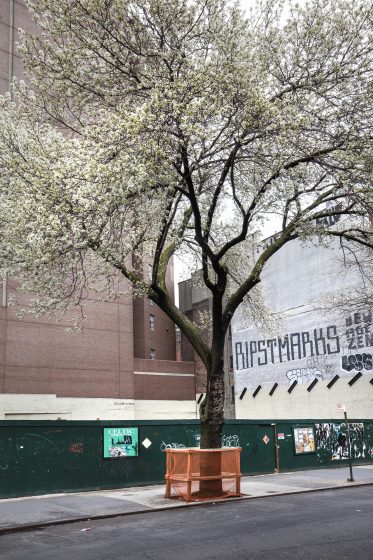
Callery Pear in bloom in empty New York City. Photo: Matthew Jensen.
Negotiate? Well, I guess the stimulus payment might be considered a settlement. Is there someone else I can talk to? Someone in charge?
I do remember that article about the 130,000 saiga antelope that dropped dead in Kazakhstan. But that was five years ago. Why am I thinking about it now? Were bats somehow involved?
How many wonderful parts of our civilization were symptoms or extensions of the worst parts? I am afraid of the answer.
I photographed all the flowers blooming around our building so our neighbors that cannot leave can enjoy a digital spring, a very silent spring.
Mike Houck
Nature Nearby, A Path To Resilience
Coming out of Covid-19 more robust psychologically and physically, individually and societally, I believe, will depend in large measure on access to nearby nature.
I will spend more time, personally and professionally, focusing on the green interstices of our city, the small, often scrappy, bits of nature nearby for my own psychological and physical health, and that of my city.
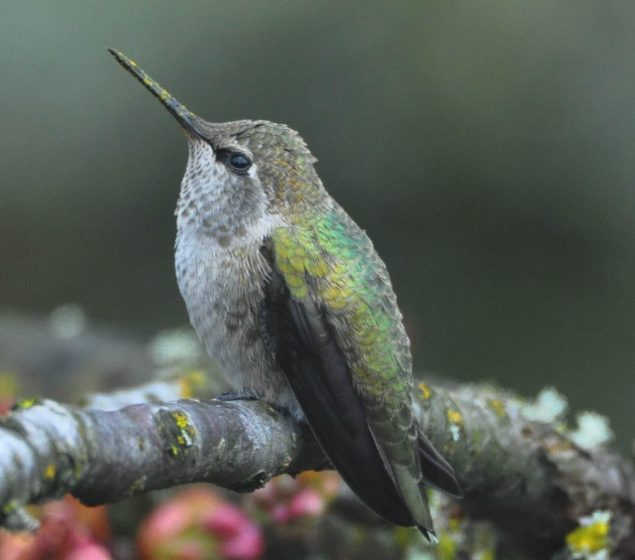
I have seen myriad online accounts of people’s interactions with nature from their apartments and nearby parks and natural areas and trails. I have had many of my own intimate experiences with nature nearby since being in lock-down. Recently, I happened to glance out of my living room window and noticed the cherry blossoms had just burst out, a profusion of pink filling the entire scene.Then a rapid, zig-zagging movement caught my eye as a female Anna’s hummingbird lit on a nearby branch. I managed to snap her image, her pollen-specked bill titled skyward. Was she looking for a predator or her territory obsessed mate? The pink blossoms and emerald-green avian buzz-bomb, calmed me, energized me, and I have no doubt left me healthier and happier for the rest of the day.
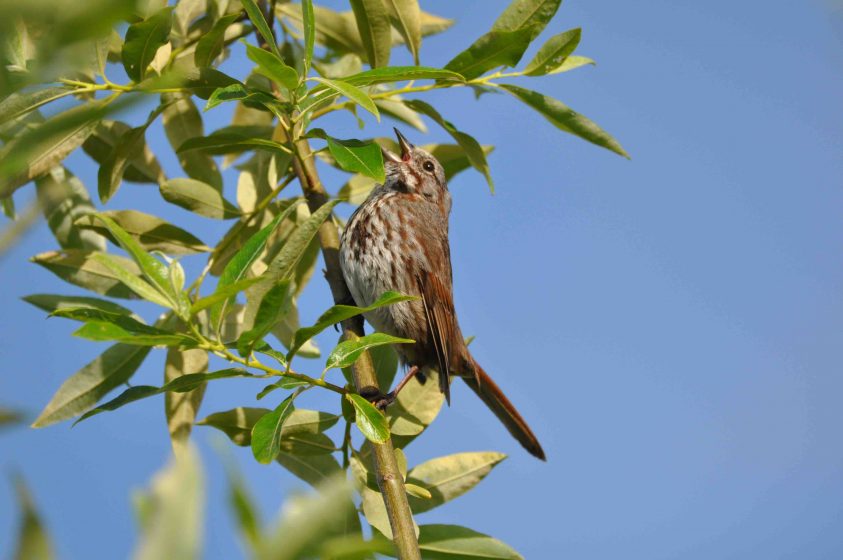
Not long ago while standing next to our newly installed rain garden I encountered a song sparrow perched next to our “backyard habitat” sign. That song sparrow has become my daily Covid-19 buddy. Each morning I stand next to him, much too close for proper “social distancing,” as he tilts back his head, puffs out his chest and belts out a beautiful, full-throated melody. I imitate him; he sings back, looking me in the eye I sing again; he flutters both wings, much as young birds do when begging their parents for food. We’ve connected; we continue our “dialogue” for several minutes after which I walk off, convinced we are both the better for the encounter. I often glance down from my second story flat to see a mother with her kids pointing at the song sparrow who’s perfectly happy to sing for anyone willing to take notice of him at the rain garden’s edge.
Scenes like this are repeated all over the city where small patches of greenspaces have been saved or woven into the urban fabric.Both personally and professionally I will spend more time focusing on the green interstices of our city, the small, often scrappy, bits of nature nearby for my own psychological and physical health, and that of my city.
Siobhán McQuaid
Post-COVID – an opportunity for a new type of business?
Over the last five years I’ve had the privilege of working with some innovative companies who are passionate about bringing more nature into cities —sometimes they’re community enterprises designing and developing “growing” projects to meet the needs of vulnerable groups. Other times they’re commercial entities who have leveraged their horticultural knowledge to create new innovations like green living rooms. Such interventions can instantly transform concrete squares into urban oases, enticing children with little exposure to nature to engage, happily picking strawberries from green walls. More recently, I’ve met start-ups harnessing satellite technology to come up with so-called “green-prints” to help cities plan, monitor and benchmark greener, healthier and happier urban environments.
We are facing now into a pivotal moment in time where it is possible to contemplate an alternative recovery plan. Governments and decision-makers need to take time out to reflect on the importance of small business, local business and nature-based business for community resilience.
In February this year, Connecting Nature, an EU-funded initiative, launched a survey to explore more widely the concept of nature and business. What type of business can nature support? How can business support nature and society? Just as Europe began to shut down country by country, we reached our first goal of 100 survey responses. A preliminary analysis shows that nature-based enterprises offer considerable potential in a post-COVID environment—not just to create much-needed jobs but equally importantly at a social and environmental level. Nature-based enterprises offer sustainable solutions to transform grey spaces into green lungs for cities, lifelines for apartment-dwellers, for homeless gym-bunnies, for communities as a whole, for nature.
This month we launch a mini-follow up survey to find out how these businesses have been affected by COVID-19. Anecdotally we have seen a wide divergence in impact. Any kind of food-growing business has seen interest skyrocket; the more local and natural the produce, the more insanely busy they have become. On the other hand, nature-based businesses depending on the construction or public sector have virtually closed down overnight, with tons of plants wilting on pallets waiting for on-site construction which has effectively been put on hold.
With plans afoot for the gradual re-opening of society, what will a post-COVID world look like for these nature-based businesses? Faced with mounting pressure, will the public sector, business and construction sector put nature on the long finger again? Will governments roll out short term economic stimulus packages focusing on a return to “business as usual” as quickly as possible? Will workers return in their hoards to city-centre offices on packed commutes? Or will government and businesses seize this opportunity to reflect and consider the situation we were in before this crisis—where “business as usual” led to unsustainable economic cycles contributing to climate change and biodiversity devastation in another type of emergency.
We are facing now into a pivotal moment in time where it is possible to contemplate an alternative recovery plan. Governments and decision-makers need to take time out to reflect on the importance of small business, local business and nature-based business for community resilience. Business leaders need to consider the proven benefits of bringing nature into work environments or even better the possibility of creating new working environments in commune with nature. We have the opportunity to incubate a new business sector, to stimulate the start-up of new nature-based enterprises and support the re-emergence and growth of existing nature-based businesses. Can each of us make the case in our own community for investment in a different type of business, nature-based businesses that contribute to resilience, community connectivity and that most crucial element we have all come to appreciate—quality of life?
(Note: The Connecting Nature survey of nature-based enterprises is open to enterprises globally. We welcome your insights on the impacts of COVID-19 and future opportunities for this sector. Click here for more information.)
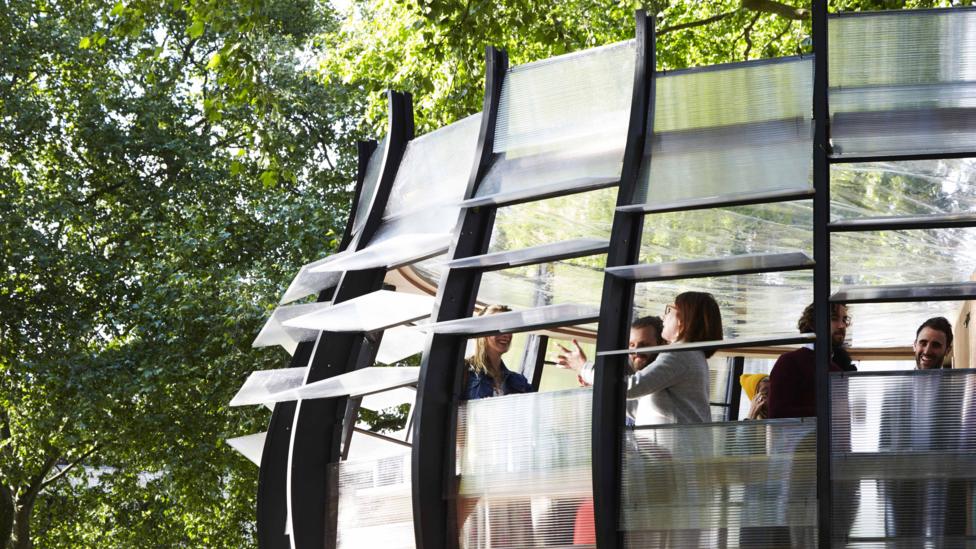
Source: Borzykowski, B. “The outdoor office spaces where workers commune with nature” BBC (2017) https://www.bbc.com/worklife/article/20170517-the-outdoor-office-spaces-where-workers-commune-with-nature (accessed 22/4/2020)Exploring nature on a mobile green living room. Photo credit: Jonathon Muller, Helix PflantzenGetting in touch with nature on the mobile green living room. Photo credit: Jonathon Muller, Helix PflantzenThe ouidoor office. BBC (2017) https://www.bbc.com/worklife/article/20170517-the-outdoor-office-spaces-where-workers-commune-with-nature(accessed 22/4/2020). Photo: Siobhán McQuaid.
Brian McGrath
New York, the current epicenter of the coronavirus, has transformed into H.G. Wells’ fictional Time Machine with a tragic twist: instead of armies of laborers working underground while the elite frolic in the open air, public life is now occupied by essential workers in service of the millions trapped indoors. Life goes on for those lucky enough to stay in our homes and still able to work. Days pass into night, Spring erratically arrives. We sleep, fitfully dream, wake up, eat, zoom, exercise, rest and sleep again.
I with others have recently postulated a metacity framework—a more flexible and adaptable form of architectural space—for the future adaptation of cities as we face a global climate crisis—such as the current pandemic. My hope for a positive outcome of this tragic virus is the development of new infrastructures in solidarity towards a just transition based on the feminist/ecologist metacity matrix.
My Parsons architectural design studio class, after dispersing across the globe, has reassembled online to complete the semester. A few international students and locals remain unable to escape from New York. For many here, a contemplative life has replaced a New Yorker’s frantic pace. As someone who recently moved out of the city, the end of commuting is a relief, with a few hours gained a day.
Horribly, thousands of our fellow citizens have been exposed to a cataclysmic respiratory assault, but Earth is finding an easier time breathing. Humans have substantially reduced their carbon footprints overnight; a behavior shift that five decades of scientific warnings about climate change barely budged. The Himalayas are in view again from India’s northern cities, and dolphins are swimming in Venice’s calm canals. Reading the architecture of cities provides a way to understand the past and the future of human responses to disease and climate. Societies have long designed cities as protective spaces for biological and cultural reproduction. Architectural inerventions such as walls, moats, spaces for worship, and blocks of houses with open spaces between, were not built not just for protection from armies, but also as strategies to avoid the spread of disease.
Interestingly, Michel Foucault begins his “Panopticism” chapter in Discipilne and Punish not with the history of the architecture of criminal incarceration, but with the strategies developed in Europe for the spatial separation of lepers, and later the architecture of segmentation to contain infection during the plague. Of course, social inequity was the object of his study just as it was for Wells. With the advancement of medical science, cities have been designed to make us individually more separated, society more segmented and wilderness more remote. Le Corbusier’s City of Tomorrow was born in the antiseptic afterglow following the 1918 Spanish Flu. Urban “reformers” cleared away the crowded segmented space of Foucault’s Victorian City, creating the towers in the park and open free plans of modernity. Ecologists Steward Pickett, urban design theorist David Grahame Shane, and I have recently postulated a metacity framework for the future adaptation of cities as we face a global climate crisis.
This current pandemic is just one of the multiple climate disturbances we face in the coming years. Through the metacity we search for more resilient city forms in the face of such an unstable future. In the 1981 essay for Heresies Magazine, Susana Torre developed a feminist concept of “space as matrix”, which advocated for a more flexible and adaptable form of architectural space that was neither the room, closet, corridor arrangement of Foucault’s Victorian age, nor the complete erasure of privacy and security promoted by the modernist free plan.
This matrix spatial logic is nature’s own, and in the matrix strategy of the metacity, neighborhood units are understood as social patches within larger natural systems of nitrogen and carbon fluxes. This social-natural strategy aided by medical science may provide a way to have an open urban society where we can maintain Earth and public health without reverting to further personal isolation and social segmentation. My hope for a positive outcome of this tragic virus is the development of new infrastructures in solidarity towards a just transition based on the feminist/ecologist metacity matrix.
Ragene Palma
I write this piece about COVID-19 with a consciousness on my privilege of being able to do so—I am comfortable in the confines of my tiny flat in central London, and continuing my postgraduate education and scholarship online. I have the option to turn off the ghastly coronavirus death toll whenever I need a mental health “break”; I ensure daily, transborder communication with my family in the Philippines; and I get to have my supplies delivered to my doorstep.
I cannot help but contrast this privilege with the plight of so many others, who are vulnerable to the coronavirus.
I call for urban practitioners and legislators to immerse in the daily lives of those who have been sidetracked for the longest time, and work from there to begin championing spatial equality—visit slums, converse with the homeless, and know what it’s like to live on the verge of the city. Our previous “normal”should not be recreated.
Years before this pandemic, urbanists have emphasised the reality of the world’s historical urban crisis, from sporadic economic challenges in the last century to today’s spatial inequality—a powerful few dominate the “rest” and the “others”, and we live segregated lives, because we simply cannot afford to live in the city anymore. Urban literature points to gentrification, “accumulation by dispossession”, and the urban-suburb dynamic, caused by intertwined factors: globalisation, neoliberalism, and urbanisation all grew hand in hand. Migrants, slum-dwellers, and the working class experience spatial discrimination in their daily life, an unfortunate reality that has become the norm.
Now, this health crisis literally exposes the reality of an urban crisis. Around the world, those without homes, or those who have been deprived of work opportunities, show us where our plans, and our cities have failed. World leaders are faced with massive challenges—in the US, a staggering 17 million people have filed for unemployment; in the UK, authorities address the rough sleepers, and look into eviction protection; in Japan, the government moves to house “internet cafe refugees” (the homeless are associated with internet cafes to access sleeping areas and showers). In the Global South, South Africa’s struggles are haunted by the apartheid; in the Philippines, regional lockdowns threaten at least 11 million informal workers, including farmers; and in India, migrant workers have been forced to walk thousands of miles due to lack of transport provisions.
In the planning profession, we deal with the elements and components of cities that have the potential to improve how we deal with pandemics: housing, mobility, urban design, ecological integrity. These are also crucial in “redoing” a new “normal”. In revisiting how we model our plans and shape our cities, we can begin with addressing inclusion and equality.
As a start, I call for urban practitioners and legislators to immerse in the daily lives of those who have been sidetracked for the longest time, and work from there to begin championing spatial equality—visit slums, converse with the homeless, and know what it’s like to live on the verge of the city. Spatially, our previous “normal” saw our urban areas create a new breed of “colonisers”, enclaves and borders, and a push-out of the “rest” of society. This was never supposed to be a “normal” in the first place; we should not revert to what went wrong, but move towards spatial solutions that provide for all, and not just the powerful few.
Basahin ito sa Filipino.
Sinusulat ko itong sanaysay tungkol sa COVID-19 nang may kamalayan ukol sa aking pribelehiyo—kumportable akong nasa loob ng isang maliit na kuwarto sa London, at pinagpapatuloy ang aking pag-aaral ng master’s sa online na pamamaraan. Maaari kong hindi pakinggan ang balita kapag ninais kong huminga nang panandalian sa nakaririmarim na bilang ng mga namatay na; araw-araw, sinisiguro kong makausap ang aking pamilya sa Pilipinas; at habang nandirito, madali naman sa aking magpa-deliver na lang ng mga pangangailangan.
Napakasuwerte ko sa ganitong kalagayan; marami sa atin ang halos walang laban sa sakit na dulot ng coronavirus.
Hinihikayat ko ang mga nasa larangan ng pagpaplano at mambabatas na pananaliksik ng pamumuhay ng nakararami—bisitahin natin ang mga iskwater, kausapin natin ang mga walang tirahan, at alamin natin kung ano ang kalagayan ng mga namumuhay sa loob at labas ng mga lungsod.
Bago ang sakuna na dulot ng pandemic, nagsulat ang mga urbanista tungkol sa krisis na pinagdaraanan ng napakaraming lungsod, mula sa problema ng mga ekonomiya sa mundo, hanggang sa kakulangan ng patas na espasyo para sa nakararami. Ang ilan lamang na nakaaangat ang nagpapatakbo ng karamihan ng negosyo, habang ang iba naman ay nabubukod sa oportunidad, at nawawalan ng kakayahang mamuhay sa loob ng siyudad. Sa pag-aaral ng urbanismo, malalaman natin ang tungkol sa hentripikasyon (o ang pagpapaganda ng isang lugar para sa mga may kakayahan), ang pagkakamal ng lupa at pag-aari habang ang iba ay nawawalan ng titirhan, at ang kagunayan ng lungsod at ng mga nakapaligid sa lungsod. Ito ay bunga ng globalisasyon (ang koneksyon ng mga ekonomiya sa iba’t ibang bansa), neoliberalismo (ang kalagayan kung saan may kawalan ng regulasyon sa ekonomiya), at urbanisasyon (ang paglago ng tao at kanilang pangangailangan). Tinatamaan ng mga ito ang mga migrante, mahihirap, mga nasa iskwater, at ang mga nagtatrabaho; nagiging karaniwan ang hindi pantay-pantay na pamumuhay.
Inuugnay natin ang krisis ng coronavirus sa kalusugan at medikal na larangan, ngunit pinapakita rin into ang isang krisis tungkol sa ating espasyo at mga lungsod. Maraming siyudad sa mundo ang naglalantad ng mga pagkukulang sa pabahay at trabaho. Sa Estados Unidos, 17 milyon ang humihingi ng benepisyo dahil sa kawalan ng hanapbuhay; sa Inglatera, binibigyang pansin ngayon ang pagpapaalis ng mga umuupa; sa Japan, binibigyan ng pabahay ang mga walang tirahan. Ang mga umuunlad na bansa ay may mga dagdag na suliranin sa pagtugon sa krisis, tulad ng kasaysayan ng apartheid ng South Africa, ang pagtigil ng kabuhayan ng 11 milyon sa impormal na sektor ng Pilipinas, at ang puwersadong paglalakad pauwi ng mga naghahanapbuhay sa India, dulot ng kawalang ng pampublikong serbisyo at transportasyon.
Sa pagpaplano, binibigyang halaga at probiso ang mga bagay na kailangan upang kalabanin ang pandemic: pabahay, paggalaw at transportasyon, disenyo ng pampublikong espasyo, at pangangalaga sa kalikasan. Kailangang kilatisin ang mga ito upang maisaayos ang laganap na kahirapan at problema sa ating mga espasyo.
Hinihikayat ko ang mga nasa larangan ng pagpaplano at mambabatas na pananaliksik ng pamumuhay ng nakararami—bisitahin natin ang mga iskwater, kausapin natin ang mga walang tirahan, at alamin natin kung ano ang kalagayan ng mga namumuhay sa loob at labas ng mga lungsod. Ang nakasanayan natin ay dakilain ang may kaya at may kapangyarihan, habang naiiwan ang ‘iba’ at nakararami. Kung tutuusin, hindi ito ‘normal’, at kailangan nating talakayin kung paano tayo magkakaroon ng patas na pamumuhay pagkatapos nitong krisis.
Si Ragene Palma ay isang urbanista o tagapagplano, at kasalukuyang nag-aaral ng International Planning sa University of Westminster, sa London, bilang isang iskolar ng programang Chevening.
Carmen Bouyer
There is a place in the village where I live that beautifully embodies what I wish for the post Covid-19 era. It is a public orchard, imagined about two years ago by Nathalie, a woman living here in a small village by the Seine river, about one hour South of Paris. Last November, the first trees were planted in a great community gathering on a land belonging to the municipality. Pear, Peach, Plum, Apple, Cherry trees, blackcurrant, gooseberry bushes, borage, cosmos, rowan, etc. all bought and planted collectively by the town’s inhabitants. The orchard belongs to no one and to everybody. It is a collective good, a common that has been reclaimed. Open to all, everyone can grow food for everyone.
I will keep dancing half an hour a day on Zoom with people from all over the world, and join the direct local actions that bring wonder, trust and care among people and among species, learning from the ways of trees and the songs of bees, together.
Orchestrated as a food forest, this urban edible landscape is a space of freedom, conviviality and pedagogy. There, villagers can learn how to plant roots, how to grow food for strangers and for themselves, and how to respect the soil and biodiversity that enable us all to do so. This place embodies collectivity among humans and non humans. Indeed a third of the garden is wild and looks just like how it was when the orchard group came, and it will stay so. As my life both slows down with the quarantine and is shaken by the daily news of Covid-19 related sanitary and economical crisis, I feel the deep urge to participate in such communal initiatives.
Not only to grow food as it is vital that we reclaim our knowledge in that sacred field, but also to grow profound intimacy with the earth and the local community. This time asks us to practice deep self care and in such deep care for the world, and this is political. We are experiencing how deeply we are all inter-related, intertwined in the fabric of a world that we all share. I feel the call to be more radical in this statement today, as work projects might become more scarce, time opens to nurture these relationships with the natural world, with neighbors of all kinds, with old time friends, dear ones and the unknown.
I know that art will bring poetry, colors and balm to this humbling period of collective uncertainty. It will enable us to experience togetherness in ways so new and old, and accompany a much needed transition to more grounded ways of life. I will definitely try to participate in this movement, using the creative skills I developed since many years, but with more energy because of how pressing this need is now. I will keep dancing half an hour a day on Zoom with people from all over the world, and join the direct local actions that bring wonder, trust and care among people and among species, learning from the ways of trees and the songs of bees, together.
“Le verger citoyen”, a communal orchard supported by both the municipality and the locale association La Manufacture de Samois, in Samois-sur-Seine, France. Photo: Carmen Bouyer
Diane Pataki
I now have a completely different perspective about the speed at which our society can change. For as long as I can remember, I’ve been told that rapid transformations to society, to cities, and to our relationship with the environment are impossible. Many of us spend countless hours brainstorming, discussing, and envisioning daring and far-reaching solutions to urban problems, only to be told “no”—that such solutions can never be implemented. How many times have we heard that there are too many barriers to change, especially in the face of uncertainties about future risks such as climate change?
I no longer find this argument valid. In the past few weeks, we’ve seen massive changes to almost every element of our society, implemented at unprecedented speed. We shut down businesses, sent workers and school children online, closed streets to cars, and changed social norms about what to wear. For my entire career as an academic, I was told that universities were slow to change and would take years to fully embrace online education. Yet, virtually every campus in the United States transitioned to online teaching in a matter of weeks, sometimes days. Professionally, most of us kept up air travel to meetings that could have easily been held online, even though we knew we shouldn’t. We didn’t want to change—until suddenly we did.
What about poverty, inequality, food insecurity, lack of access to clean water, climate change, and pollution? Now that I know we can act in response to COVID-19, there’s no turning back. Our society can change – completely and rapidly. The next time we have a daring solution, let’s not take “no” for an answer.
All of this happened under massive uncertainty: we still don’t know how many COVID cases there really are, whether the virus will persist through the summer, whether anyone really has immunity even after they’ve recovered, and how long it will take to develop a vaccine—if ever. And yet still, we acted. We acted because lives were at risk, or because it was the right thing to do, or because we were afraid, or because we were compelled, or because the risk of not acting seemed greater than the risk of change.
This is not to say that the societal changes we’ve seen so far have been positive. Many have been devastating. In New York City, where I grew up and where my family still lives, the changes are heartbreaking. In the New York borough of Queens, a global epicenter of COVID-19, my elderly family members no longer step outside. Every two weeks my brother dons protective gear and visits several grocery stores to find enough food for all of them, quietly delivering their groceries without saying a word or going inside. Family friends became infected, and one died when the hospitals refused admission for three days in a row because the ICUs were full.
The human toll has been horrific, and many governments were, in fact, too slow to respond given the circumstances. Yet still, I’ve seen more wide-reaching government and societal action in the last two months than in my entire life. When lives are threatened, we can change the way we do things to a phenomenal extent.
So what about the other ways that lives and wellbeing are threatened in cities? What about poverty, inequality, food insecurity, lack of access to clean water, climate change, and pollution? Now that I know we can act in response to COVID-19, there’s no turning back. Our society can change – completely and rapidly. We transformed when it was necessary and we can do it again. Radical changes are possible, and urgent. The next time we have a daring solution, let’s not take “no” for an answer.
Steward Pickett
This Changes Everything
In this Time of Pandemic: You can’t see your friends; You hunger for a simple hug, even a fist bump; You must stay home for months; You must manage time better and keep from an emotional abyss; You must remember this is real and serious. You understand this is part of a system of ignorance, forgetfulness, and greed; Face has been saved with lives lost; This has happened before.
In Uncertain Times: Euphemisms emerge; They will sell you a car along with a dose of sincerity.
In the Time of Climate Change: Spring comes in all wrong; Floods happen too soon, or find welcome places far from floodplains; The ocean steals into coastal water supplies; People move as if from tectonic disaster.
In an Era of Unprecedented Fire: Entire towns are consumed, just as in the days of wooden cities and timber camps; We have to learn new ways to fight fire, or how to give up, or how to prepare.
In the Era of Globalization: Jobs are snatched away, Philanthropy grows huge, but distant and blind; You have interesting new neighbors, and your cousin moves to a place where your language won’t work.
In a Time of Civil Unrest: People let go their anger; People stomp their frustration in the street; The pawn shops and big box stores are empty of guns. Fear is the order of the day. Power is still in the same hands as usual.
In the Time of the Slave Trade: The mythology of race matures and finds a home in “the natural order of things;” Some people are capital; Those who are capital are forbidden to acquire the other tools of capitalism, and so unto the generations.
Under Jim Crow: White supremacy emerges again in the public sphere, and is legally and habitually reinforced for the next ninety years; The monster cannot be subdued by individual action, and it kills, corrals, humiliates, and excludes at will.
In an Age of Mass Incarceration: “Neither slavery nor involuntary servitude, except as a punishment for crime whereof the party shall have been duly convicted, shall exist within…” (Amendment XIII); Private prisons are profitable business; The burden falls inequitably; Jim Crow is dead/long live Jim Crow.
In the Time of the Scapegoat: Fear becomes personified; Political and commercial accountability is subverted; Chinese Americans have been insulted and assaulted in the name of COVID19; in some places mask wearers are honored, while in others vilified.
In the Time of Cholera: A time that has never ended; A time that rises from time to time in different places, from squalor and untreated water; A proper name for pandemics past.
In a Time of Increasing Automation: A threat to workers in city and country; The missing tellers, clerks, help desks; The lost wages and gained profits; The idle, hungry hands that cannot leave.
In this Crazy Time: The label that comes up when my friends and I text or video chat.
In this time…You can’t see your friends; You hunger for a simple hug, even a fist bump; You must stay home for months; You must manage time better and keep from an emotional abyss. Some friends have moved away looking for jobs; They’ve lost their pride and hope as work they might have aspired to dries up; Others have died long ago from drugs and the endless litany of the pandemics in whose times we continue to live; This changes everything – again; Will those of us who survive learn this time? All of us are on some verge.
Alex Herzog
Restaurants in syntropy
As Chef at a bistro in Rio de Janeiro, I try to imagine how the new “normal” will be, when restaurants finally get “discharged” from quarantine. How many will survive Covid, and reopen their doors? I believe that the ones that resist, will need resilience and high adaptation skills, in order to see a new way of making business emerge. I compare this crisis, to a drastic prune done to protect the whole tree. You cut branches, leaves, everything that seems like too much, and then, when the foliage sprouts, it’s an explosion of nature. I presume the same will happen with restaurants. Why? Well, people will have been confined for weeks, if not months, no going out, no visiting family, friends or coworkers.
I believe there will be a strong enhancement of circular economy, increasing the value of local, its people and its businesses. Consequently, waste will decrease, and much of what before was seen as such, will begin to be reused. In other words, a syntropy in restauration.
At some point, everyone had to begin cooking for themselves. People will have, more than ever, the desire to go out, have fun, see friends, see the ones they like. One simple hug, will gain a never before seen proportion. For centuries, restaurants have been one of the best places to connect with one another. Parisian establishments such as Le Procope, founded in 1686, or “Bouillons”, that served soup for workers, so they could be “restored” (originating the name “restaurant”), are proof of all of that. These establishments have in their DNA: time for leisure, social gatherings, happiness, reunions, and of course many hugs.
Many will have to adapt to people’s fear and also to the new paradigm expected to rise following the crisis. Worries about hygiene and agglomerations, will reveal that people are going to prefer eating in open spaces. Cities and neighborhoods will have to adapt. Clients will be more educated and will stop taking for granted all the hard work that goes on behind the scenes in a restaurant. Local products will gain value. Inputs, with high ecological footprints, will become expensive.
Costs in the kitchens will have to be cut, preventing food waste. At the top of the list of many establishments, will be actions, such as donating “doggie bags”, to people in vulnerable situations. Following the same community-oriented actions, people will start to think more in a collective sense, engaging more with their community. People will end up living closer to their workplaces, decreasing the need to commute. We will have “smaller” cities, and in that sense, parks, gardens, public spaces will have to be re-conceived. Nature will be more appreciated. Restaurant outings will tend to stay within the same neighborhood, strengthening local businesses. And as they rise, chefs will have to review and rethink the ingredients used in their menu, begin to buy from local producers, and ultimately turn up their creativity in making dishes. There will be a change in the way people consume. They will stop buying just for sake of buying. Exotic inputs won’t be as interesting as before, as they will be hard to get and prices will high. Comfort meals will be more appreciated, bringing lost wellness during quarantine period.
Many businesses will increase their revenues through delivery. There will be a considerable investment in this area, once people will remain worried about a new pandemic wave. Delivery and frozen foods will have an important role in restaurant sales, as they will be the solution to keep them up well and running, even as new viruses appear.
Recapping, I believe there will be a strong enhancement of circular economy, increasing the value of local, its people and its businesses. Consequently, waste will decrease, and much of what before was seen as such, will begin to be reused. In other words, a syntropy in restauration.
{Syntropy: Is an integrated system within itself and in balance, where all the energy produced is consumed within its own system, without losses.}
Rudd
I wake up without an alarm—bad dreams are just as effective—and take 100 ujjayi breaths, then brew coffee while we air out our 60m2 apartment. This is our morning ritual. Much bird song pours in during these 20 bracing minutes and I realize that my only previous memory of hearing springtime birds through an open window is from the 1980s at my great-grandmother’s house in the Appalachian foothills. Either I never took the time to notice the springs of intervening years or the reduced noise of background traffic during the last 42 days (apart from ambulance sirens) has brought them to the fore. All the same, the indifference of nature is comforting.
Sparrows gather in the honey locust in front of our building while, inside, neighbours text-quarrel over common space protocols. Some have started leading yoga from the courtyard balconies. Two weeks ago, when I first went outside, clustering teenagers brandished their normalcy and callery pear trees blossomed in oblivion to their invasive stigma.
New York is as quirkily convenient as ever, and food and supplies can be delivered right to our doors. However, this ability to conduct life (almost) as normal exposes the ugly class divide between those who can afford to self-quarantine and those who cannot. Here COVID-19 prevalence is highest not in the dense core, but in peripheral neighbourhoods where those with the highest occupational hazard can afford to live. The national health director of the US claims that the role of federal government is merely to ‘facilitate’ the pandemic response in cities, but this left New York with distressingly fewer ventilators from our own national government (400) than others around the world (1,000 from China).
Now is also a sobering time for urbanists. A number of columnists are arguing unfoundedly against compact living and attempting to resurrect segregated, car-centric living patterns. Samuel Kling writes that the scapegoating of urban space for disease is nothing new. But we again have the task of revealing the socioeconomic causes of our social ills so that cities’ positive potential can be maximized. People are social animals, and they require co-existence in shared physical places. So does climate action.
One of my tasks at the UN will be to help frame a more convincing argument that, rather than sharing space, the more likely transmission factors are destruction of natural habitat, excessive air travel and disintegrating (or nonexistent) public health systems. Another will be to research urban form and human behaviour, including surface touch and close-contact networks. Cities are going to need this evidence if they are going to build for survival. And my colleagues and I will have to design solutions that accommodate the impact of our actions at multiple scales—the immediate, near and far. Mariana Mazzucato writes that we now have the opportunity to rethink capitalism and rebuild the public sector into more than a fixer of crises.
I am frequently in mourning that after this crisis the world will never be the same. I am also hopeful that after this crisis the world will never be the same.
Sarah Charlop-Powers
When I present about the work of the Natural Areas Conservancy, I frequently lead with two research findings: NYC’s forests are surprisingly healthy—85% of canopy trees are native species; and 50% of New Yorkers primarily rely on NYC’s parks for recreation and access to nature. New York City’s 7,300 acres of forested natural areas are a critical form of nearby nature. And, they require financial and community investments to ensure their longevity and to continue providing significant social and environmental benefits.
While I often speak about these important points, COVID-19 has made them even more significant and real for me personally. In March, as I shed my everyday routine—like my subway commute from Brooklyn to Manhattan; bus rides with my son to preschool; Saturday morning trips to the farmers market, followed by muffins on a park bench and a visit to the local playground—I started feeling as if life in our very dense urban neighborhood was unbearable.
While we’re all navigating through this extremely stressful—and sometimes downright scary—moment, I can’t imagine what my life, and the lives of all New Yorkers, would be like without our local parks.
As my wife and I began splitting our days into a relay of childcare and working from home, I started a new daily ritual: visiting natural areas with our three-year-old. I anxiously put on our masks, and as we ride the elevator from the fourteenth floor to the lobby I remind my son not to touch anything. When we arrive at a park and take that first step into the woods, we both exhale. During a recent hike in Pelham Bay Park in the Bronx, we spotted a skunk, a herd of deer, and an eagle catching a fish. In Forest Park in Queens, my son spent 30 minutes throwing sticks into a pond. And in Brooklyn’s Marine Park, we wandered through the park’s shrubby maritime forest and experienced the thrill of exiting the woods onto a smooth beach. Together, we are experiencing the simple pleasures that come from spending time in nature.
Right now, many families are relying on their local parks for respite, breathing room, and relaxation. With playgrounds and recreational facilities closed, we are seeing increased visitation in our natural areas, not only in New York City, but in cities around the world.
The lines between my personal and professional identities have now blurred. I am experiencing first hand the importance of local parks and natural areas—not simply in a “nice to have” context, but out of necessity. And while we’re all navigating through this extremely stressful—and sometimes downright scary—moment, I can’t imagine what my life, and the lives of all New Yorkers, would be like without our local parks.
Dagmar Haase and Annegret Haase
Reflections about Corona pandemic and the nature of cities
An urban ecologist and an urban sociologist sharing under current social isolating measures in Germany one home office and—due to the nature of this matter—are constantly exchanging thoughts, experiences, and perceptions, wish to share the following reflections with a wider community interested in TNOC: Dagmar is convinced that, firstly, we need to rethink what we as urban ecologists mean be “co-evolution” in urban systems. Evolution in wilderness systems—regardless being situated in a city or beyond—has been continuously endangered by humans in a way that it—finally—endangered humans, in cities or beyond, with zoonosis. For cities, this means, sharing a larger habitat together, humans and wildlife need real niches in urban systems where wildlife can develop without disturbance surrounded by buffer zones access of humans and livestock is limited. Refraining from current increasing living space per urban capita, we have to understand that it is the size of the niches for wildlife in and around cities that has to increase first!
COVID-19 is not just a natural, virus, or health crisis, it is a societal crisis. The response has to be given by the whole humankind. Urban nature, its maintenance, care and fair use, forms an important part of this global response.
Huda Shaka
As an urban planner, I am hopeful that COVID-19 will bring a renewed understanding and appreciation for urban resilience and what it means for communities, infrastructure, facilities, and governance. I am not simply referring to measures to facilitate life with physical distancing. In fact, I hope that we do not get stuck on the concept of physical distancing. It is a necessary extreme measure which is needed while we live through the pandemic. However, the next shock to face our cities will likely not be a pandemic and it will likely require a different set of responses. We need to be more strategic and plan for more holistic inclusivity, flexibility and robustness in our urban systems.
I am hopeful that my work will look at the planning and design of housing and public spaces differently. I am hopeful that developers and local authorities will be more interested in minimum standards that provide acceptable and accessible outdoor and indoor spaces for all. I am hoping that there will be more interest in promoting “complete communities” where basic amenities are provided within walking distance. I am hoping that there will be renewed interest in facilitating active travel, and in ensuring that our streets and policies are flexible enough to accommodate people’s needs and lifestyles.
As for how I do my work, COVID-19 has highlighted to me the importance of face-to-face office interactions. No amount of video calls can replace unplanned, informal chats with colleagues and clients or over-hearing project discussions happening in the background. At the same time, I realized how many of our planned, formal meetings can occur virtually, and maybe even more successfully. For one thing, its easier for me to keep quiet and focus on listening when there is a mute button!
On a personal level, the pandemic has helped me realise my fragility and dependency on others, particularly for my mental wellbeing. I hope that my post-COVID “normal” will include being more accepting of my limitations and weaknesses, and more open to reaching out to others. I expect that I will be more aware of my level of anxiety and better able to manage it. I will no longer expect certainty.
I have been reminded what it means to have three meals a day with family, and I hope to have more of those days even after I go back to working from the office. I have also been reminded of the privileges I have which others do not: having the option to work remotely, having access to quality public space and amenities at my door step, having a choice about how I travel and where I spend my leisure time, and having leisure time. I will work harder personally and professionally to bring those privileges to others, I hope.
Mitch Pavao-Zuckerman
I held my last non-virtual class of the semester over 6 weeks ago in a course on urban ecosystem services. We were focused mainly on my nascent plans for moving to online instruction. To my surprise the students pivoted this discussion to talking about the potential for cities to be transformed by the impacts of COVID. These are the inspired and creative moments in the classroom that we live for! Having taught online before (and not during a crisis), I knew having discussions like that would be more difficult. Still, as my students were quick to realize, COVID will provide an opportunity for transformation. How will COVID will change teaching—and how will it change teaching for the better?
Not all of our students have the desire to learn online, and not all have the resources to do so. There is talk about how the new normal will impact university budgets and student enrollments. This experience is teaching many about the real lives and experiences of our students, and we need to be sure that any transformations in the new normal reflect on inequities in access to time, technology, and privacy.
Six weeks later, we’ve all experienced the challenges of teaching online—how much more time it takes, the drain of using Zoom, and the disconnection we have if we aren’t able to use technology to connect directly with students. The relative stability of campus life has dissolved for many students as they cope with the need to find jobs to help parents who are newly unemployed, care for sick family members, and the lack of internet and computers to connect with online courses. It is clear though; our students are hungry for the opportunity to engage and to help make a difference within our local communities. How can this transformative moment support this hunger?
At my university we talk a lot about the “land grant mission”—that research and education should be linked to improve communities and the environment—but that mission is not integrated well into the classroom. As we plan for the new normal, we are anticipating remaining online to some degree for the near future. We are looking for ways to modify internships and capstone experiences to fit a distance education format. We seek to transform these experiences so that students can problem solve and gain service-learning experiences in addition to professional development and research skills. If we succeed in bringing this land-grant model into online courses, this is a transformation that we need to maintain once we are back in the classroom.
Not all of our students have the desire to learn online, and not all have the resources to do so. There is talk about how the new normal will impact university budgets and student enrollments. This experience is teaching many about the real lives and experiences of our students, and we need to be sure that any transformations in the new normal reflect on inequities in access to time, technology, and privacy.
Personally, I’m still figuring out the new normal, but one thing COVID is teaching me is about the illusion of time. In some ways, we seem to have more of it: spending time with old friends across the country playing virtual games and listening to music, baking, taking long daily walks, and watching our kids explore along the streams in our neighborhood. This time to connect has been a welcome source of joy and normalcy. Post-virus, I hope these transformations stick for the better too.
Mary Rowe
Better Normal
A few months before COVID I accepted a position to lead a national charity focused on the quality of life in Canadian cities. Canada’s Urban Institute was founded 30 years ago, before cities were as widely acknowledged as the dominant unit of human settlement of the 21stcentury. But in 2020 they are. Canada is one of the most urbanized countries in the world with close to 90% of the population living in communities of 5000 people or more. Two-thirds of this nation’s GDP comes out of six urban centres. But the dominant narrative in Canada does not reflect this reality. We still perpetuate a settler story: rural communities, smaller towns, two or three “global” but more likely niche cities, and an agrarian and resource extraction-based economy.
I think the most profound challenge for any of us working in urbanism through and after COVID, is now that we have seen how our cities truly function at their most vulnerable, what possible excuse do we now have to not emerge solely committed to fixing it?
The dilemma that aged story presents Canada is an absence of coordinated urban policies and inconsistent public investment commitments to address real challenges.
To create a more realistic and compelling narrative to lead to systemic change, my focus taking this gig was to focus on creating new forms of connective tissue: to foster an ecosystem of urbanism—horizontal, peer-to-peer learning in a vast country whose governance has historically run vertical: from municipalities to provinces to the federal government. What if we were able to catalyze connections between city builders—in every sector, people engaged in making their urban places more livable and resilient?
We were headed on to doing that, planning urban “residencies” in a dozen cities where we would set up a week of deep listening and connecting. The first were to be in April in two cities hardest hit by the global collapse of the oil industry: Edmonton and Calgary.
Then COVID hit and travel plans were dashed.
COVID seems to have acted like a particle accelerator—a term I borrow from NYU sociologist Eric Klinenberg, who first used the analogy to describe the how the 1995 heatwave in Chicago exposed all the neighborhood dysfunction that existed before that July, leaving poorly designed and resourced neighborhoods much more vulnerable than others. We see the same in our urban neighborhoods in Canada here in 2020. Where density was imposed without adequate public amenities, creating isolated, often over-crowded buildings, the impacts of COVID—and stay at home orders—have been devastating. Similarly, our city shelter systems, safe consumption sites, food banks—none of these have proven adequate to provide these essential services in safe, socially-distanced ways. Victoria has moved their support operations to town parks; Toronto shelters to sports arenas; public library parking lots are now foodbank depots (with librarians now stocking pantry shelves).
Our efforts during COVID have been to create three live platforms to grow our connective tissue and create a dynamic narrative: www.citywatchcanada.ca, www.citysharecanada.ca, and www.citytalkcanada.ca. These are being populated daily by hundreds of partners and volunteers. That’s the connective tissue value proposition: it tells the good (how responsive local governments and resourceful communities have been), the bad (areas where resources are badly lacking and planning and design has utterly failed) and the ugly (the starkness of underlying inadequacies in so many areas). I think the most profound challenge for any of us working in urbanism through and after COVID, is now that we have seen how our cities truly function at their most vulnerable, what possible excuse do we now have to not emerge solely committed to fixing it?
Bram Gunther
Let me indulge myself, as I need some utopian escape during this dreadful moment.
In these images from my brother I can imagine the future, in part because I’ve walked these blocks thousands of times as a lifelong New Yorker. Its emptiness is its blank slate. The pandemic forced (most of) us inside, leaving our cars parked and silent, and the air is cleaner and so are our waterways. This then is the time to re-imagine the famous thoroughfare—Broadway and Times Square.
Four hundred or so years ago, Times Square area was composed of an oak-tulip forest, Appalachian oak-hickory and oak-pine forests, a red maple swamp, and marshy and rocky headwater streams.
The wildlife then—otters and whales in the harbor, wolves and bears on the land, the bees asteroids of yellow and black—was so abundant it was more biodiverse than that of Yellowstone National Park in the western United States.
Photos: Matt Gunther
We’re a forward-looking city but at the moment we’ve been forced into a more old-fashioned way of life. Things are quieter (for most of us), work is more fluid, and I can take longer breaks in between meetings and assignments to cook a hot lunch and talk with my son. I take stock of my relationships and make sure to express my feelings to those I love. I’m less focused on myself than the health of my community, my region. When I go out, cautiously, I go into nature as there is no Covid-19 hanging menacingly from a tree’s bark or on the flower of a daffodil.
Looking forward, instead of opening the streets up to cars again, muscling each other and spewing their nasty exhaust, we should keep the cars where they are now, inert, and let’s develop a program to buy automobiles back from owners and recycle their materials. I’m in! Then dig up the streets and sidewalks of Broadway and Times Square, where I’ve had numerous concrete jungle experiences, and restore it with some of the ecosystems, in miniature and in-between the towers, that used to thrive in this place.
Slowly, the whole city would transform itself in this way, streets turned into nature trails lined with aster, sweet pepperbush, and oak trees. (Our world-class electric-powered mass transportation system would connect all our neighborhoods as one equal family.) This would allow us to keep our emissions down and our rivers and harbor clean. Starting with Broadway as it intersects with 7th Avenue and forms Times Square, the city will brim with forest (but no bears and wolves), wetland, and garden, and it will change how we live: where cars used to be there is now nature, clean air and water, and because of this more time spent outside with neighbors and loved ones, especially the kids, surrounded by and healthy within the renewing biodiversity all around us.
Can you imagine a New York City like this? I can.
Photos: Matt Gunther
Kevin Lunzalu
To say the crisis has disrupted professional and personal endeavors is an understatement. The pandemic will evidently leave behind a permanent scar, likely to reshape our professional and personal practices. New practices will come to life while some existing ones may be forgotten. With new developments come new adaptations-skills, techniques, rituals, and modules. This resilient and adoptive nature of humanity has enabled it to survive centuries of occasional unprecedented calamities, each time coming out stronger, unified, and wiser than before. COVID-19 is not an exemption.
As a coordinator of a national youth network, I anticipate that the pandemic will catalyze several important alterations to our work. We have to reassess, restructure, and re-plan how our grass-root projects, youth workshops, training, and related impact will play out both in the short and long run. In the very least, digitization and automation will be at the core of things. Minimizing human interactions while scaling up our work will mean exploring technological tools that are at our disposal.
Youth capacity-building workshops, campaigns, policy meetings, and related document reviews, and training modules will be largely be conducted online. However, while all these options seem feasible, we cannot be blind to the fact that access to technology and internet solutions is still a challenge in many developing countries, including Kenya, especially at the local level where most conservation work happens.
This crisis lays a tangible test on the ability of many organizations in Africa to adapt to the super-changing technological provisions and also embrace circularity. Exploring partnerships beyond our niches to include cloud computing service providers and digital companies is one of the strategies we have to embrace. This is also the time for me to evaluate my professional landscape in terms of what I need to adjust and learn, to grow and attain my personal career goals in the post-crisis era.
As a pan-African, I strongly believe in the power of coming together as a community and largely as a society. African Traditional cultural provision are largely based on human interaction. The current crisis provides a challenge to rethink a new “norm” concerning cultural engagements.
In my personal space, I enjoy diverse cuisines, making new friends, meeting people, being entertained, and traveling. The COVID-19 curfew and stay-at-home directives paralyzed transportation, and the closure of entertainment places (including a halt to football matches) have given me the space to reflect on viable alternatives to these practices. For instance, I am rethinking my food consumption patterns, the modes in which I travel, what entertainment options I have, and different forms of meeting people. With reports of pollution levels going down during the pandemic, I am being convinced that working from home for certain days of the week may prove to be one of the best environmental practices as it reduces traffic pollution, office space needed, and use of facilities that may be directly harming our natural world. I have also started appreciating nature found around my home, doing balcony gardens, and generally converting the home space to be greener. Some of these practices will greatly shape my post-crisis personality.
Antonia Machado
Most schoolchildren in Puerto Rico experience at least one field trip to El Yunque National Rainforest, the only tropical rainforest in the United States’ national forest system. Careening through the humid rainforest in noisy buses while learning about one of the Caribbean’s most precious natural resources is a unifying national experience. A particularly memorable lesson learned on these excursions is that hurricanes are mechanisms for forest renewal, ultimately increasing the resilience of the ecosystem. This lesson shaped my understanding of these occurrences, providing a sense of assurance when hurricanes pummeled the island and left us without power or running water. In the face of the coronavirus pandemic, I cling to the same hope that we are in the midst of a transformative event from which we will emerge more resilient.
A pandemic is undoubtedly different from a hurricane, but these disasters share key similarities. When I returned to Puerto Rico after Hurricane Maria, I flew in over a sea of blue tarps that covered all of the structures where the roofs had been torn off, a patchwork of blue squares against the denuded landscape. While the pandemic has left our houses intact, it has managed to pull the roof off the top of our systems, like prying the lid from a fuse box, allowing us to peer inside. Two definitions are useful here: The word “crisis” derives from the Greek word krisis, which means “decisive moment”. The word “emergency” is derived from the Latin emergere, “to bring to light”. Indeed, this crisis provides an opportunity to recognize the interdependence between our social-ecological systems, and to consider how we can act upon that recognition to increase our collective resilience.
The coronavirus has exposed deep structural weaknesses, reinforcing the notion that working across silos and centering equity is imperative to building resilience and moving towards transformative change.
My work centers itself around developing strategies for catalyzing transformative partnerships through Tree for All, a collaborative landscape-scale restoration program in the Tualatin River Watershed, just west of Portland, Oregon. Tree for All counts more than 35 organizations as partners, enabling the program to be one of the nation’s most successful large-scale conservation programs. In the midst of this pandemic, I am peering into the metaphorical fuse box and contemplating the role of transformational partnerships and collective impact to rebuild from this crisis.
It is well established that the impacts of large-scale conservation extend far beyond the ecological arena, providing significant benefits to the local community and economy. How do we expand upon this model, leveraging our collective capacities to pursue interdisciplinary and multi-sector approaches to wicked problems such as houselessness and climate change? This work is beyond the capacity or resources of any single organization or institution. The coronavirus has exposed deep structural weaknesses, reinforcing the notion that working across silos and centering equity is imperative to building resilience and moving towards transformative change. Our collective health is only as strong as the most vulnerable among us, and as such, this issue is not beyond the mission of any sector. A characteristic endemic to all crises is their ability to uncover the weaknesses in our structures, but it is ultimately our responsibility to use that information to inform our rebuilding efforts. My unbridled hope is that we may use these lessons to provoke an era of innovation in the form of interdisciplinary partnerships that spur transformational change.
David Simon
Inevitably, the personal and professional aspects of my life are closely intertwined. At one level, coping with the disruption and uncertainties at all levels has been greatly facilitated by no longer having dependent children at home who need home schooling and boundless time and energy in so many ways. We also no longer have elderly parents or in-laws and their siblings to worry about and care for.
On the other hand, our elder son and his fiancée are both intensive care doctors who have been under relentless pressure on the frontline in two London hospitals. Given the risk to unprotected healthcare workers, exacerbated by the ongoing shortages of personal protective equipment and ongoing inadequacy of the testing regime for staff, this has been a nagging worry on them and us.
I am also immensely privileged in living in a detached house with good-sized garden on the very edge of the green belt, and with the forested expanses and beauty of Virginia Water lake in Windsor Great Park just around the corner. Unlike so many, I have therefore been able to swap my regular squash and tennis for training cycles “in nature” as the daily exercise for which, along with essential shopping and medical appointments, we are allowed to leave the house under the UK version of lockdown. Moreover, the 90% reduction of daily flights into and out of nearby Heathrow Airport has greatly reduced ambient background noise, making the birdlife far more audible.
Professionally, the progressive shutdown of travel and the universities caused anxiety and indefinite postponements of long-distance travel for research work, related workshops in Kenya, a PhD defence in Germany, and a guest university lecture in Luxemburg. Where practicable, rather like the teaching and assessment work of my university, we have rapidly reorganized to do the work online, so the guest lecture will go ahead on schedule.
While I have already done one UK PhD defence via Skype, the German system involves a whole ritual including a public lecture by the candidate and then a debate with the examiners. Hence the host university refused to countenance a slimmed down online version and we have set a provisional alternative date in mid-July. All bets are off.
Conversely, while certain other activities are amenable to onlin-isation, others are not. The bulk of planned fieldwork, multi-stakeholder discussions and academic writing training workshop for PhD students and early career researchers in Kenya require travel and face to face engagement. To date it has been impossible to reschedule this because the team comprises colleagues from Kenya, Tanzania, Uganda, South Africa, India, Argentina, the UK and Sweden and each country has different restrictions and lockdowns, timelines and so forth. Who knows when all will be clear, flights will resume, visas be obtainable, the respective universities have rejigged their activities to cope with lost time, and thus leave of absence be granted?
Kenya’s universities will struggle since they have been unable to go online because many students lack wifi at home, let alone stable electricity, personal computers, and enough domestic space to be able to study quietly. As I started writing this, my own university has announced radical plans to reconfigure next academic year’s curriculum and modes of delivery, on the assumption that something resembling normality for our global student catchment will be unachievable before next January. The adaptational effort will be immense, and thus, apart from contractually agreed circumstances, sabbatical leave (which I have due for Sept to December this year) has summarily been postponed a year. What this means for the grant-funded research projects I hope to win and start in September/October, not to mention other activities incompatible with intensive curriculum redevelopment and teaching…
Giles Lecuir
Paris, (too) mineral city Sunday, March 15, 2020, I land at Roissy-Charles-de-Gaulle airport, back from a week of work in Montreal to discuss with local partners the idea of a French-language The Nature of Cities (but that’s another story, which we’ll tell you more about here soon). The next day, the President of the French Republics announce a strict confinement of the entire population except for those people essential to essential services. But already since Thursday in Quebec, the pre-confinement was already being felt, and I spent the last two days of my trip in my hotel.
Returning to my Parisian apartment, a stone’s throw from the Moulin Rouge, I kissed my wife and children and we were committed to a confinement of at least a month. As the days go by, I realize that in this nascent spring, I can’t observe a single floricultural insect (my main hobby, via the Suivi Photography of Insect Pollinaors, the SPIPOLL, a French participatory science program). I miss it.
From my window on the 1st floor, I can only see the sky through the reflections in the windows of the upper floors. I miss that too.
Thanks to the ornithologist Maxime Zucca, who every day on Twitter describes a Parisian bird that can be observed and listened to from home, I watch the songs, I search. Only the Crow visits me. It nests in the tall trees of the nearby Montmartre cemetery, which is closed to the public, as is the small square of Deux-Nèthes; these are the only “green spaces” in my neighbourhood. Twice a week, I go out to buy vegetables and bread, and get some fresh air: not a single flower on the sidewalk, the feet of the large plane trees on Avenue de Clichy are dry and compact, and in any case, we took great care to put a geotextile sheet on them during the last renovation of the sidewalks, to make sure that no undesirable grass can grow there.
On my typical Haussmann-style street, which has two parking lanes and a one-way traffic lane, not a tree line. 100 metres away, a few flower boxes decorated with horticultural plants have been installed by the City of Paris, at the request of the inhabitants, to avoid the annoying parking of motorized two-wheelers on the pavement.
The confinement makes me feel intimately what I have known and said for many years now: the presence of nature in the city is not a decoration, it is a vital need for the city dweller.
What to do in the future? Remove at least one of the two rows of car parking, an unnecessary and polluting occupation of public space, and replace it with a grassy area planted with a few bushes and small trees. The City of Paris has started to create these “green streets” in an experimental way, such as Rue Blanche. It’s still very horticultural and not really low-tech, but it’s a start. We now need to massively generalize this principle of de-waterproofing and renaturalize car parking areas. This will limit the urban heat island effect caused both by the paving materials (bitumen and stone) and by the canyon-like shape of our streets which reverberate and store solar energy during the day, making the night stifling and dangerous for the most fragile among us during heat wave episodes. It is also an opportunity to devote part of the roadway to bicycles alone…
Paris, ville (trop) minérale
Dimanche 15 mars 2020, j’atterris à l’aéroport Roissy-Charles-de-Gaulle, de retour d’une semaine de travail à Montréal pour notamment évoquer avec les partenaires locaux de l’idée d’un The Nature of Cities francophone (mais c’est une autre histoire, dont on vous reparlera ici bientôt). Le Président de la République française annoncera le lendemain un confinement strict de toute la population sauf les personnes indispensables aux services essentiels. Mais déjà depuis le jeudi au Québec, le pré-confinement se faisait sentir, et je passais les deux derniers jours de mon voyage dans mon hôtel.
Regagnant mon appartement parisien, à deux pas du Moulin rouge, j’embrasse ma femme et mes enfants et nous voilà engagés dans un confinement d’un mois au moins. Au fur et à mesure que les jours passent, je me rends compte qu’en ce printemps naissant, je ne peux pas observer un seul insecte floricole (mon loisir principal, via le Suivi photographique des Insectes polinisateurs, le SPIPOLL, un programme de sciences participatives français). Cela me manque.
Depuis ma fenêtre du 1er étage, je n’aperçois le ciel qu’à travers les reflets dans les vitres des étages supérieurs. Cela me manque aussi.
Grâce à l’ornithologue Maxime Zucca, qui décrit chaque jour sur Twitter un oiseau parisien qu’on peut observer et écouter depuis chez soi, je guette les chants, je cherche : seule la Corneille me rend visite. Elle niche dans les grands arbres du cimetière de Montmartre voisin, fermé au public, tout comme le petit square des Deux-Nèthes ; ce sont les seuls « espaces verts » de mon quartier. Deux fois par semaine, je sors acheter des légumes et du pain, m’aérer un peu : pas une fleur de trottoir, les pieds des grands platanes de l’avenue de Clichy sont secs et tassés, et de toute façon on a bien pris soin d’y mettre une bâche géotextile lors de la dernière rénovation des trottoirs, pour être bien certain de ne pas voir s’exprimer une herbe indésirable.
Dans ma rue haussmannienne typique, qui comprend deux voies de stationnement automobile et une voie de circulation à sens unique, pas un arbre d’alignement. A 100 mètres, quelques jardinières ornées de plantes horticoles ont été installé par la ville de Paris, à la demande des habitants, pour éviter le stationnement gênant des deux-roues motorisés sur le trottoir.
Le confinement me donne à ressentir intimement ce que je sais et dis depuis de nombreuses années maintenant : la présence de la nature en ville n’est pas un décor, c’est un besoin vital pour le citadin.
Que faire demain ? Supprimer au moins l’une des deux rangées de stationnement automobile, occupation inutile et polluante de l’espace public, et la remplacer par une zone enherbée et plantée de quelques buissons et petits arbres. La Ville de Paris a commencé à créer ces « rues végétales » de manière expérimentale, comme par exemple rue Blanche. C’est encore très horticole et pas vraiment low-tech, mais c’est un début. Il faut maintenant généraliser massivement ce principe de désimperméabilisation et renaturer les zones de stationnement automobile. Cela limitera l’effet d’îlot de chaleur urbain provoqué à la fois par les matériaux de revêtement (bitume et pierre) et par la forme en canyon de nos rues qui réverbèrent et emmagasinent l’énergie solaire en journée, rendant la nuit étouffante et dangereuse pour les plus fragiles d’entre nous lors d’épisodes de canicule. L’occasion aussi de consacrer une partie de la chaussée aux seuls vélos…
Isabelle Anguelovski and Panagiota Kotsila
One most recent and direct impact we have had in our practice is the need to rethink and cancel multi-stakeholder meetings we were preparing as researchers and academics from the Barcelona Lab for Urban Environmental Justice and Sustainability on the topic of creating more just and sustainable cities, and which were going to take place in Barcelona during spring-summer 2020.
One of them, focused on ongoing urban socio-environmental conflicts and struggles, was originally planned for March 19, 2020. The event was going to bring together activist platforms in the city who are working to address real estate speculation and large-scale redevelopment in their perspective neighborhoods while, at the same time, fighting for greener and sustainable neighborhoods for long-time residents – rather than for visitors, tourists, or high-income residents. Our idea as conveners was to reflect with participants on the common issues they are facing and to strategize on possible alliances and coalitions. Our meeting was going to be supported by short videos that filmmaker Alberto Bougleux was in the process of filming about each neighborhood struggle. Needless to say, both the event and the videos have been postponed for later this summer. Because of the topic of the event and the types of activists—vulnerable residents, local groups within one city—the idea of moving the meeting online is not in order. The challenge here lies in being able to grasp how the epidemic has changed activists’ priorities and abilities to participate amidst a process of recovering from a pandemic, while also in maintaining a thematic focus that is relevant, as the timeliness of activist oriented events is key to their meaningful outcomes.
The second event was a European wide Arena event in Barcelona, planned for June 4th and 5th 2020, which would bring together academics, urban planners, practitioners, and civic groups from across Europe and thus invite a transversal (cross-domain, transdisciplinary, intersectional) dialogue on the manifestations and drivers of urban injustice in the context of sustainability planning. Some of the questions on the table have been: How does racialized or ethnically exclusionary urbanization create inequalities in access to green amenities? How does tokenistic participation in urban planning reproduce exclusion in planning more sustainable and equitable food systems? How does urban regeneration create new inequalities in planning sustainable neighborhoods and eco-districts?
For this event, organized within the framework of the UrbanA EU project, the greater uncertainty surrounding international travel, even within Europe, for the next 3-6 months, has prompted us to transform it into a two-day series of small webinars (Agenda available here). The event will thus host already registered participants and hopefully welcome additional participants who might not have been able to participate before (due to time or travel restrictions) but now might find renewed opportunity to attend and—and can now apply online.
The balance between keeping but delaying community engagement meetings, moving them online, or cancelling them all together, will be some of the many difficult decisions we will have to make in the near future.
Apart from the different type of interaction that an online event can bring (and this restrictions in building connections between our participants and Community of Practice), an important caveat here is that people will probably be “Zoomed out” by June 2020 and thus might be discouraged by the prospect of online meetings. Our plan is to have highly interactive, short webinars, with concrete outputs, rather than long online sessions. We also intend to invest quite some time in engaging participants with the ideas and the people that will be “present” in each online conversation.
The balance between keeping but delaying community engagement meetings, moving them online, or cancelling them all together, will be some of the many difficult decisions we will have to make in the near future.
Pippin Anderson
The comma is used to package ideas and thoughts, to give meaning to phrases strung out across a sentence. Importantly, it also signals to the reader when and where to breathe. I recall as a child reading aloud and skipping over the commas, uncertain of their purpose, and being quite desperate for air by the end of the sentence. I like to think this pandemic is a comma in my life. It’s a pause. Don’t get me wrong, this is not a moment of idleness, of downed tools (this is no luxurious paragraph break). It is a pause that packages what came before into one entity, and similarly will give meaning to what comes after.
The differences in the lives of our students is stark. With everybody heading home for lock down, the somewhat levelling experience of a shared campus has gone like Cinderella’s carriage at midnight. Some get to leave the ball as they arrived, and others are left with pumpkins and rats.
Professionally I have been moving all my teaching and supervision engagements to online platforms. This is a novel, and rather fun challenge in it is most basic form. I am not technologically savvy and have been on some steep learning curves. Less cheering is navigating paths with students who do not have access to internet services or devices or live in circumstances that preclude participating. The differences in the lives of our students is stark. With everybody heading home for lock down, the somewhat levelling experience of a shared campus has gone like Cinderella’s carriage at midnight. Some get to leave the ball as they arrived, and others are left with pumpkins and rats. The route ahead for these students through their degrees is at best difficult, but most likely devastating. This harsh reminder of the true South Africa, one of such gross inequity, is certainly reason to pause for thought. This is something to be tackled with greater conviction into the future. I hope the second half of this sentence has healing, and optimism.
To be at home in lock down with my family has been a pleasure. My husband is a delightful office companion, and my children drift into our office to chat, share an idea (did you know Genghis Khan has 16 million male offspring?), or to ask a question (can I tie-dye the bedsheets?) and then bumble off to get on with school work (we hope). Lunches have a holiday atmosphere of bread and cheese in the sun. I have had the time to notice the daily passage of light through my house at this time of year. Like other parts of the world with the muted city we hear birds as we never have before. I am aware this is not everyone’s experience of being home in lockdown and count myself lucky. It’s most certainly a pause, and one to be relished. We all know what lies ahead will be difficult to navigate. This brief time however will give us happy memories and familial resilience. We are certainly drawing breath for what is to come.
I hope the second half of my sentence will be slower, more thoughtful, and less cluttered than the first half. I hope it has resolution in it, healing, and optimism
Erika Svendsen
Nature’s Stage Crew
It’s true that my normal weekly routine has changed, but I have returned to an activity that I have always enjoyed: walking and watching.
At the beginning of this crisis, I was walking with friends. Then, with just one friend. Then, only with my husband. And then, alone. And in doing so, I remembered how much of my early research had been inspired by everyday urban nature-human observations. These days, before my household is awake, I rush outside to walk and look for signs. Signs that remind me of the reciprocity between humans and the non-human world. Signs that spark my curiosity. And signs that give me hope. I see sign on fences thanking hospital staff, teachers, and restaurant workers. I see purple ribbons tied around trees. I notice new vegetable plots carved out of front lawns and side yards. I see people setting out window boxes and planters.
I am grateful for all those who are working outside during this crisis and the sacrifices they have made all these days. Nature’s stage crew, so to speak. In the future, I’d like to explore ways to help strengthen our green workforce and support those within it that are most vulnerable during times of crisis.
I started to think about how my friends and family have been telling me how grateful they are for nature. Grateful for the trees and the trails, the forested parks and gardens, the playgrounds and lawns, the bikeways and waterfront parks. All providing bit of solace during these tragic times. I have to admit that I started to get a little defensive in my mind as I thought, “That’s cool. But do people realize that there is a stage crew that helps to put on this amazing public nature show?” I took my own walk in nearby Prospect Park in order to regain some calm repose and an inner voice reminded me, “Hey, remember that all this natural beauty doesn’t come easy.”
Each day, I look out the window to see the park across the street from my apartment. It has been locked for weeks. When the emergency orders began, people flocked to the parks for some fresh air. People gathered in a way that was too close for comfort, so many of the parks have closed. I watch as an elderly woman pushes a cart and stops at the gate. She looks defeated as she ponders the lock and chain. I think to myself, “Does she have another place to go? Where can she rest around here? She can’t possibly get on the subway or a bus to find another park!”
I recognize a park regular as he sits down on the edge of a street tree guard. He sets out a small cup for change. I see a worker walk toward the park with a morning coffee and bagel. He quickly pivots to sit on a stoop across the street. I hope no one comes out to usher him along before he finishes breakfast. I see a woman simply standing at the corner of the park. I see she is closing her eyes and tilting her face up, toward the sun.
As time goes on during the stay-at-home order, I see fewer people around the park. I still look out that window, waiting for my favorite redbud trees (Cercis canadensis) to bloom. I notice there are two people who return to the park each day. They arrive at different times. The morning person is a park worker, wearing a bright NYC Parks t-shirt. She is sweeping the park, picking up the occasional food scrap (sorry, squirrels) and straightening up. I now realize she has always been there, since the beginning of this crisis and long before.
In the afternoon, a man appears in the park and gets to work quickly, tending to the flowers and my redbud trees. Weeding and a bit of pruning today. I know him to be a park volunteer. I think about that. Where does he find the time? Like the park worker, he is wearing a mask and working alone, not speaking to anyone.
My thoughts go back to all the park workers out there, the volunteers and the greening NGOs in my city. In our parks, they are bravely showing up despite their own challenges. I know that many of these park workers are seasonal or temporary. I know that the greening NGOs are trying to find ways to adapt their field work, funding and programs as a result of this crisis so they can continue to support the nature just outside my window and well beyond.
I am grateful for all those who are working outside during this crisis and the sacrifices they have made all these days. Nature’s stage crew, so to speak. I am also proud of the network of people that I work with in my field of forestry and natural resource stewardship. In the future, I’d like to explore ways to help strengthen our green workforce and support those within it that are most vulnerable during times of crisis.
Eric Sanderson
A few great things
I was in the middle of a really great thing when the COVID-19 pandemic came to town.
Last spring, I was offered one of fifteen coveted fellowships at the Dorothy and Lewis B. Cullman Center at the New York Public Library. For nine months, I was going to commit entirely (well, almost entirely) to one project: to complete research on a book I longed to write, summarizing everything I had learned from two decades of study about the historical ecology of all of New York City, as a kind of sequel and complement to my earlier book, on Manhattan (sensu Mannahatta). The forests of Bushwick, the wetlands of Jamaica Bay, the schisty basements of the Bronx, and the towering hills of Staten Island, and their ancient forefathers and Earth mothers, were my topic. Generations on generations of relationships, human and mostly not, developed through the planet’s long and dramatic history, had been expressed in extraordinary, beautiful, biological splendor right here, in the place where the five boroughs came to be. If the streams, meadows, and indigenous inhabitants had been forgotten under the relentless onslaught of concrete and asphalt of the 21st century city, then some old maps, dusty books, and our remaining natural areas, plus a bit of historical and ecological puzzle-solving, could help me remember them for all of us.
Outside the library, on “Library Way,” also known as East 41st street, this quote from John Ruskin’s Sesame and Lilies is embedded in the sidewalk. I used to walk by it every day on my way to the New York Public Library’s Dorothy and Lewis B. Cullman Center for Scholars and Writers.
The very best part, though, was that I had lucked into spending nine months of my working life with people unlike my usual science-oriented cohort at the WCS. My fellow fellows were novelists, journalists, poets, translators, philosophers, and historians, all scholars and writers committed to plumbing the human heart and exploring the reaches of the human mind, not a scientist amongst them save me. They could carry on in ancient tongues or witty English. They ruminated on the pros and cons of back story. They knew engrossing details about people I had never heard of. Lunch time conversations ran from Nabokov to the National Book Award to techniques for baking the best sourdough bread. Yes, we were baking and breaking bread long before the library was shuttered, and we were all forced to skedaddle.
I totally understand that the breakup of our fellowship is among the lightest of burdens to carry during the pandemic. Although a few of us have been sick, none have died; and we all have some version of a home to which we can return. The library is closed, but not insolvent. Our work is largely imaginative and portable. Like so many, we now zoom and text and email; we connect as best we can; we share rumors and speculations; and we try to claw out of the vacuum vortex of talking only about COVID-19. We live and work cognizant of better days to come, if only because every other disaster we have ever seen or read about has had better days that followed worse ones, as dawn follows night.
What is life, if not hope? What are our cities, if not an investment in our future? Great things will come again. Take care, my friends; hold on; and invest what you can into the long now.
What does any of this have to do with the Nature of Cities? Everything really. Cities are successful because of the kind of interactions the Cullman Center exemplifies: new people, new ideas, new expressions, new feelings, new friends. Scientists in conversation with artists, artists laughing with librarians, librarians effusing to philosophers. Cities, such as New York, which have been in the urban business a long time, have invested in institutional structures to foment such connections.In much the same vein, The Nature of Cities connects our global community of urban-obsessed, nature-loving, polyglots.
Of course, this same trick of determined confrontation with difference is the genius of nature too, though in manifestly more diverse ways and means. Nature is all about felicitous combination, shaped by the conditions and circumstances of place and time, informed by the past, but not bound to it, channeling an effervescent hope for the future.
What is life, if not hope? What are our cities, if not an investment in our future? Great things will come again. Take care, my friends; hold on; and invest what you can into the long now.
Some books by this year’s fellows at the Cullman Center. How are books like these made? Through the magic of the nature of cities.
Olivier Scheffer
The post-Covid Cities
The Coronavirus pandemic has had the effect of a giant X-ray on our liberal globalized economies, of which megacities are the utmost expression.
We’ve discovered (or directly experienced) that our food autonomy is only of a few days. The city of Paris, France, for example, would only have a 3-days food stock if food supply stopped (be it because of trucking strikes, energy supply shortfalls or … a pandemic).
Moreover, food travels hundreds of miles (“food miles”) before reaching citizens (an average of 660 km in Paris[i], and up to 3500 km for a yogurt[ii]). The Paris Region (“Ile-de-France”) produces only 10% of the food its inhabitants eat, so most of the food is imported from “outside” the Paris area. On a national scale, 30,000 semi-trailers cross France every day to supply factories, warehouses and retail chains just-in-time[iii]… which in the context of freight traffic disruption, might simply cut the supply of a large array of food products.
Last but not least, the whole food production value chain, from agriculture to food processing and distribution, relies heavily on energy. Researchers have calculated that for the U.S. food system, it takes 7.3 calories (one unit of energy) as fossil fuel to recover 1 calorie as food[iv], and the same is true for most industrialized countries with intensive agricultures, like France. Energy has always been used to produce food, but the major shift that happened from the 1960s on, with the “Green Revolution”, is that it started depending heavily on fossil energy, with peak oil behind us and shale oil EROEI plunging[v].
Harchaoui S, Chatzimpiros P. 2018. [vi]
On top of that, biodiversity and climate emergencies are still looming behind the Sars-Cov-2, putting our agriculture and food system at very high risks, as was stated as early as 2015 by the Lloyd’s[vii] and later by the IPCC[viii].
Regionalized projections of the soil relative humidity index (spring average), compared to 1970. (IPCC RCP 6.0 scenario: 3 °C in 2100). Source: Drias-climat (www.drias-climat.fr)
We are standing at the edge of the cliff, and the coronavirus is right behind us…
So how do we urgently change the urban metabolism to something higly resilient?
A study of the food autonomy of Paris[ix] by Sabine Barles, Professor of town planning and development at the University of Paris 1, concluded that it would take the whole Seine watershed area to produce organic food for parisians, who would have adopted a demitarian regime (50% cut in animal proteins). Commenting the study, she stated “Of course, it requires a strong political will. And above all, that public authorities and the State control land in cities as well as in peri-urban areas. We can therefore hope for development policies where the security of agricultural land is effective and where we develop a housing policy that consumes less space.”[x]
As for the low-tech technical solutions to agriculture, they already exist with permaculture, agro-forestry or ecological agriculture.
[v] We know that peak oil is now behind us and that it has become a critical raw material as “Today approximately 90% of the supply chain of all industrially manufactured products depend on the availability of oil derived products, or oil derived services. […] Approximately 70% of our daily oil supply comes from oil fields discovered prior to 1970. […] Since 2008, the Shale revolution (North-american tight oil or fracked oil) has increased global oil supply which stabilized increased demand.“[v] But as we move from conventional oil to shale oil, the EROEI is falling from 10-15 to 4-5 at best, and down to 1,4 for tight oil – and with the current fall in demand and prices, exploration investments will be postponed. Michaux Simon, « Oil from a Critical Raw Material Perspective », Geological Survey of Finland (GTK), December 2019 (http://tupa.gtk.fi/raportti/arkisto/70_2019.pdf)
[vi] Harchaoui S, Chatzimpiros P. 2018. Energy, Nitrogen, and Farm Surplus Transitions in Agriculture from Historical Data Modeling. France, 1882–2013. Journal of Industrial Ecology. doi:10.1111/jiec.12760
The misnamed Spanish flu of 1918 infected over 500 million people and was responsible for 100 million deaths. Since it coincided with WWI and economic depression it is difficult to separate the effects the epidemic might have had on the way people live from the equally devastating effects of war and famine. As we collectively devour articles, scouring over the past in order to find clues of what may lie ahead in our near future, I find myself most curious about the long-term effects Covid-19 will have on our lives. Re-dimensioning circulation corridors for social distancing, inserting sneeze guards at checkout counters and increasing the number of divisions within homes seems to me akin to other spatial investments in the past such as underground bunkers in German homes, or bullet proof glass separations in convenient stores in Brooklyn. In other words, they may have been absolutely critical for a finite period of time, but not structural in the way we live or the choices we make.
It is clear that the way we have been living and the patterns of governance we have chosen could be very different, they could change the second we decide to make them a priority and work collectively toward their fulfilment.
As a direct consequence of the Spanish flu, so far, I have been able to identify two clear long-term outcomes. The first one involves changes in interior design and furniture motivated by sanitary reasons. It was believed that increased light, air and openness would help kill germs, (the flu’s exact cause was still unknown) and the elimination of bacteria-lodging-crevices in ornament, and dust-collecting draperies typical of 19h century homes came to be seen as a deterrent for maintaining homes free of disease.[i] In other words, the white, spacious interiors flooded with light associated with modern architecture and the continuous surfaces of bent wood and tubular steel, used by Alvar Aalto, Marcel Brewer, Le Corbusier, and Mies van der Rohe in their furniture design, was as much a consequence of increased concern for hygiene as it was about practicality and the industrial aesthetic.
The other even more amazing change to which I have become aware, is the story behind Sweden’s modern welfare state. The flu affected the town of Östersund particularly hard, due to the fact that it hosted several army regiments, which in response to the war had increased in number to the point of swelling the town’s population by 50%. They were stationed in close quarters which facilitated the spread of the diseases. Another factor that aggravated the situation was the severe inequality that had resulted from the industrialization process of previous decades. Many families lived in cramped quarters, wooden shacks and tents. Apparently, this all changed when the city’s bank director Carl Lignell, decided to take matters into his own hands by using federal funds to turn a school into a hospital, since the city did not have one.[ii] He had people quarantined in their homes, he convened a medical team to scour the city for victims and moved the sick into the transformed school. These efforts were strengthened with city-wide cooperation to organize relief, raise funds, feed and clothe the most vulnerable. After the epidemic, what had been a week state, adopted the cooperative approach to social reform and one hundred years later, Sweden boasts one of the world’s most exemplary welfare systems.
So, what might be the long-term effects of COVID-19 in 2020? I would like to believe they will also be closely tied to both eliminating what is superfluous and the empowerment of institutions focused on mitigating inequality. We have all been shocked to see how quickly pollution levels have diminished in the atmosphere and nearly extinct animals have reclaimed their habitats. What is superfluous and unnecessary in this case is the way we contaminate and destroy the environment, the way we overgraze our share of a planet that is shared with other beings. Considering the second point, not surprisingly, we have witnessed the complete impotence of people living in informal settlements and the homeless to defend themselves from the virus’ eminent spread. Might we, like the Swedes, collectively grow indignant of what has thus far remained a tacitly tolerated humanitarian injustice, or will we continue to embrace our indifference as a society to these manifestations of inequality. In either case, it is clear that the way we have been living and the patterns of governance we have chosen could be very different, they could change the second we decide to make them a priority and work collectively toward their fulfilment.
Maps by NASA’s Earth Observatory. Levels of nitrous dioxide NO2
Notes:
[i] Paul Overy, Light Air and Openness: Modern Architecture Between the Wars, London: Thames & Hudson, 2008.
[ii] Brian Melican, “How Spanish flu helped create Sweden’s modern welfare state”. The Guardian August 29, 2018.
Laura Shillington
“It’s the end of the world as we know it and I feel fine”
Like many who read and write on The Nature of Cities, my hope is that the world at all scales (from personal to global) is radically changed as we slowly emerge from the global COVID-19 pandemic. In particular, I hope that we have not forgotten that we were in a crisis before this—the climate crisis—and that perhaps living through this pandemic and seeing how the world has changed (for example, the clear waters and skies in cities normally clouded in smog) will persuade more individuals to take the climate crisis as seriously as the coronavirus pandemic. Reflecting on how I have been professionally and personally changed by the pandemic is an interesting task. As a geography professor, I have continued to teach my classes online, so my schedule and life has altered little. Just as my college closed, I was about to start economic (development) and population geography in my “Introduction to Human Geography” class. As I prepared to pivot online, I altered the course content to incorporate the pandemic. In doing so, I revisited my books and articles on feminist political economy and political ecology. I wanted to give students new ways of thinking about economies, populations, health and, most importantly, the role of individuals within a collective. Two books, specifically, have become essential to me during this troubled time: The End of Capitalism (as we knew it) (1996) and A Post-Capitalist Politics (2006), both by JK Gibson-Graham.
As I re-read, I was reminded how insightful, instructive and inspiring the books were and still are. There are two broad ideas that can help us transition into thinking in radically new ways as we negotiate a new post-virus normal. The first is that we already live in a world of diverse economies. Despite the taken-for-granted assumption that we are a globalized, capitalist economy, and that this economy was the pinnacle of so-called development. Yet there have always existed other economies, but such economies tend to be viewed as not important, stuck in the past, and a threat to profits. Without diverse economies, what we know as capitalism would not have emerged and functioned. In the current pandemic, we are seeing the importance of these other economies, especially the care economy. Other economics, especially economies of care, have greater potential to bring about not just social justice, but also ecological. Recognising the important of other economies will (hopefully) lead us to “ethical practices of thinking economy and becoming different kinds of economic beings” (2006, p. xxviii).
Gibson-Graham’s second main idea is the importance of collective action and the politics of the subject (2006, p. 127). They ask and attempt to answer: “How we might become post-capitalist subjects?” We can add to this how we are different post-pandemic subjects. The politics of the subject for Gibson-Graham is a complex, not-so-neat process of “resubjectivation” – “the mobilization and transformation of desires, the cultivation of capacities, and the making of new identifications with something as vague and unspecified as a ‘community economy’ ” (2006, p. xxxvi). The process is reciprocal: as we change ourselves as subjects, we also change our worlds.
Indeed, there is a reciprocity in the current global pandemic. It is changing us as subjects (individual and collective) as well as changing our worlds. While we may be sharing a global experience of living in a pandemic, how we experience it is very specific to place, age, class, race, and gender. Can we use this experience to create a new normal with each of us as more ethical subjects to imagine new worlds?
“It takes a world to create a locality, and an imagined world to transform ourselves in place” (2006, p. 196)
Rob McDonald
Both personally and professionally in this time of Covid-19, what I thought was important is changing.
A pandemic like this has a way of clarifying what is important, and what is not truly important, in one’s personal life. I am on day 39 of self-quarantining with my family in our little apartment in Washington, DC. It has been an intense event, for all the usual cliched reasons but also for more spiritual ones. I could make jokes about the challenges of home schooling two kids while two spouses do Zoom calls to people in all time zones around the world, etc. But those jokes seem already fully played out in popular culture, and don’t capture what I find novel about the experience.
Rather unexpectedly, I have found all this time at home with my family to be a spiritually clarifying moment. It has given me an increased appreciation of the power of family in a time such as this. I have often been someone who threw himself at work, who saw work as not just a job but as a calling, who perhaps spent too much time working and not enough time at home. So, it is humbling to realize that, at this moment in time, perhaps the most important thing I can do in the universe is be with my family. We are lucky to all be healthy, and for both my spouse and I to have jobs that allow us to work at home, so I don’t mean to imply that it was a particularly hard lot for me. Rather, just that I have realized the work of teaching my kids and psychologically connecting with my family, of helping us survive and thrive mentally as a family, was more important than any of my official work as an urban ecologist.
Professionally, this pandemic has brought some big changes for me. The Nature Conservancy, like many non-profits around the world, will have its budget significantly impacted by the economic crisis we are in. This will lead to significant changes in how our urban work is structured, which we are still working through as an organization. Moreover, it seems clear to me that the “traditional” agenda of urban conservationists, of pushing for nature-based solutions in cities for the ecosystem services they provide, for resilience and human well-being, may not be enough. There are hard questions being asked within the conservation movement right now. What is the value of nature during a pandemic? Does nature matter in cities post-coronavirus? Is there even a future for cities post-coronavirus, and if so, what is it? How can we talk about the links between nature and health, which are real and significant, without seeming trite compared with the enormity of the health impact of this pandemic? While we are beginning to find some answers to these questions, they will take months or years for the conservation movement to fully ponder. I truly don’t know yet how much our movement will change, or how.
M’Lisa Colbert
I am changed by it. Everything in my small apartment looks more precious to me than it did a few months ago. I keep thinking about how to be careful with everything—the dishwasher, brushing my teeth, not wasting any food—because finding a technician, taking a trip to the dentist or risking it at the grocery store are all incredibly difficult and dangerous things to do right now. I feel constrained, uncomfortable, and anxious, and yet I am also ashamed of this because the majority of people around the world live like this on a daily basis.
My best friend sent me a GIF from Venezuela that asks of the rest of the world: “Oh, rationing, first time?”
I am confronted with how much I need trees, grass, and fresh air to remain a sane human being. Being stuck between the four walls of my apartment all day feels foreign and unnatural.
It also makes me think about arguments I’ve made for increasing density in cities. Let’s build up. But how much do we build? And where? Is there a point where it because unsafe? I live in an area of Montreal that is food poor. They built condos, and leased main strip commercial space to expensive restaurants and boutique clothing stores to build out marketing campaigns for realtors that raised housing prices, but groceries stores and other practical services are scarce. This is ordinarily a heavily contested urban planning problem we argue about in our community, but the pandemic is highlighting just how critical it is, and will be for the future, to mix public services and access to diverse services in each borough in a city.
Mostly though, I am confronted with how much I need trees, grass, and fresh air to remain a sane human being. Being stuck between the four walls of my apartment all day feels foreign and unnatural. If this isn’t a stark reminder of just how much a part of nature humans are, I am not sure anything will push us to remember. I remain hopeful though, that this just might be the thing to do it.
Naomi Tsur
Time to Rethink and Reset Our Urban Systems?
Many of us are spending time in contemplation and reflection during these difficult days. We have a gut feeling that beyond the immediate and severe impact of the global Corona pandemic, there will need to be game-changing restructuring of our systems in the period following it. However, post-Corona is as yet an indistinct concept, too hazy to consider, especially as we are barely managing to cope with the storm of the pandemic as it rages.
There is an inherent contradiction in our current circumstances—we need and want to pull together, but must do so while observing strict social distancing. Virtual work meetings and social interaction are all well and good, but not as productive nor as enjoyable as real-time human interactions. Moreover, the current shut-down throws the whole world into severely challenging economic territory.
I am among those who believe that in the post-Corona age the main shift will have to be in our economic thinking and planning. When Adam Smith wrote his famous treatise, “The Wealth of Nations”, published in 1776 (the same year that the U.S.A. gained independence….) he laid the foundations of modern economic thinking. He could not have been expected to, nor did he take into account that 250 years later the world’s population would have reached its current size, and that there would be a serious danger that global resources would no longer be sufficient to provide food, water, energy and other needs for the ever spiraling numbers. In 1776 the global population was 800,000,000, compared to 7,795,000,000 today. He could certainly not have anticipated a world in which 90 percent of the total population live in cities, nor one in which more than half of us are over the age of sixty. Add to that the current on-going climate crisis, with the steady rise of sea-levels, the increasing incidence of natural disasters and the life-threatening rise in temperatures, and you might agree that there is a sufficient basis to re-think our way of looking at things, even before the recent outbreak of Covid-19.
In spite of the rise of democracy in the western world, and the attempt made in some countries to establish a welfare state (my own country, Israel, among them), the free market economy is globally predominant. Adam Smith’s “hidden hand” still moves and shakes global economic trends.
Economics students are taught that the economy is healthy when there is growth. However, as early as the mid twentieth century, some economic thinkers were already pointing out that growth cannot go on forever, especially if we take into account the dwindling resources of a finite planet. So we currently live in a world where we have to over-consume in order to maintain a healthy economy, yet we must live modestly and consume mindfully, if we are to enable our planet to continue to support human life. I am sure that many will join me in finding an inherent contradiction here.
Adam Smith claimed that the job of government is to protect national borders, to enforce civil law and to engage in public works (education, infrastructure etc.). In our over-populated world of dwindling and finite resources, it makes sense for governments to invest in the kind of infrastructure that will conserve and protect natural resources—renewable energy, sewage treatment, desalination, innovative methods of food-growing, sustainable transportation, public health, social welfare and so on. I would humbly point out that most world governments are failing in this. Moreover, in the face of the current global Corona pandemic, world leaders are talking about a “temporary” breakdown of their economies, with the goal of picking up on production and consumption levels when this nasty patch is over.
How does Covid-19 fit into these dilemmas? The pandemic is first and foremost an equalizer, since it does not make any distinction between rich and poor, or people of different faiths, and has proved that it is truly borderless. Countries round the world are maintaining only essential services, and a tremendous drop in pollution levels has been marked worldwide as a result. On the other hand, we are paying a heavy economic price. There is a genuine spirit of community support, but a real danger that elderly people, living in physical isolation, may develop depression and anxiety.
In my own urban world, in a locked-down neighborhood of Jerusalem, I find it a fascinating game to try and reconcile the restrictions imposed on us with the concept of “local is good”, that reflects the spirit of modern sustainable urbanism. Since we are supposed to go no more than 500 meters from our homes, this is clearly a good time to see if we have all we need within that perimeter. A grocer’s? A small park? A shaded path to walk on without noise and air pollution? Kindergartens? A school? A family clinic? A community garden? A day center for the elderly? A post office? A glimpse of nature? Perhaps it is time to think just what is needed for a happy neighborhood. We might be surprised to learn the positive health impact of one that offers clean air, a taste of nature, plenty shade and locally grown fruit and vegetables…..
Looking ahead to the post-Corona era, dare we hope and strive for a better world, in which economic security does not go hand in hand with over-taxing of our natural and finite resources? Can we “repair our world”, by basing our economic planning on an equitable and sustainable system? If we do, we may look back on Corona as the chance we were given to rethink and reset our urban world, something we would have been much less likely to do if we had continued with business as usual.
Carly Ziter
As a new professor, I’ve spent the past year working with my very first cohort of graduate students, preparing for our first big field season, and generally setting the stage for a long-term research program. Covid has brought disappointments (the inevitable cancellation of professional opportunities), and tough decisions (which projects to put on hold, or let go entirely). It’s hard not to feel some sadness—or maybe self-pity—watching career opportunities fade away just when I felt I was gaining momentum. However, the increased media focus on urbanism and the importance of local nature has also re-invigorated my commitment to build a research program centred on co-production of greener, more sustainable cities.
I also feel incredibly fortunate to have a relatively secure position. Having made this transition so recently, I can’t help but empathize with students and early career researchers entering an (even more) uncertain job market. It’s clear Covid is no equalizer; disproportionately affecting those already disadvantaged by our current systems. Moving forward, I hope we can collectively find equitable ways to account for the inevitable disruptions to productivity, and protect those at vulnerable career stages. I know I will continue to reflect on how I can better use my position to support those facing difficult circumstances—Covid-related or otherwise.
Despite the many challenges, if there is a professional silver lining to our work-from-home reality it’s a strengthening of communities. Colleagues and collaborators have been incredibly generous with their time and advice throughout this transition, and I sincerely hope this collegiality and kindness continues long after we’re back in our physical workspaces and the hectic pace of academia resumes. I’m also encouraged by my students’ resilience—adjusting to online courses, developing new research directions after cancelled field seasons, and supporting peers. I’ve worked hard to build a positive lab environment this past year, and recent events have affirmed that a culture where we make time for and support each other must be a priority as we enter post-Covid life.
Finally, days full of Zoom, Slack, Moodle, and more have of course highlighted technological promises and pitfalls. Our department has embraced virtual communication, and my lab has finally developed a decent online workflow—changes that will improve communication long term. I will soon attend my first online conference, and am optimistic that virtual meetings will catalyze more climate-friendly, accessible options post-Covid. On a personal note, I video chat with family weekly, my college roommates have revived our years-old group chat, and my 85-year-old grandmother has learned to text. While I wish it hadn’t taken a pandemic, I am grateful for the reminder to slow down and prioritize connecting with the important people in my life. I won’t say I’m ready to go fully online or flight free in my work or personal life—I desperately miss interacting with family, friends, and colleagues in person—but I do plan to be more intentional about the choices I make, and to appreciate every family visit, conference, and chat in the hallway a little bit more as we make our way to a new normal.
Stéphane Verlet-Bottéro
On Valentine’s day this year, I was in Karlsruhe, Germany, to take care of the winter pruning of a fruit orchard with the ZKM museum staff. A few months before, I had made a proposal to the museum to reclaim and restore the abandoned meadow, legacy of a traditional fruit farming system that is among the most species-rich landscapes in Europe. The point was not only to regenerate a biodiversity hotspot and urban food forest, but also to sketch a terrestrial future in which museum would expand their maintenance practices, from human artifacts to non-human compositions.
This embodied experience came with a collective understanding of the institution’s necessary transformation towards radical sustainability, from carbon footprinting its upcoming exhibitions to an ongoing environmental policy working group. Landing on a world of pluriversal becomings implies to rethink all means of production, including cultural networks: travel slower, exhibit differently, etc.
Two months later, the world tipped. Bees thrive and trees blossom in the orchard field, giving a glimpse of those speculative projections. But darker futures may also be observed. Frontline struggles, unequal vulnerability, racist, sexist, and classist body politics. Artists are not spared: while symbolic work on trauma recovery will be essential, restrictions on travels and public gatherings will deeply inhibit this therapeutic function.
National culture agencies are setting up emergency funding. Museums and festivals are moving their programs online. I would also like to see in the current crisis, where and when it is possible, an encouragement to pause the race for audience figures, mega-exhibitions, hypermobility.
Like requests for conditional bailouts and calls to “not go back to normal” by other productive sectors, can we, as artists, organize ourselves to inspire our institutions and societies to keep the engine on slow and never start again the machinery of neoliberal destruction?
Ask museums, festivals and institutions to take binding environmental measures immediately (zero carbon venues, no flying policies, etc.)
Decolonize cultural networks and improve mobility for Global South artists
Shift focus to local/regional audiences and communities
Work towards stronger ethics, economic resilience and equality for staff and artists
End oil and other harmful corporate sponsorship
We talked long enough about politics in art. Time for action and art-as-politics.
Lindsay Campbell
I find myself hesitant to write this post, to say anything for public consumption just yet, in the midst of so much rapid change and crisis. When time has become so fluid—is it Monday or Thursday?—yet one week ago feels like an eternity. Speculating about the “post-virus” era feels like begging to offer something dated and irrelevant. Most of all, I feel so privileged to be salaried, housed, healthy, and home with my family. But at the same time my life is completely transformed, as are all of our lives. So I write this dispatch in the midst of the “during-virus, non-normal” moment, from a quiet corner in Red Hook, Brooklyn—proximate but worlds away from the epicenter here in New York City.
Over the years, my thinking and writing has focused on reciprocal relationships of care between people and their environments. Along with three of my colleagues (Erika Svensden, Michelle Johnson, and Laura Landau), we started a collective journaling effort of our observations of our changing experiences with nature, stewardship, civil society, and environmental governance in the time of COVID-19, all throughlines in our pre-existing research. The effort began with a series of text exchanges and then a shared google document we started on March 13. We have been writing near-daily since then from our homes across Brooklyn and Queens, sharing our reflections, photos, links: messages of hope and sadness that we encounter in our virtual and physical communities. The process has been deeply therapeutic for me and I think will feed our research for years to come. On a personal level, it led me to the story I’d like to share today.
Lilacs are one of my favorite plants and a wonderful signal of spring and warmer days ahead. Last week I saw some images online from the (closed) Brooklyn Botanic Garden of their beautiful lilac collection and it made me have a visceral yearning to see and smell the plant. I knew we had some in Red Hook, but I couldn’t recall their location. So I texted my plant-savvy friend and neighbor, Gillian, to ask if she knew some lilac whereabouts and she immediately responded, telling me she had smelled some yesterday just a few blocks from where I live. So my husband, daughter and I immediately walked over to visit them; and it was certainly the highlight of my day.
I think this vignette is revealing of how I—and perhaps many others—are experiencing nature in the time of COVID-19. I braid together virtual communities (the botanic garden post), personal social networks aided by technology (the text message exchange), and embodied experiences with my immediate family in my hyper-local environment. I tune into the simple beauty and sensuous experience of nature. I slow down and move at my toddler’s pace. I don’t mind if it takes me 20 minutes to walk one block to my neighborhood park, because I literally have nowhere else to go. My daughter has learned the words daffodil, tulip, and dandelion (or candylion, to her); she logrolls in the grass, because the playgrounds are closed. I walk and walk and walk, grateful to live just a block from the harbor, where I can smell the salt spray and watch the setting sun.
I appreciate this keener observation of our socio-natural world and I know that others around the globe are tuning in as well—to birdsong, to the wind on their face, to the sun shining through their window, to the sound of applause and cowbells from our neighbors—separate but together—cheering for the frontline workers. For those of us privileged to be sheltering at home, the crisis has created a new sense of simplicity and attention to place. May we carry that forward wherever the future takes us.
Abdallah Tawfic
Growing Hope in the time of a Pandemic
Do you think its the first-time humanity faced a dark cloud? Skimming through history books, mankind has been through serious and tough plights. But I always wondered what keeps us going in the face of any adversity. We as Human Beings are remarkably resilient as a species. We don’t fully understand the science, but we know that the “support of one another” is crucial and is what keeping us strong during such difficult times. The experiences that we are going through nowadays will probably stay in our hearts before our minds for the rest of our lives. Covid-19 should be a lesson to all of us on how to go beyond the norms and routines of our daily “for granted” lives and be more dynamic and resilient inside our cities and within our communities. It should also allow us to have a glimpse through our past, learn and reflect from previous times of distress, and highlight and get inspired by solutions, innovations and successes that we always refer to in our history books with pride and admiration.
Urban Agriculture’s loyalty through stormy seas of our history. Through history Urban Agriculture has been an effective tool and a supportive friend for lots of cities worldwide, especially during critical times of humanity. Urban Agriculture is nothing new. In fact, it’s been around for as long as humans have lived in cities! Through time, the significance of urban Agriculture has taken on different levels of meaning; from serving as tools for social reform, to promoting environmental justice, and as subsistence in times of food insecurity during wars or pandemics, and even as a simple pastime and leisure in times of prosperity.
During World War I and World War II, most supplies and food were prioritized for the war effort, leaving many at home to deal with scarcity. In order to boost food supplies, many countries promoted “Victory Gardens” or “War gardens”, or gardens cultivated by citizens on private and public land. Besides alleviating the strain on the public food supply, it also was a way to boost morale and patriotism. In the US, President Woodrow Wilson asked Americans to plant Victory Gardens to prevent food shortages. Victory gardens were responsible for about 41% of all consumed vegetable produce in the US in the year 1943 according to some resources 1.
Nowadays Urban agriculture can be crucial to feeding more than half of the world’s population, whom are residing in cities, potentially producing as much as 180 million tons of food a year—or about 10% of the global output of pulses and vegetables, according to a 2018 study published in the journal Earth’s Future 2.
Do we have a potential to grow food during this critical times ? Balconies, gardens, empty lots and roofs are potential spaces that we can make good use of and start growing different types of productive crops, and decrease stresses happening nowadays on our global food supplies. Panic buying in some countries during this crisis has led to empty supermarket shelves and an uptick in the purchase of seeds, according to media reports. Many urban farms across the world are switching to this kind of community-supported-agriculture model (CSA), which guarantees a weekly supply of produce and may save their recipients trips to crowded supermarkets. The idea can also have a direct impact on our usual visits to busy local markets and thus decrease possible health compromises from social interactions we unfortunately aren’t encouraged to do nowadays.
World War II poster created by the United States Office of Emergency Management, circa 1941-1945. Image courtesy of Pinterest
Planting is a representation of peace and hope and we should continue to encourage, support and spread it in such critical time, for the sake of our health and wellbeing. Let’s be hopeful and revive victory gardens again all over the world, let’s get back to our roots, and grow food and hope inside our cities.
How surreal, to be alive during this global pandemic. Surreal in the sense of living through a prophesy I recall from the beginning of my career. My memory may be hazy, but I’m certain that my cohort (Environmental Science and Biology, Trent University, 1995) discussed, even debated, which organism, if any, would put a dent into the irrepressible population of Homo sapiens? Would Kingdom Fungi, or Bacteria, reign supreme? The Viruses? Or would we bring it upon ourselves by permitting our leaders to ignore the precautionary principle?
Personally and professionally, COVID-19 has changed my life in various ways. I’m growing food and traveling less. I’m teaching online, which has actually been a big deal. I’ve always enjoyed teaching, but now I’m not so sure anymore. Maybe the “virtual classroom” will grow on me, I don’t know. The 2-dimensional quality gives a limited sense of connection with my students, and I’ve been quite stressed by the massive prep time required and the steep learning curve.
Meantime, I’m contemplating alternative and new ways by which to engage my energy, expertise, and love for the world. It is a bit of an existential place, which enlists the whole range of my creative and scientific faculties. If this is the new normal, where “business as usual” no longer applies, then how do I wish to contribute?
Do I stay with what I’ve been doing, teaching and advocating for ecological green infrastructure? Do I start up a new enterprise, to help re-build up the economy and the ecology? The latter idea is inspired by that aspect of the Great Depression in which governments created employment schemes to get some of the population working on public projects, like building infrastructure. In this moment in time, much work needs to be done on creating climate jobs, building resilience, transitioning to post carbon society, getting off pesticides, restoring degraded habitats, etc. Another contemplation is whether I should get into politics, and serve as a vocal force for good. I want to see an end to perverse subsidies (e.g., industries of war, fossil fuels) and for those funds to be transferred towards life affirming industries (e.g., renewable energy, organic agriculture, small business). I imagine that the latter are like small trees in a forest, waiting for the big trees to fall. Perhaps this pandemic is the equivalent of some big trees falling, creating a gap in the canopy, and now those alternative industries can get their share of the sunlight and move into the mainstream.
The tragedies of the pandemic are inconsolable, and much gratitude is owed to the small and large acts of kindness everyday. Whether this virus’ effect becomes that of a Plague remains to be seen. At the very least, it has created a space for us to slow down. Recalling the debate, Kingdoms Fungi and Bacteria will always reign supreme. The big question is whether Homo sapiens can organise itself in line with the precautionary principle.
Andreas Weber
The window of the room stands open and allows the late sunlight in. Outside, there is a big maple unfolding its green blossoms. On the small plot between my condo and the railway tracks stands an apple tree. The sun makes the blossoms shine with a creamy white. Insects oscillate in the air like dancing crystals.
Every couple of minutes a commuter train passes. I see a few people inside, widely dispersed, wearing face masks. After the train is gone, bird voices fill the silence. In the past, which ended a month and a half ago, this would have been a noisy work day afternoon in Berlin. Now there is stillness, and the quiet signs of all those which are not human.
Last summer I taught a seminar about “Collapse”. The summer had started like this, with a series of flamboyant and beautifully sunny days, for weeks in a row, without one drop of rain. I showed a movie from the early 2000s, “Children of Men”, by Alfonso Cuarón. The plot was set in a future about two decades on from the release date. Everything was pretty much the same, apart from the fact that no children were being born.
I retained the picture of a society trying to function in its usual incomplete way, while there was something deeply, profoundly off. It seemed invisible at first, but then you understood that the balance between birth and dying had invisibly shifted towards death. It felt like a grief over something immensely bad that could not be undone, like having killed somebody, or having lost a child. The birds sang, the sun poured its light into the evening, and somehow there was grief, and horror, and would not go away.
We will live with the virus for some time to come. It is a strange plague that hits hard in some places, and is near to nonexistant in others, that seems to be terribly present and apathically absent at the same time. I sit at home and write and avoid the S-Bahn and the city, and the sun is warm, and something feels just slightly off, and unconsolably so.
I have been asking myself how much I will miss the clean air stirrend by the shining insects’ wings and the sweet waves of birdsong, when corona will be behind us. But in truth I doubt that we can plan for a time after. I watch the apple blossoms shiver in the sun, and I wonder that what awaits us, what has actually begun, is the time with corona.
It is a time where something is slightly off, and everything is changed, although we will be trying hard to pretend that we are going on with our business. It is a time where life has become radically cheaper. It’s a time where I won’t know if my next speaking gig, or the dinner with my son and his friends, will turn out to be life-threatening, for me, or for others.
I wonder what we will make of the insight that we are suddenly so vulnerable. I watch the glittering insects in the sun, much less numerous than some years ago behind this same window, and listen to the nightingale that plucks those insects from the twigs to feed their young. I sit in silence, until the first bat is out and shatters the pale sky with its ragged path.
Diana Wiesner
TIME OF NESTING: Praise to the care of the other
We can imagine various scales of nests, of ways of housing, of inhabiting. From the constructions of the insects, to the planet nesting in the inhabited universe. This strange period, during which we live within a micro shelter, makes us understand the termite nest, the bird’s nest, and the social system of many forms of life. Some keep their social group, as it happens with bees or ants. Insects make their homes as protection for their offspring because they are delicate and in their immature stages need it. Thus, we are seeing ourselves in a global fabric of shared feelings and uncertainty. The nest contains the process of what is brewing inside it. Inside the social group, or the being itself. We are not even clear about what form that which is evolving is going to take.
Nest. Jewelry by Ligia Ceballos de Wiesner. Photo: María José Velasco
Bogota, a tropical megacity now led by an exceptional, gay woman, full of energy and enthusiasm, has managed to orient the supportive citizenry towards the self-care and care of the elders and the most vulnerable. In this period of another speed of perception and reality, where both in Bogota and in the other cities of Colombia development plans are being reconciled, the pandemic gives us an opportunity to rethink the ways of planning cities and territories. These plans will surely adjust to the new priorities that are being developed in the minds, of each individual, family niche and social group: to take care of the other is to take care of any manifestation of life. Participation and action take a priority role.
Image of Okaina’s basketry. Photograph by Cecilia Duque. Creative language of the ethnic groups. Indigenous people of Colombia. Suramericana Publishers. 2012.
The world reacts to the ways of being connected and understanding that we function as a system and we must remain and decide together. Nesting has given us new time to relate, to slow down, to be more observant and to have a thought tied to the speed of the ancestral steps and paths. This vital interconnection is evident in networks: the world sings simultaneously. The neighbors integrate in gestures of solidarity and talk between balconies. This period, where the desire for the green becomes the great opportunity for those of us who have dreamed for years that the order would dance to the rhythm of the water and the soil. The public and mental health, which has finally taken relevance as never before, show the importance for each human being to feel their own breath walking in a place that privileges nature.
In the case of Bogota we hope that this will happen.
Ecology and economy are coming closer than ever, the era of valuing what is really productive has begun.
Nesting from our homes of introspection, we feel this great universal connection that will derive in new forms of education in a great global conversation.
In this period we have created and are perfecting the channels to have this great conversation. This pandemic has opened a crack for consensus among all global inhabitants. In this crack, citizen actions are already flourishing: consumption from local producers, strengthened solidarity and support networks, questioning of traditional pedagogical methods, forms of citizen participation, and valuing the essence of the inner nest.
We are the birds that make up their nest with everything they find: branches, bark, feathers, leaves, hair, and even strands of wool, any material to protect the essential: creatively reinventing what will emerge from this process of caring for the global nest.
Nested necklace, jewelry by Ligia Ceballos de Wiesner. Photo María José Velasco.
TIEMPOS DE ANIDAMIENTO: Elogio al cuidado del otro
Podemos imaginar diversas escalas de nidos, de formas de alojarse, de habitar. Desde las construcciones de los insectos, hasta el planeta anidando en el universo habitado. Este extraño periodo que vivimos dentro de un micro resguardo nos hace comprender el nido del termitero, el de las aves, y el sistema social de muchas formas de vida. Algunos, guardan su grupo social, como sucede con las abejas o las hormigas. Los insectos, hacen su casa como protección de su prole, porque son delicados y en sus etapas inmaduras lo necesitan. Así nos estamos viendo en un tejido global de sentimientos e incertidumbre compartida. El nido contiene el proceso de lo que se está gestando en su interior. En el interior del grupo social, o del propio ser. Ni siquiera tenemos claridad de qué forma va a tomar aquello que está evolucionando.
Nido. Joya de Ligia Ceballos de Wiesner. Foto: María José Velasco
Bogotá, una mega ciudad tropical recientemente liderada por una excepcional mujer gay, llena de energía y entusiasmo, ha logrado orientar a la ciudadanía solidaria hacia el autocuidado y el cuidado del abuelo y del más vulnerable. En este período de otra velocidad de percepción y de realidad, en donde tanto en Bogotá y como en las demás las ciudades de Colombia se están conciliando los planes de desarrollo, la pandemia nos da una oportunidad de replantear las formas de planear las ciudades y los territorios. Estos planes seguramente se ajustaran a las nuevas prioridades que se gestan en las cabezas de cada individuo, nicho familiar y grupo social: cuidar del otro, es cuidar cualquier manifestación de vida. La participación y la acción toman un papel prioritario.
Imagen de la cestería de Okaina. Fotografía de Cecilia Duque. Lenguaje creativo de las Etnias. Indígenas de Colombia. Suramericana Editores. 2012.
El mundo reacciona respecto a las formas de estar conectados y entender que funcionamos como sistema y debemos permanecer y decidir juntos. La anidación nos ha dado nuevos tiempos de relacionarnos, en ir más despacio, ser más observadores y tener un pensamiento atado a la velocidad de los pasos y caminos ancestrales. Esa interconexión vital se evidencia en las redes: el mundo canta en simultáneo. Los vecinos se integran en gestos solidarios y conversan entre balcones. Este periodo, donde el deseo por lo verde se convierte en la gran oportunidad para quienes soñamos desde años que el ordenamiento baile con el ritmo del agua y del suelo. La salud pública y mental, que por fin ha tomado relevancia como nunca, evidencian la importancia para cada ser humano a sentir su propia respiración caminando en un lugar que privilegie a la naturaleza.
En el caso bogotano esperamos que suceda.
La ecología y la economía se acercan como nunca, se inicia la era de valorar lo realmente productivo.
Anidando desde nuestros hogares de introspección, sentimos esta gran conexión universal que derivará en nuevas formas de educación en una gran conversación global.
En este periodo hemos creado y perfeccionado los canales para tener esta gran conversación. Esta pandemia ha abierto la grieta para consensuar entre todos los habitantes globales. En esta grieta ya están floreciendo acciones ciudadanas: consumo a productores locales, redes de solidaridad y apoyo fortalecidas, cuestionamiento a métodos tradicionales pedagógicos, formas de participación ciudadanas y valoración a lo esencial del nido interior.
Somos las aves que componen su nido con todo lo que encuentran: ramas, cortezas, plumas, hojas, pelos, y hasta hebras de lana, cualquier material para proteger lo esencial: reinventando creativamente lo que va a emerger de este proceso de cuidar el nido global.
Collar anidado de Ligia Ceballos de Wiesner. Foto María José Velasco.
Katrine Claassens
I write this on the day I was meant to be hanging my paintings in a Cape Town gallery, an event now indefinitely postponed, as so many things have been.
Here in Montreal, my home studio window looks out onto Parc Laurier. With this view, I have been drawn with a cord of tenderness into the intricate politics of neighbourhood cats, the love between a chickadee couple, the diligent industry of iridescent black birds nesting in a nearby tree, the aesthetically pleasing daily walk of the man in the red coat with the dalmatian, and the ceaseless antics of the squirrels.
This year has been one of partings without end: one billion animals dead in the Australian fires, swarms of locusts in Africa on a scale never seen in living memory, mass bleaching of the coral reefs, the warmest January on record. And now, with COVID-19, partings of a different kind, that rob us nonetheless of the same precious thing: of life and of a map for the future.
In this context of extreme ecological collapse and human despair, I have found some comfort in the stories of nature “rebounding” as documented by locked-down urban residents from their windows around the world. Shy but adventurous wild boars, coyotes, and deer wandering the empty streets; skies clearing to reveal faraway mountain ranges not seen from industrial cities in a lifetime; the canal waters of Venice almost crystalline (with rumours of dolphins!). It is breathtaking, the sudden clarity, the speed, the utter brilliance of the blue, and green, and the rough fur of the wild against our city surfaces.
And these visions of a different world are a powerful thing. While COVID-19 restrictions are unlikely to meaningfully move the needle on climate change and its attendant horrors, these stories offer a peephole to another kind of city. One that is wilder, one that is allowed to go to seed, one with cleaner water and skies. Once you have seen the mountains, you will know to miss them.
And through this eyelet of possibility comes a lesson, a warning, a flare. The pandemic teaches us this: rapid, coherent change is possible. It has also laid bare that there is much to be actively dismantled, and much to be actively built. For guidance on how to do this we can ask the questions that a gardener asks at the time when seasons change. What will we bury, and put to sleep? What seeds will we save? When will it be safe to sow? What wild seeds have travelled to our soil on the wind, and lie dormant waiting to be weeded or to delight?
Down in the park, I found the body of a young squirrel, small and sleek, under a tree. I marked its place with the most ancient of human writing, pushing sticks into the frozen ground, setting a circle of stones around it. An act to bear witness to life at a time when life seems so worth witnessing, and as a call for dog walkers and gentle children to observe the perfection of its paws and the almond shape of its closed eyes.
Xin Yu
I have often chatted with my colleagues at The Nature Conservancy about why we should pay more attention to urban conservation. Many don’t quite understand my overwhelming confidence in urbanism and its relationship with conversation or biodiversity. Some of them are used to working in the field and not in favor of being engaged in human society, and some of them might not be able to imagine what can happen to people’s urban world when one (re)integrates biodiversity.
Talking about COVID-19 pandemic, I’m certain that its enormous impact over the economy, governance, and people’s lifestyles is bringing us a different urban world, leaving us no choice but to change our ways of working. For those who are not familiar with urban conservation, I believe this has opened a door to them, allowing them to rethink based on the recent evidence from around the world showing a visual increase in urban biodiversity in just a few months, when most urban residents are staying home. These images press us to look at our cities as habitats shared by so many other types of creatures. This is a new lesson to teach most of us that urban land, rivers and coasts have never been truly taken away by humans from mother Nature.
Urban conservation is all about introducing changes to people’s minds and behaviors. However, due to COVID-19, urban residents are now changing themselves in many ways. It has become more difficult to organize them physically to participate in conservational actions.
In Shenzhen, the third largest city in China, after the pandemic curve has been flattened for a couple of weeks, we recently launched a responsive action called the “Grow together” Community Pro-nature Project. As a comforting nature education activity, social media and Zoom-like online conferencing tools were used to organize online workshops to provide trainings to community members about gardening. At same time, we distributed seed packets to the community while adhering to social distancing measures. Residents are now growing plants at home and will later transfer them to local community gardens or public green spaces.
It seems that rebuilding the relationship between people and Nature, as well as between people themselves are the keys to our future work. We need to gain more skills on communicating with people via remote platforms to encourage them to stay closer to Nature in a more united way. Will the pandemic flame urban residents’ passion to get in touch with Nature? I really hope so. Will people further respect and take care of Nature after the post-pandemic world becomes the new normal? We need to find out and do more.
Samarth Das
The Covid-19 pandemic has certainly brought normal life to a grinding halt. Following the spread of the virus worldwide, the Indian government under Prime Minister Modi took the bold step of enforcing a nationwide lockdown—initially for a period of 3 weeks which has since then been extended for another 18 days. India has done surprising well so far and the numbers speak for themselves.
This duration of the lockdown has offered a lot of time to reflect and critically think about work and other daily engagements. We all certainly have found ways to ensure that the work flow of our offices are not too hampered. As an architectural practice such as ours, it was difficult to cope and manage design work. But this was overcome through adapting several modes of communication and a certain up-skilling that individuals have undertaken. This testing time has certainly thrown light on finding efficient ways of communication, collaboration and co-producing work. Human desire to succeed in tough situations prevails, and with it brings copious amounts of positivity and hope.
But being locked up in the comfort of our homes is certainly a privilege. Social distancing in a time like this is a luxury afforded by a few. Over 55% of Mumbai city’s 13 million inhabitants live in slums where 6-7 people share a single room in most cases. The fate of daily wage workers who live hand to mouth is truly deplorable. With industries and businesses coming to a standstill, these workers are completely cut off from their daily source of income. Despite the state’s efforts in providing food and water to this vast and mobile people, are isolated, stranded in cities with no way home to the comfort of their loved ones. It does hit one hard.
We are all hyper aware of the pandemic at this moment in time, but the fact is that a majority of the urban poor in our country live in and encounter pandemic like scenarios on a daily basis with no access to formal housing, affordable healthcare, stable employment or any other sense of social security. It has certainly made me think about how we utilise our resources be it water, energy, produce, products, etc.
The Covid-19 pandemic has paralysed the world economy and taken countless lives. It has been close to 100 years since the devastating Spanish flu of 1918, but the frequency of such epidemics is bound to increase as we move forward. As an architect, it certainly fuels my drive to pursue large scale affordable housing as well as promote the development of accessible amenities and open public spaces for the urban masses. The general quality of everyday living must improve for the vast majorities who are often neglected in our development agenda. The change must happen now. A structural change in the way we approach policies and strategies that promote equitable distribution of resources, housing, healthcare, education and livelihoods must be taken up immediately.
The silver lining amidst this crisis has been the respite that our natural environment is receiving. With no human activity, our beaches and waterfronts are cleaner than even before, coastal marine life has come to the fore, the air is the cleanest it has been in decades and the continuous noise of cars has been replaced by the swelling sounds of bird calls. Nature is getting its much deserved break, albeit temporary. What will be the new ‘normal’ we aspire to achieve once this is behind us?
François Mancebo
Staying at home all day long is not something new for me: a good part of my job consists in writing articles, books, project reports, reviewing papers, etc. And usually, I like all of it. But not now, because now I don’t stay at home. I am contained at home, which rhymes nicely with detained. I didn’t decide it. It was imposed upon me to counteract a plausible risk: a virus. But wait a moment, is this virus looks the only bad guy in the story. I don’t think so.
Covid-19 is not the reason why all activity stopped in the world. The ultimate reason is fear: anticipation of a disaster amplified by social networks. The situation reminds me of two quotes from Montaigne, a French Renaissance philosopher too little-known in English speaking countries and a very good reading during containment: “There is no passion so contagious as that of fear” and “A man is not hurt so much by what happens, as by his opinion of what happens”. Well, putting aside collective fear what is actually happening with this virus.
Covid-19 did not go viral by itself. Hyper-mobile human beings did the job. Covid-19 is not a serial killer. Human failures in most countries concerning warning and early response procedures turned it into a serial killer. There is nothing natural about pandemics. They depend on how humans deal with their living environment and what risks they are willing to take by adopting such-or-such urbanization pattern or ways of living. For example, choosing to promote hyperconnected global cities —Wuhan, New York, Paris, etc.— that generate massive flows of people and goods is a pretty risky option as far as pandemics and other disasters are concerned. Well hidden behind any disaster, there always is a cost-benefits analysis that went wrong.
Yet, more than often those who decide on the acceptability of a risk are not those who will be most exposed once the disaster happens. To prevent a similar situation in the aftermath of the pandemic, it is crucial to decide now who and what actions should be priority in the aftermath of Covid-19, and by whom these choices should be made. And it won’t be easy to decide upon these priorities, since we are dealing here with what can typically be considered wicked problems, namely problems which involve dealing simultaneously with a sizeable number of factors which are interrelated into an organic whole, neither rational, nor completely chaotic. A wicked problem never entails a single answer. There always are many, which differ according to how the person or the group who proposes an answer perceive his environment and his best interests. All are equally valid, but usually result in conflicting solutions. There is no magic bullet here. Always keep in mind that after the crisis, everything could very well start over it was before, but even worse!
When the containment period began and millions of French urbanites discretely fled with their friends to the countryside, what does this tell us about the domination exerted by urban centers on rural areas? When—at the same moment—millions of others flew to distant sunny countries to escape the pandemic and get some extra vacation, and when the virus finally arrived in the “paradise” where they were staying—an easily predictable situation—rushed to the airports and embassies asking to be repatriated for free, what does this tell us about the human nature and the colonial type consumer relation people in developed countries have with the rest of the world and with their own country? Right now, it is the evening in Paris. I am looking out the window: very few lights in the apartments, most people walked off.
Nina-Marie Lister
Pandemic Pause
I am frustrated as I turn the loaf in the old cast iron oven. I can’t tell if the heat is even or the crust is charred. Wood-fired sourdough is a learning curve. I’ve always been a baker, and I’m (not so secretly) proud of my sourdough, made with my lively 6-year-old home-grown ferment. But here, on the farm in isolation things are more basic. No thermometer, electronic scale, artisan flour, or exotic sea salt. I have just the raw elements: flour, salt, water—plus the basic biology of fermentation, the alchemy of microbes at work. The irony does not escape me that the coronavirus pandemic seems to have catalysed the (re)discovery of yeast… and baking. The store shelves are devoid of flour. Instagram photos of home baking have surged. I wonder, have the microbes have conspired to distract us?
In these hazy locked-down days that blend from one to the other, along with (but apart from) many others, I am doing a lot of baking. I am also exhausted and yet I can’t remember what time it is. I am always on the computer or the phone, contingency planning or organising food deliveries. I admit there are too many wine bottles in the recycling bin. I swing between euphoria and depression, caught in the pandemic pendulum. Everything has changed in a relative blink: we’ve pivoted from working in close physical and social proximity to virtualizing our offices (albeit clumsily and tenuously), blending our home and work lives into a slurry that slips between chaos and creativity.
Of course, our homelives are just that, homes, often shared with children, elders, pets, and plants that creep and crash into our Zoom screens as an abrupt reminder of these now-blurred boundaries of live, work, and play. Many are struggling with the more immediate social and economic fallout of the pandemic pivot: risk, hunger, poverty, bankruptcy, abuse, despair, fear, loneliness, and of course, sickness and death. No one wants to be here, everyone wants to go back/forward/anywhere but this. Being “at home” is now loaded; it means so much more suddenly. More pressures to combat doing nothing at the office by doing everything in the home: Learn a new language, homeschool the kids, take up dance, play an instrument, write a book, organise those pictures, master knitting, sewing, singing, baking. Anything to keep busy, pass time, distract and deflect our attention from what is really happening. We don’t want to see or feel, let alone be in this moment. I think we want to bake our way into oblivion.
But crisis is where we will learn who we are. Really, we need to just STOP. Breathe. Slowly. Sit, as Donna Haraway reminded us, with the trouble. I don’t know when this will end. I can’t tell my students or my kids with any certainty at all. But I do know it has changed us, and what matters is what we will do with this change. For this we need to stop, breathe and think a while. Steep in the pandemic pause. Look up and around, notice, listen, SEE. The air is cleaner, the waters are clearer. Wildlife are roaming our streets, returning to the places we’ve abandoned. We say the cities are “eerily quiet”, but this really means less traffic, construction noise and airplanes. When I listen, I hear the songs of people, birds, frogs… and the earth breathing.
What are we learning in this in-between, in the months where time seems suspended? What will we take from this turn? The invisible force of a virus catalyzed a change in human behavior that only months ago was unimaginable: we shut down the global economy, and we paused. For a brief moment, humanity acted together, for our own collective good. And the planet breathed. So in the headlong rush to return to “normal”, will we lose the gift of this foresight, a glimpse of the possible in the pandemic pause? I don’t know, but I hope.
And for now, I take solace in the routine of daily bread. The measured pace of the knead, the proof, and the rise offers structure to my blurry days. Ultimately, it is the realization that this simple, measured act and its alchemy are both literally and figuratively what sustains us in its slow and patient way.
Yvonne Lynch
Living and working in Riyadh, I have been predominantly insulated from the tragic chaos that has gripped major cities around the world. Measures here were put in place swiftly, healthcare was made freely available to all and stockpiling did not occur. Work is now conducted remotely and has very much continued at the same pace, so it’s quite possible that proactive resilience planning measures here will result in a quick bounce back to business in the post-virus era.
Riyadh city is in the midst of delivering several megaprojects that will transform the urban fabric with the introduction of a world class metro rail and bus network, more than 3,300 new parks and gardens, one of the world’s largest urban parks, 7.5 million new trees and the development of a water recycling network. These projects are part of implementing the Vision 2030 for Saudi Arabia which is an incredibly well articulated strategy to drive economic diversification and greatly improve liveability. This work is unlikely to falter.
In general, I remain positive regarding a post-virus era because, notwithstanding the gravity of this situation, crisis always presents opportunity for positive transformation. Professionals in my field have always struggled to convince decision makers of the benefits of urban greening and climate adaptation. Increasingly now, I am hearing people everywhere extoll the virtues of urban nature and express gratitude for their trees, parks and gardens during their lockdowns. This growing vocalisation and awareness of the benefits of urban nature presents an unprecedented opportunity to create a persuasive and powerful narrative linking social and urban resilience to nature. Strong communities are healthy communities, and healthy communities have easy access to nature.
We will undoubtedly experience a global economic downturn for at least two years, and I think we will see the cities that have resilience plans move forward to execute ambitious projects. Already, proactive leaders are driving change that was previously opposed or planned for gradual implementation. Europe is speeding a transition to a low car future with the Mayors of Paris and Milan leading the way with plans for extensive bike paths.
Unfortunately, the cities that are not prepared will start to slash budgets with greening amongst the top items on the list. Some of our peers will lose their jobs, others will have their budgets dramatically reduced. Those of us who are not affected, must take the time to consider how we can help our peers, so that we can maintain and grow the momentum that has been created in recent years.
As things return to normal, and they will, we need to continually and collectively drive home the message that dramatic changes are possible and to articulate the business case for creating a new and improved normal.
Marcus Collier
“The Chinese use two brush strokes to write the word “crisis”; one brush stroke stands for danger, the other for opportunity. In a crisis, be aware of the danger—but recognize the opportunity.”
John F. Kennedy, April, 1959
While the first part of this quotation is now recognised as a mistranslation followed by a misinterpretation of Chinese characters, in my opinion the second part is more relevant as an aphorism for me during the COVID crisis. As an ecologist and sustainability scientist, I am well aware of how crisis or disturbance in an ecosystem can negatively impact some species, even to the point of extinction, but also provide opportunities for others. We live in a world of both natural disturbances and, as we all know, significant anthropogenic disturbances. Cities are, for me, the ultimate of anthropogenic disturbances. Their presence and operation does not permit “natural” processes to adapt and/or recover at the same rate as would historically have occurred, and therefore cities are a continual “danger” and “crisis”, to follow JFKs sentiments. This is the part of my work that fascinates me, and this is why I am a more than a little obsessed with urban novel ecosystems! While urban areas of all sizes and scales are increasingly dominating our global ecosystem, within them we observe many differing life forms coping, adapting, and in many cases, thriving. So while I am “trapped” indoors during the COVID crisis, I feel myself wanting to emulate these urban life forms and forcing myself to cope, adapt, and (I hope) thrive. You see, my mission to understand and quantify urban novel ecosystems has been faltering lately, and I have been growing increasingly despondent particularly with my inability to attract funding and interest for creating a citizen science approach to recording the effects of urban novel ecosystems on human behaviour.
Photo: Marcus Collier
However, during the COVID lockdown period I have noticed a significant increase on observations of nature in cities with a plethora of new websites, social medial feeds, and mainstream media observations of nature in cities. The absence of large numbers of people and vehicular traffic is permitting many animals to be brazen; unashamedly wandering through what were once busy streets. It should be said here that it is not the case that there are more animals or more bird song, however it is the case that we are better able to observe them now that the noisy, chaotic background of human activity has been removed and we are forced to “stop and smell the roses”. I love that people are posting their observations, some of them for the first time, and this will make my job a lot easier when I am trying to convey the diversity and resilience of species in urban environments. What is even more exciting is that urban ecologists are being provided, free of charge, with a growing data resource complete with images and geolocations. We are being given a snapshot of what cities could be like when nature is permitted to do its own thing, and thus we have more opportunities for generating theory and measuring urban ecological processes and characteristics. Indeed, this data resource could be an opportunity, in combination with data from transport, air and water quality, and so on, for convincing urban communities, planners and policy-makers of the values of adopting urban regreening strategies. Moreover, this is possibly our best opportunity to definitively prove to our fellow humans that by changing our behaviour we can have greener and healthier cities, and that these greener cities will make us healthier in mind and body; yes, we can cope, adapt and thrive!
Photo: Marcus Collier
Wait, I’m beginning to think that COVID might be doing me out of a job! Well no. With all sorts of tiny wildernesses appearing on walls, or in cracks in the pavement, or in the unmanaged corners of parking lots and parks, for me personally this crisis is providing an opportunity for some of the poorest members of our society, who perhaps cannot afford to visit a national park some distance from the city, to experience what wild nature really looks like. I have been speaking of the potential values of urban novel ecosystems for many years, and finally I am starting to see people voluntarily commenting on the emergent wildness of cities; emergent nature in cities! So, I am excited by the prospect of being able to demonstrate the values of urban novel ecosystems “in the flesh” as it were, and this has provided me with a new resolve to overcome my despondency and try harder to find a means to engage urban communities with wild nature. In this case, the first step is literally on the doorstep!
Patrick Lydon
Remembering: What We’ve Been Needing
A haphazard series of slight changes, sometimes seemingly disconnected, have occurred here in Osaka. Shops close early, big gatherings are prohibited, people are going to their offices less, nearly everyone wears a mask. The tourists are gone too, which in Osaka means about 10 million would-be consumers will have vanished from streets and balance sheets by year end if this continues.
On the other hand, suddenly more people visit parks and green spaces in the middle of the week, cars are fewer, and many of the trains and public buildings that once relied on climate control, now have their windows open to encourage fresh air instead.
Privately here in our home, coronavirus has meant more time spent cooking—and growing—new foods, sewing and fixing clothes instead of buying them, and working to enjoy the process of finding where we can slow down and be more attentive, to ourselves, to our neighbors, to our environments.
Much of my work as a writer and artist—and my wife as an herbalist—is becoming more virtual. After six months of preparation, an exhibition in Kyoto was canceled just days before we were set to open due to COVID-19. We went ahead virtually instead, substituting an in-person audience for an “online” audience thanks to The Nature of Cities’ new Urban Ecological Arts Forum.
We’re now trying to expand this opportunity, to help more urban artists who are in similarly difficult positions.
The closed exhibition ‘Typhoon Queens, Exhibition #1’ at Art Spot Korin in Kyoto, Japan / CC BY-SA, Typhoon Queens
It seems this is a theme across other disciplines too. Helping those in need suddenly becomes the obvious thing to do, when we realize so clearly that all humans, and the entire living world around us, are in need.
It seems many other urban needs are finally being realized at this time, too.
In most industrialized nations, we have been in need of a slowdown, of more time listening to nature, of more urban gardens, of clean air, clean water, and of bringing and end to jobs that degrade the environment and human health. We’ve also been in need of ways to feed and house our fellow mortals—as ecologist Larry Korn liked to say—in ways that support the wellness of all beings.
We’ve needed these things in our cities for a long time.
Now, suddenly, miraculously, seemingly accidentally, so many of these needs are being revealed to us in very potent ways. Outdoor air pollution —which kills over 4 million people every year—is giving way to blue skies that have not been seen for lifetimes, and the same is true for the reduction of urban noise pollution. There are Coronavirus Victory Gardens popping up all around Los Angeles. Tiny homes for homeless are being built in San Jose at rapid pace, and Americans are suddenly listening to birds, and going out into nature in such numbers that authorities don’t know how to handle the new influx of nature lovers.
With these revelations, come some inevitable questions. How do we keep the skies blue, the herons cackling, and the gardens growing, after this is all over?
What will be the new normal?
Perhaps now is our chance to slow down, take care of ourselves and our fellow living beings a bit better, look to nature, and figure it out.
Gillian Dick
Looking Back to discover the new normal
It crept up slowly, the tension building. Work on Friday 13th March was relatively normal. Work on Monday 16th March was not. The train was crowded and uncomfortable. People looked worried. We were still in “herd immunity” policy. Social distancing had started and we were playing a waiting game. By the time I went home we were heading towards lock down. A week later we were there. We offered a collective sigh of relief. Then into how to we make this work. Our IT systems were not ready and some of our team members found themselves in full on hack mode. It took us a week to get our planning service up and running again. Unlike our colleagues dealing with Parks, Roads and Environmental Health, we quickly discovered that there was lots of work that we could do from home. Planning applications still need to be processed; government consultations still need to be responded to and, as Planners, we started to think about how to get our communities back on their feet once we come out of lockdown. The sheer tenacity and resilience of my team astounds me every day.
Firth of Clyde—Home. Photo: Gillian Dick
I revisited a set of essays that were published after the Christchurch earthquake in 2011. They were grouped under a set of headings that to my mind builds a framework for the future and makes me think differently about what the new normal of urban planning will be and where modern British Town Planning came from:
Making Plans: We’ve always made spatial plans. The idea goes right the way back to the UK response to the Cholera epidemic in 1848. The first planned places came from the first Public health act that recognised that in order to be healthy people need space.
Selling the plan: The Boar War exposed the poor health of recruits and led directly to the first UK planning legislation in 1909.
Rewriting the rules: The idea to plan for places grew following the Spanish flu pandemic of 1918, which led to a greater emphasis on the need to have open space within housing areas and on to the garden city movement.
Considering the common good: The devastation of WW2 led to the 1947 Planning Act that viewed unregulated market forces as a threat to public health.
Thinking Big: Post war urban planning sought to rethink and reimagine communities that were fit for modern living
Acting Small: Gradually planning and health disconnected. But communities started to think that there was a better way. Community empowerment and activism started to grow.
Meeting in the middle: Covid-19 is changing everything. Are our resilient communities still going to be there? Is a new community spirit emerging?
Building back better: In lockdown people need space both within and around buildings that they can call their own. Balconies, roof gardens and more generous building space requirements are needed.
Reimaging recovery: There is a new normal coming for our communities. A new way of being and a new way of living. Will we embrace a more locally connected world? Will we return to the old normal?
Covid-19 has upended all my normal routines. I’m optimistic that the new normal creates a more resilient; equitable place where more people work flexibly and in different ways. I don’t think any of the folk that I work with think that we will go back to where we were four weeks ago. It’s an opportunity to reset, reinvent, and reimagine. We definitely need to take the opportunity to build back better, but we also need to pause and not rush when we hit the reset button. We need the right rebuilding, in the right place, at the right time, for the right communities.
Paul Currie
I am caught in tension between two hopes: I hope everything can return to normal: that no one suffers further loss of life and loved ones. And I hope that nothing is ever the same again: that everyone’s calls to action for a transformed post-covid society will bear fruit.
Covid has shown how quickly we can dismantle our globally interdependent society. It has shown the disastrous consequences of negligent leaders, and offered the basis for solidarity and pride. It has shown the stark differences between what we consider to be necessities. It has shown how meaningless these words are when cash flow stops and we can’t feed ourselves and our dependents. And unfortunately, it has reminded us that true commitment and action is so often dependent on a crisis.
Have we not for decades been demanding radical transformative action to realize social justice, environmental restoration, and equity across multiple realities or expressions? How do we get the powers that be to acknowledge the slow crises? How do we get them to acknowledge the crises of climate change, structural inequality, racism, gender-based exclusion and violence, child stunting and environmental degradation? I am moved by our president in South Africa, who has issued the first call to a nation since 1994. I am moved by his acknowledgement of the failings to achieve an equal post-apartheid society. I hope now that when the declared national disaster for Covid is lifted, he immediately declares another national disaster that has been decades in the making, and coordinates action to address structural, rather than surface, ills.
In my work, I trace the hidden flows in cities that we tend to take for granted. These are the flows of resources that support our lives: where does our water flow? How does food grow and find us? How do we power our homes? And whither our waste be gone? A crisis shows these ignorances plain and none more so now than food and mobility. I have ever argued that some of the best infrastructure systems are based on people, and we see now the great losses as people are halted, as workplaces are closed, as informal workers are deemed non-essential, as cities grind to a halt. But we also see the new infrastructures of solidarity emerge as communities share supplies and food. In the imaginaries of future cities, I hope we don’t lose sight of the importance of people in shaping their homes, communities, and societies.
Covid has surfaced a key reality for me: choice. I will be paying more attention to how cities increase the promise and attainment of choice for their citizens, who are so often restricted by cost, geography or demography, to one option. In our efforts to improve food, water and energy security, how are we considering choice and agency? The city of the future lays options before all citizens, regardless of circumstance.
Todd Forrest
All is (too) Quiet in the Garden
Not long ago an accountant friend gleefully told me about an article he had read claiming that accountant and horticulturist are professions attractive to misanthropes. Knowing us both, it made sense to me. Each of us tends toward the gloomily irascible and neither of us would be the first person you would invite to a dinner party if you wanted to cultivate a fun, chatty vibe.
I didn’t consciously choose a career in horticulture because of its apparent appeal to grumpy people—I was fortunate to follow my lifelong passion for nature into the world of plants. Ironically, perhaps, given what my chosen profession says about me, I have spent nearly my entire career at The New York Botanical Garden (NYBG), an institution founded in 1891 to educate, delight, and serve people.
But when my friend shared this observation, I thought a bit and realized that most public horticulturists I know do spend maybe a little too much time grousing about the sins an oblivious public delivers upon their beloved plants. Footprints in flower beds, bouquets of pilfered peonies, branches broken by would-be Tarzans. The tragedy of the commons! The only negative aspect about public gardens, a colleague once cracked, is the public.
But what is a garden if not a distillation of nature’s miracles organized just so for the enjoyment of people? People are not an imposition on a garden, they are its raison d’être. If I suspected this all along, the past six weeks at NYBG have proved it true. As a beautiful spring has unfolded in the eerie emptiness of pandemic New York, this magnificent place, which generations of gardeners have cultivated in partnership with nature for the benefit of the public, feels only half alive. Yes, there aren’t any footprints in the flower beds, but neither are there exclamations of amazement and wonder. This garden needs people just as much as people need this garden.
A garden feels empty and pointless without people to enjoy it. So does nature. While I have always felt strongly about the importance of nature to a person’s well-being, I have never been so keenly aware of the essential partnership people have with the natural world. We struggle to preserve nature; we thrill in revealing nature’s complexities; we delight in sharing nature’s beauty with others. We do this not for sake of nature, but for the benefit of humanity.
A now-questioning misanthrope, I look forward to seeing visitors here at NYBG soon so that the NYBG I love will feel whole again. I hope that those whose lives have been turned upside down by the pandemic will find some joy and solace here when they are allowed to return. I hope that once we have had a chance to put our lives and the lives of our loved ones in order, we will rededicate ourselves to nurturing our partnership with nature for the good of all.
Emilio Fantin
Many people define this pandemia as a war. If you look at what has been happening since second world war, I would say that nothing is going to change in a short time. In Italy, after the first moment of depression, we had the economic boom. That meant the improvement of health, poverty, and social conditions due to the circulation of a huge amount of money, as a consequence of reconstruction of houses, streets, bridges. A new man arose, apparently happier, but more cynical and more individualistic than before. So, if you look at the long term situation, you can understand that war didn’t bring a real change in ethics and moral. What happened, was exactly the contrary.
Talking about coronavirus, egoism needs to be switched into solidarity and sharing, but this cannot be done as a reaction to contagion fear or daily body count. It has to be the result of a long path towards the achievement of a new existential consciousness.
Many reflections and essays deal about the relationship between chemical and electromagnetic pollution and coronavirus. Some others speculate on how to reinforce our immunity system, but all conclusions bring to the same result: respect humans and not humans, love nature, take care of the environment, be sympathetic.
That’s why the new urbanism has to be thought as a care for the environment. The design of the city has to switch from a logistic and pragmatic vision to the consideration of those aspects which balance broken down rhythms and neurotic habits of city life. Time and space cannot be seen only in term of mobility and economic value, but we need to consider both in term of preserving human health end preventing possible diseases (I am not talking only about virus, but also about neurotic behavior and poisoning). We have to start such a process from below, reducing the number of our cars, limiting the use of our smart technologies, asking for new cycle lines, walking in our cities. The immunity system of the city will improve its force which depends on its inhabitants’ behavior. To fund healthcare doesn’t only mean to build more hospitals and provide new technologies. This approach comes from considering the view point of the “effects”. What should be done is taking into account also the “causes” (which mean low life quality). Rather than using the term urbanism we might find a more appropriate word in order of re-thinking the city as a living organism. If we don’t want this organism to get sick, we should ask politics to limit private interests in the building industry, to avoid the abuse of power into water business and not to break the balance between natural and artificial elements inside the city.
It looks simple, but it is extremely complex. Why? Because of profit, private interests, economic strategies, political conveniences? Yes of course, but it is also a matter of our action, in term of considering ourselves as a part of a “city organism”, by feeling its skin, heart and brain.
A city like a human body and soul.
Andrew Grant
I have just read Station Eleven by Emily St.John Mandel. Published in 2014 and based around a global flu pandemic that wipes out 98% of the population, it is very hard not to use this book to imagine the potential consequences of an even more virulent Covid-19 outbreak leading to a total breakdown of life as we know it. No vehicles, ships, planes. No electricity, gas, clean water, gadgets. No government structures, schools, hospitals, prisons. Yet there are things that endure in the book. Art, music, reading, play, albeit on a basic analogue level. Then nature recovering and reclaiming the abandoned landscapes and cityscapes. People reverting to hunting, foraging, and farming for food. Life, Art, and Nature as enduring themes.
Meanwhile, Covid-19 has brutally illustrated how our values have been corrupted and I think it is time for Life, Art, and Nature to reassert themselves as fundamental components of our culture and approach to urban development. The images of streets and squares empty of vehicles all across the world just makes you wonder why we ever need to fill them up again with such a polluting, undemocratic model of people movement. At the same time, the spotlight on parks and green spaces and walks highlights how they are universally beneficial to our health and enjoyment. I hope we can move towards landscape based cities rather than road based cities from here on.
I have learned to take time to notice, and perhaps I have learned that however devastating Covid-19 is being, it has taught me to reflect on my Life, my Art, and my Nature.
I also hope Covid-19 proves to be the “Tree Shaker” for my professional world. We were already seeing a distinct move towards nature-based systems, greening cities and inviting nature into our lives. The climate and biodiversity emergencies were, and still will be, key drivers for change in the way we all work. Can Covid-19 be the accelerant to that? Shifting urban planning and design from vehicle and economics dominated systems to people and nature motivated place making? To social, creative, and ecological models rather than financial?
At the heart of both our professional and private lives will be the need to adapt to the new post Covid-19 world. It might be one or two years before we are able to even think about this but in that time we are all going to change how we live and work. It will strip out waste and inefficiencies. It will make us understand the value of our life support systems of clean air, water, fresh and healthy food. It will see the end of unsustainable industries and perhaps even the rapid demise of anything fossil fuel and petrochemical related. It will inevitably mean all designers have to focus on cost effective sustainable solutions informed by resilience, circular economy concepts and availability of materials. Landscapes in cities will move away from hardscapes to softscapes. Rural landscapes will move towards rewilding in those areas of poor agricultural performance and to more productive farming in the better soils. Forest and woodlands will spread across the planet. Landscape as art will also become more relevant as we try to make marks on the land that make sense about our place in the world.
This Easter I sat outdoors each day watching the world turn green. Slow at first but then rapid unfurling of leaves of multiple hues of green fill my valley view. Birdsong almost saturates the soundscape. Sunshine warms the soil ready for planting out seedlings. For the first time we have had a hedgehog in the garden, newts and frogs bring new life to our natural pool. We have had a pink moon illuminating the nightscape. I have learned to take time to notice, and perhaps I have learned that however devastating Covid-19 is being, it has taught me to reflect on my Life, my Art, and my Nature.
Paul Downton
“Let us talk, I will isolate myself.”
The title and all other quotations are from “The Machine Stops” by E.M. Forster, first published in 1909.
The usual routines of my wife and I are minimally affected by the pandemic as I work from home and have long relied on electronic communications. The dog gets a walk on the beach every day but I no longer plan to do anything else. In a world turned on its head my frustrations are trivial. But I’m angry.
COVID-19 has forced changes that have given nature a breathing space, but I’m betting when the capitalist engine of destruction returns to “normal” it will raid the stores of nature like a selfish bully in a candy shop. It won’t be pretty.
Australia has dealt quite well with COVID-19 but we hold a fraction of the world population. Trump wants to sacrifice lives to rescue the US economy whilst making “democracy” and “freedom” meaningless globally. America is fighting a bizarre civil war and I’m wondering when “the Hunger Games” will start in earnest…
Imagine, if you can, a small room…
In Forster’s prescient 111 year old story “The Machine Stops”, Vashti lives a static life in a single room, nevertheless, like an avid Facebook user:
She knew several thousand people…
Dealing with the pandemic would be unthinkable without the internet.
…in certain directions human intercourse had advanced enormously…
COVID-19 has accelerated changes already underway. Our doctor offers phone consultations and our grandchildren are attending school virtually; families are zooming in to teleconferencing…
“I see something like you in this plate, but I do not see you.”
We accept being isolated in order to talk to others, we accept a simulacrum of someone’s image on a screen and mechanical reconstitution of their voice as if they were the real thing.
The clumsy system of public gatherings had been long since abandoned; neither Vashti nor her audience stirred from their rooms.
Public space has been central to urban civilisation but life in personal bubbles mediated by machines is part of modern urbanism and pre-COVID-19 we were already abandoning meetings in the flesh.
She made the room dark and slept; she awoke and made the room light; she ate and exchanged ideas with her friends, and listened to music and attended lectures; she made the room dark and slept… Those funny old days, when men went for a change of air instead of changing the air in their rooms!
Air-conditioning and artificial light have separated urban generations from reliance on diurnal cycles and a sense of how the earth moves through space has been eroded to a point of irrelevance for much of our industrial civilisation. COVID-19 seems likely to exacerbate this condition. As we connect on-line, we disconnect from the planet. It becomes harder to understand the poison gas we can’t see and that other great invisible force pressing on our civlisation. Global heating will take many more lives than this pandemic, and there’s no quick fix.
“Have you been on the surface of the earth since we spoke last?”
Few people experience anything wild in a world of industrialised civilisation. Children ape their elders thinking that farmland is “nature”. Many will never stand on the pre-industrial surface of the earth.
And if Kuno himself, flesh of her flesh, stood close beside her at last, what profit was there in that? She was too well-bred to shake him by the hand.
Tactility is part of being human but now it’s anti-social and dangerous. Social distancing, facilitated by reliance on the virtual, presages a disaster in terms of healthy human evolution. How is it not possible to feel angry and worried about this? Is it just too “abstract”?
“You know that we have lost the sense of space. We say ‘space is annihilated’, but we have annihilated not space, but the sense thereof. We have lost a part of ourselves.”
Like many of us, I’m reviewing assumptions about the way physical social space functions in our cities. I don’t have any answers yet. Then there’s our relationship to the rest of nature. COVID-19 has forced changes that have given nature a breathing space, but I’m betting when the capitalist engine of destruction returns to “normal” it will raid the stores of nature like a selfish bully in a candy shop. It won’t be pretty. But it’s hard to be an optimist as the Trumps and Bolsanaros make things unnecessarily worse and the world outside our “western” universe isn’t looking too good, with estimates of 3 million or more likely to die in the next 12 months in Africa alone.
Forster’s story doesn’t end well but allows a glimmer of hope, with others “…hiding in the mist and the ferns until our civilisation stops…”.
Civic leaders and community members regularly put time and energy into caring and advocating for the environment. We call these acts of care stewardship. Beyond improving green and blue spaces, stewardship can also lead to other types of civic action. Local stewardship groups can strengthen social trust within a neighborhood. People who come together around the shared love of a garden or park steward not just that space, but also their relationships to one another—making them poised to organize around any number of issues affecting their community.
It drew upon the USDA Forest Service’s Stewardship Mapping and Assessment Project (STEW-MAP), which is a dataset of thousands of civic stewardship groups’ organizational capacity, geographic territories, and social networks. STEW-MAP has been implemented in approximately a dozen global locations; it was piloted first in New York City in 2007 and then updated in 2017, which was the source of the data that were used in this exhibit.
The show featured artists whose work aligns with the themes of community-based stewardship, civic engagement, and social infrastructure: Magali Duzant, Matthew Jensen, Jodie Lyn-Kee-Chow, and Julia Oldham. Through photography, drawing, book arts, and performance, these artists reflected upon, amplified, and interpreted the work of stewards and the landscapes and neighborhoods with which they work.
This essay excerpts content taken from exhibition wall text, data visualizations, and artists’ work—interspersed with comments from the curator. The video below is a virtual tour of the exhibition.
What is stewardship?
When you take care of a place you love, you are engaging in stewardship. Whether you pick up trash that you see in your park, band together with a few neighbors to tend to the trees in front of your building, or teach the next generation about the importance of biodiversity, you are joining a network of care that keeps cities like New York green and flourishing. Caring for the environment happens at different scales, and there are roles for all sectors: public, private, and civic. Most often, civic environmental stewardship happens in groups—from a couple of friends, to small informal associations, to citywide or even international nonprofits. But sometimes the important work of these civic groups can go unrecognized. This exhibition aims to make these groups more visible.
The first artist perspective that I will highlight here is Matthew Jensen. Training his eye on the street tree, he reveals the incredible diversity and resilience of this form of nearby nature that is for many New Yorkers (including me) and for many urban dwellers around the world—their first entry point into stewardship action. As a qualitative social scientist interested in place meanings, I found many resonances with Matthew’s multi-modal approach to research (photo documentation, interview, mapping, archives). His process of walking and observing the landscape has taught me a great deal about the porous and blurry line between art and science. He is not only an observer, however, he is also a participant, as he trains himself in the practices and tactics of his subjects, such as becoming a Citizen Pruner to better engage in the care of trees.
Matthew Jensen
Selection from The Forest Between: Street Trees and Stewardship in New York City, 2019. Courtesy Matthew Jensen.
This photographic series celebrates the myriad of ways city residents care for street trees and the spaces surrounding them. Jensen is especially taken with what he refers to as New York’s amazing trees— distinctive for their impressive size, ability to thrive in unexpected locations and defy such obstacles as, extreme damage or abnormal habitat. Jensen’s project recognizes a diversity of practices—from homemade tree guards and creative support systems, to ornate gardens. Through the process of documenting, the artist also participates in his own form of tree stewardship.
Matthew Jensen is a Bronx-based interdisciplinary artist whose rigorous explorations of landscape combine walking, collecting, photography, mapping and extensive research. During his 2017/2018 artist residency at the NYC Urban Field Station he developed his current project The Forest Between: Street Trees and Stewardship in New York City.
Stewardship comes in all shapes and sizes
Stewardship territory reflects each group’s claim on space; it is their basis of power and their landscape of care and concern. Territory ranges in scale from a single tree, to a watershed, to an entire region. It varies in shape and can include rectangular lots, linear strips, curving shorelines, and blocky political districts. For some stewards, such as community gardeners, territory is the specific site where physical land management occurs. Other groups focus on advocacy across wider spatial scales, such as environmental justice groups running neighborhood air quality or green job campaigns. Finally, some groups focus on transformation of waste, food, or energy systems, and therefore have multiple sites across the city.
Stewardship territories. Image created by Pratt SAVI using USDA Forest Service STEW-MAP NYC 2017 data.
Stewards respond to disturbance
Stewardship is one of the ways that communities respond to social-ecological disturbances and stressors, including both disinvestment and gentrification, as well as climate change and its attendant weather extremes. This pattern has repeated over time here in New York City, with stewardship groups forming in response to the fiscal crisis of the 1970s, September 11th, and Hurricane Sandy. The act of caring for local places can transform not only the physical environment, but also our relationships to those places, and, perhaps most importantly, our relationship to each other. It is this shared sense of trust and reciprocity that serves as a building block for the radical changes that are required to steer our cities toward a more just and sustainable future.
New York City is facing a housing affordability crisis. Debates center on concerns around “green gentrification,” rezonings, and whether and how stewardship groups can be part of efforts to both stabilize communities in place and improve local environmental quality with and for residents.
Our changing climate has multiple impacts, including more intense coastal flooding and an increase in the heat island effect. Stewardship groups are on the front lines of observing these impacts, adapting to change, and enhancing the ecological function of sites. Map created by Pratt SAVI using USDA Forest Service STEW-MAP NYC 2017 data.
New York City is facing a housing affordability crisis. Debates center on concerns around “green gentrification,” rezonings, and whether and how stewardship groups can be part of efforts to both stabilize communities in place and improve local environmental quality with and for residents.
Julia Oldham’s artistic work helps us think through stewardship and connections to nature in the era of climate change. Across Julia’s body of work, she imagines both dystopian and more hopeful renderings of our future. She also points out spaces that are often neglected by humans—where human/nature/animal relations have undergone a radical reworking—as with her video “Fallout Dogs” about the Chernobyl exclusion zone.
I was excited to see what sorts of spaces or futures Julia might envision for New York City. At the same time, these futures are rooted very much in the embodied experience of being there—Julia is an intrepid explorer of wildernesses both urban and rural and never travels without her wellies. It also reflects the importance of talk. She interviewed dozens of government workers and volunteer stewards to find both their favorite wild places and to understand their hopes for the future of those places. In particular, Beaver Village reflects Julia’s truly inter-species affection for living things, and playfully imagines a different way in which we might cohabit with non-human others.
Julia Oldham
Beaver Village from Undiscovered City, 2018- ongoing. Courtesy Julia Oldham.
Oldham’s series presents an amalgamated vision of New York City’s future, inspired by conversations with those most intimately connected to its wilderness. During her New York City Urban Field Station residency, the artist used the STEW-MAP database, to connect with nearly 40 stewards of the city’s natural areas. Asking scientists, park rangers, gardeners, beekeepers, educators and volunteers to share their views—especially in regard to nature and climate change—Oldham collected projections ranging from the utopian to the less optimistic.
The visual narratives here are a combination of Oldham’s own methodical documentation to create a unique 360-degree photograph, followed by a process of digital collaging with satellite images, drawings, and found photographs. Julia Oldham’s work expresses moments of hope in a world on the edge of environmental collapse. Working in a range of media including video, animation and photography, she explores potential in places where human civilization and nature have collided uneasily.
Stewards are agents of change
The power of civic environmental stewardship groups comes from their ability to create lasting change through direct action, management, education, and advocacy. Beyond environmental benefits, civic environmental stewardship groups provide opportunities for people to get to know one another and beautify their community in the process. These actions create a sense of social connection and a feeling of ownership and place attachment. Stewardship groups work on everything from restoring New York City’s oyster population, to protecting natural areas from development, to helping women get outside to exercise and form empowering friendships and civic ties. Taken together, these efforts can collectively transform our environment and communities.
How can we understand both the collective impact and individual experiences of these thousands of stewards? Magali Duzant’s work takes a deeper dive into the knowledge, practices, and actions of Queens, NY-based stewards, revealing that each of these dots on a map is comprised of important (and even sometimes humorous!) lifeways and histories. In order to uncover these stories, she queried the STEW-MAP database, scoured the internet, and talked with stewards. A self-professed outsider to the world of environmentalism, Magali shared that she found surprising resonances between the network of stewards and her existing world of artists and arts organizations. Everyone was just a few links from each other, and was happy to pass on another recommendation, a site to visit, and event to participate in. Magali navigated that network of relationships to create a new publication that could serve as a sort of “starter kit” for an interested novice to get involved in stewardship work (and play) in Queens and beyond.
Magali Duzant
A page from Whole Queens Catalog, 2019. Courtesy Magali Duzant.
Whole Queens Catalog is a free (limited run) publication commissioned for Who Takes Care of New York? Magali Duzant’s new commission, Whole Queens Catalog, takes inspiration from Stewart Brand’s 1960’s American counterculture magazine and product catalog (Whole Earth Catalog). Duzant has gathered anecdotes, recipes, disaster survival techniques, and other wisdom from stewardship groups throughout Queens that she identified from the STEW-MAP database and additional research.
Magali Duzant is an interdisciplinary artist based in New York. Her work spans photography, books, installation, and text. In collaborative and participatory approaches to projects, she couples research-based practices with a poetic knack for capturing where public and private experiences converge.
A page from Whole Queens Catalog, 2019. Courtesy Magali Duzant.
Stewards work together
Civic stewardship groups collaborate across a broad constellation of stakeholders. Whether they need more volunteers for an event they are holding, a bag of compost for their garden, or information about how to build their own tree guards, the larger stewardship network provides. STEW-MAP asked groups who they work with in order to visualize these vital connections of ideas, materials, labor, and capital. Over time, these relationships shape governance across civic, public, and private sectors, and influence the policy agenda and the form of the city.
NYC Parks, the largest land manager in the city, is also the most connected broker in the entire stewardship network. Partnerships for Parks is the central broker in New York City’s civic stewardship system. Working with hundreds of “Friends of Parks” groups across the city, they were removed from this visualization in order to see other connections between groups:
This diagram focuses on the civic-to-civic component of the STEW-MAP respondent network. Dots represent individual groups and lines represent collaborative ties between them. The network is organized by the types of places where groups work (athletic fields, urban farms) and their issues of concern (employment, seniors). Image created by Pratt SAVI using USDA Forest Service STEW-MAP NYC 2017 data.
Visualizing the power of sometimes subtle forces is not easy. How do we show the strength of a network? Jodie Lyn-Kee-Chow’s work uses a patchwork dress, a picnic, a participatory performance—each of these forms demonstrate the way in which the whole is greater than the sum of its parts. Lyn-Kee-Chow has created a series of picnic performances staged in various locations of the public realm of New York City—including streets, parks, and museums. While the artist herself anchors and orchestrates these performances, she engages others both as co-performers and as participants. For this piece, Lyn-Kee-Chow invited stewardship groups focusing on food justice work to share their wisdom, their harvests, and their relationships in a conversation and celebration on the outstretched dress-as-gathering-space. Throughout the rest of the show, a similar dress hung as a symbol of this gathering.
Jodie Lyn-Kee-Chow
The Picnic: Harvest of the STEW, 2019. Photo: Christina Freeman
Jodie Lyn-Kee-Chow’s participatory performance on September 15, 2019 honored stewardship groups in the five boroughs whose work centers around food justice issues. Lyn-Kee-Chow was joined by representatives from Edible Schoolyard NYC, Hunter College NYC Food Policy Center, Smiling Hogshead Ranch, and Sunnyside CSA, groups she learned about through the STEW-MAP database. These organizations serving The Bronx, Brooklyn, Harlem, and Queens were highlighted for their projects organized by and supporting New York City’s communities of color and immigrant populations.
Since 2010, Jodie Lyn-Kee-Chow has created a series of picnic performances that set up space for the public to have conversations. Inspired by the kitchen tablecloths of her grandmother, she sews together vinyl tablecloths from bargain stores, creating elaborate dresses that double as picnic blankets. Embracing her mixed Chinese and Jamaican heritage, her projects reflect on multiculturalism, food migration and the colonial food trade. Hailing from a lineage of farmers on both maternal and paternal sides of her family, food justice has a particularly personal connection for the artist.
Jodie Lyn-Kee-Chow is a 1.5 generation Jamaican-American interdisciplinary artist living and working in Queens, NY. Her work often explores performance and installation art, drawing from the nostalgia of her homeland, Caribbean folklore, fantasy, globalism, spirituality, and migration.
Stewardship timeline
Stewardship groups not only exist, they persist. They have evolved along with the social, political, economic, and environmental histories of our city.
This animation shows the emergence of stewardship groups by year founded, including the proliferation of groups after the 1970s.
Stewardship animation. Video created by Pratt SAVI using USDA Forest Service STEW-MAP NYC 2017 data.
The timeline calls out selected key moments and turning points in New York City’s stewardship history.
Stewardship timeline. Image created by Pratt SAVI using USDA Forest Service STEW-MAP NYC 2017 data.
Stewards in their own words
Quotes were collected from interviews with a subset of stewardship groups. USDA Forest Service researchers asked stewards to share their definition of stewardship, stories of ways in which they helped to take care of the environment, and their vision for the future of stewardship work in NYC.
Stewardship stories. Image created by Pratt SAVI using USDA Forest Service STEW-MAP NYC 2017 data.
Finally, we have been gathering personal accounts of people’s stewardship stories from all over the world. These narratives range from cherished memories, to everyday occurrences, to sparks that started social movements. To add your own story to the map, go here!
In the future, I could imagine a whole series of exhibitions—Who Takes Care of Paris? Who Takes Care of Cairo? Who Takes Care of Delhi?—featuring the faces and actions of stewards in each of these places combined with artistic perspectives on that work. Not only global cities across the world, but also mid-size cities, smaller towns, and rural areas have their own stewardship stories to tell. Perhaps we can begin to see more clearly the ties of care and connection that bind us all.
Acknowledgments:Who Takes Care of New York? was organized by the NYC Urban Field Station, a partnership between USDA Forest Service researchers (Lindsay Campbell; Michelle Johnson; Laura Landau; Erika Svendsen), NYC Parks (Caitlin Boas), and the Natural Areas Conservancy, with a mission to improve quality of life in urban areas by conducting, supporting, and communicating research about social-ecological systems and natural resource management; Pratt Institute’s Spatial Analysis and Visualization Initiative, SAVI (Jessie Braden; Can Sucuoğlu; Case Wyse; Josephina Matteson; Zachary Walker; Lidia Henderson), a multi-disciplinary mapping research lab and service center within Pratt Institute that focuses on using geospatial analysis and data visualization to understand NYC communities; and Independent Curator, Christina Freeman. Thank you to the thousands of stewards across this city whose work we aimed to amplify in this exhibition.
As human beings who inhabit bodies made mostly of water, connecting to water as an element means connecting to a large part of who we are. Yet more than this, the artists in this roundtable teach us that if we pay close attention, water can help us connect in profound and useful ways to the environments around us.
Artists who work closely with water seem to take upon themselves a duty, to help us remember, imagine, and even embody the importance of water to life on this planet, and in our cities. They remind us that rivers run through our cities, but also through our bodies. In connecting the water within us and the water that makes up the world around us, they offer opportunities for the kinds of deepened relationships with the Earth that our society can benefit greatly from. Here, water becomes both teacher, and a sort of guide for us to imagine how we might build cities with respect for this precious element.
In cities, water flows through human infrastructures, from drinkable water systems and agricultural fields, to sewerage systems, it travels through pipes, channels, ravines, aquifers, and treatment plants. Yet water continues to follow its ancient patterns too, ever present as the cohabiting sea, lake, wetland or river, streams, taking form in the weather; the monsoons, the snow storms, and the periods of drought, where withering landscapes, and their co-inhabitants, respond to its sudden absence.
Human settlements are responding to water-related issues constantly. Streams and rivers are covered by urban expansion in one area; elsewhere others are unburied and restored. In many parts of the world water pollution is egregious, with two billion humans lacking access to clean water, and countless other beings in nature suffering even worse fates; elsewhere laws to regulate pollution and waste are mitigating or reversing these pollution and access issues. As sea levels rise and climate change affects our cities more broadly in unpredictable ways; in parallel we adapt and protect, creating ecological parks to form living buffers and promoting vibrant water-protecting ecosystems.
On an even more fundamental level, changes to social attitudes towards the precious resource of water – often attained through the collaboration of arts and science – are driving efforts to create more long-term sustainable ways of living and being with this Earth.
For this, our second roundtable, we invite eleven artists to present their conversation with water in cities. Coming from seven different countries—Czech Republic, France, Mexico, South Africa, Spain, Turkey, and the United States—these artists inspire our own experiences with water in cities. They engage with water in the shape of fog, rain, ice, restored wetlands, urban rivers and creeks, city fountains, and reclaimed urban spaces. To them, water is an inclusive moving matter that when listened to, can serve as a conduit to larger understandings.
Water is vital, spiritual, and restorative. It is a common that connects us all, to each other, and to our biosphere. The conversations here take various forms, from the performative to the media-based, from poems to sculptures to design, and from community and civic engagement, to methods of collaborative caring for water and for each other. We are pleased to have you discover these conversations with us, and invite you to further enrich them by responding to the work and perspectives together.
Carmen Bouyer and Patrick M. Lydon Panel Co-Chairs
I live in Rincón de Beniscornia (Murcia), a small village in South East Spain. It is in a traditional irrigation area called Huerta de Murcia located in the floodplains of the Segura River, very close to the city. In this place, water has been essential for the economy, culture and landscape. Over centuries, the river has flooded the area and people made a living from varied agricultural activities.
Art can lead us to reflect on our relationship to place: promote place attachment, point out the ecological and cultural values, and generate dialogue and imagination about the future.
However, today the place has changed deeply: urban developments have been built on top of fertile soils, the river has been channelized and engineered, and parts of the irrigation channels have been funneled into pipes under roads.
Not many people still cultivate the land, and water has become scarce.
The ecological values of the ecosystem have been degraded. In addition, climate change is bringing more challenges, among them higher temperatures, droughts, and floods.
From my perspective, art can promote reflection about our relationship with place. These are some projects where I try to promote attachment to the place, point out the ecological and cultural values that still remain, and to generate dialogue and imagination about the future of those places.
Azarbón (2009, Rincón de Beniscornia, Murcia, Spain)
Azarbe or Azarbón is the channel that collects the water that has not been used to irrigate the lands and brings it back to the river. When I was a child I used to play there. My grandparents fished and played there, drank that water and used it to cook.
Nowadays, you cannot see water very often and it is not drinkable.
I did an artistic intervention in this place using reeds (Arundo Donax) which is an invasive plant but very used historically here. The goal of this piece was to keep the memory of flowing water alive in that channel. In the short film Azarbón you can see how the artwork was created and also learn from the memories of José Cano Cano and Antonia Cano Cano about this place.
In Rincón de Beniscornia, I began a process of learning about the place from the elders, from old photos and ancient maps and documents. I understood how the river had been a living organism moving in the floodplain for centuries until we constrained it by levees and how important the smart irrigation system is. I walked with people who live there and outsiders to share my knowledge, to keep on learning from them, and to generate connections and learning networks.
I drew maps of the place where you can see features that do not exist any longer like the last river or acequias. They also include the traditional names of places.
We filmed eight videos of a farmer (Joaquín Martínez Ortín) doing traditional agricultural tasks, such as preparing the soil, planting potatoes, or watering the plants. They are part of the series of videos called “The cycles of the orchard”.
A community walk during the Iskurna project.
Hand drawn map for the Iskurna project.
After these two projects, I understood this as an ideal place to develop a strategy of adaptation and mitigation of climate change. Therefore, I published an article in Ecosistemas science magazine about how we can promote connectivity between the current river, the last meanders of the river and the irrigation channels to embrace different effects of climate change. This system could surround the city, Murcia, and generate a green corridor which regulates temperature, provide shelter, generates oxygen and sink carbon dioxide. In addition, if we eliminate some of the levees of the river and generate natural areas to flood and we also open partially the old meanders, we could embrace floods and promote life at the same time.
Last year, I was an artist and postdoctoral research fellow at University of Washington-Tacoma supported by a Fulbright Scholarship. Below is one of the arts-based projects developed during this time, a process of connecting with the community and scientists, collecting memories, photos, maps and other memories about the Puyallup River in order to learn about how the community had related to the river.
Images from the Puyallup Project.
I developed the exhibition Let the River Draw Again with a mural about the river, a video, collages, some drawings, old photos and maps of the channelization works and questions about how we relate with rivers in urban areas. I learned that Puyallup People had lived for thousands of years sustainably and that in the beginning of the twentieth century the river was channelized to control it.
However, recently, there is good news that Pierce County (WA) is developing a project to reconnect the river with the floodplains.
For me, this is a sign of how we can change the paradigm of controlling rivers to a paradigm of living with them. We need to design plans of coexistence instead of plans of defense from rivers and from nature in general.
How can we learn from the places and their ecological dynamics to evolve with them promoting life and resilience?
How can we learn from those who have lived in a place over centuries and from their culture?
From my perspective, art can facilitate the conversation and raise questions about our relationship with the place.
I am now drawing some of the possible futures for the river in the place where I live in order to share them and promote dialogue and hope about how our relationship with the place could be.
Claudia Luna Fuentes
Saltillo
Water: the blood of the world. Creative processes around.
I grew up in a desert, where the sun calcinates the tender buds that have no protection from trees or roofs, where the water slowly evaporates at 45 degrees centigrade. Here there are urban communities that see the water of their rivers contaminated by industries, and rural communities that defend water from the dispossession of cities or the presence of toxic waste deposits. And also, in counterpoint, I grew up with a family that was looking for water to submerge their bodies. That was my childhood: trips to the heart of the desert to swim in pools of water of the valley of Cuatrociénegas and see silhouettes of fish, turtles and grasses, salts and their marks.
Some poems give an account of this relationship, and also some photographs of oxidized metals by the action of water, which account for the work of workers in the desert.
The presence in the community of actions and elements originated from art has provoked a reflection beyond art.
Forest, water, and community
I started writing about forest and water, from a training that made me cross 28 kilometers of the Sierra Madre Oriental. There began the spell, observing the darkness I entered, and then, the dawn with the frozen mantle of fog refreshing my face. Spider webs full of dew were added like diamonds because of the sun that was beginning to appear, also the needles of the bright pines with the soft humidity deposited, the perfumes of the flowers and the earth, the gift of the landscape. I wrote a text in a local newspaper. This writing resonated with an inhabitant of Saltillo, Alejandro Arizpe, who contacted me to write poems and take photographs of this part of the Sierra Madre, called Sierra de Zapalinamé. Thus, in 2009 we published Diario de Montaña. Without proposing to us, we set up a movement based on art, which makes visible the protected area of this mountain range, whose wells offer Saltillo more than 60% of the water. This water motivated the foundation of the city and owes its name: Saltillo, Salto de agua: jump of water.
We call this initiative Yo Soy Zapalinamé and it was consolidated, when observing a construction company invading lands next to the protected area. The work includes publication of poems, a conservation guide to the mountains, reading poems, concerts in nature itself and a musical festival in the protected area.
We also convened through social networks and media, to form a collective citizen that saw the light in 2014 and performs interventions of urban art called environmental communications, as they include common and scientific names of species, as well as conservation phrases.
We are currently in the process of proposing a legal figure that allows citizens to acquire, with small contributions, a percentage of the protected area and avoid reducing the number of hectares.
Personal work
The creative process led me to generate a different support to the book for the poems. In 2014, invited by the Contemporary Art Gallery MACO, Quintana Roo, I wrote chronicles about the biodiversity of the jungle and mangroves; They were made during an expedition with the artists Irma Palacios, Gabriel Macotela, Alberto Castro Leñero, José Castro Leñero, Patricia Soriano, Teresa Zimbrón and Mauricio Colin.
Water became important, until it became a collection of poems. With the support of a PECDA Coahuila 2014 scholarship, I wrote a book of poems initially called “What saves a legion of fog”, inspired by the water and biodiversity of the Sierra de Zapalinamé.
For the reading of this book of poems, I invited the sound artist Mike Campos. We did interventions in book fairs in Saltillo and Monclova, where water is a controversial issue. For these readings we collect sounds of water, stones, grass and wind in the protected area, and we include water sounds in real time.
And as part of the same effort, in 2015 I gave a workshop for young people based in the protected natural area; the participants generated poems and a piece with sound records of the site.
Shortfilm images: “2046. Year of Our Lady The Fog”, a collaboration between Claudia Luna Fuentes and videographer Reginaldo Chapa.
Shortfilm images: “2046. Year of Our Lady The Fog”, a collaboration between Claudia Luna Fuentes and videographer Reginaldo Chapa.
It is said that fog is a very low cloud, which is made of tiny drops of water that never stop falling. It is said that fog in order to be fog, must be so thick that it obstructs the vision; that if you look ahead, it is possible to see no more than one kilometer. All that is true, but we say that Fog is the will of Water, the Water that walks standing behind a veil. We say the Fog is our Lady and it is sacred. — Poem by Claudia Luna Fuentes, from “2046, year of our lady The Fog. (Versión Gerardo Mendoza Garza)”
Recently, in collaboration with videographer Reginaldo Chapa, I produced a short film that has as a script part of the poetry collection “What saves a legion of fog”, now under the title 2046: Year of Our Lady the Fog. Mike Campos generated the soundtrack; is also conceptualizing sound pieces from this book of poems.
Currently I continue with interventions in rusty cans found in expeditions to the desert, I add images of flora and fauna of the desert, and also words.
Agua útero desierto, Saltillo, 2018
Agua útero desierto, Saltillo, 2018
As part of this poetics, from recycled glass and ceramics I generate containers and elements that store water or reflect on it. I create visual poems made with earth tones obtained from the site, liquid gold leaf, candelilla wax and filaments of ixtle extracted from the lechuguilla -a plant present in the interconnection of desert and forest-. I use water from a spring in the protected area, mixed with my blood, in reference to the struggles and conflicts over water, and also, to allude to the foundation of life: water.
This is my conversation with water, which has allowed the presence in the community of actions and elements originated from art, to provoke a reflection beyond art. I look for the representation of reality, from step to action in reality itself.
Katrine Claasens
Montreal
Wild Water
In Cape Town, we thought we had domesticated water, but we had only tamed it, and taming can come undone.
In the city the water goes neatly, invisibly through underground pipes. It performs pretty tricks obediently in the fountains and it submits its rivers to discreet concrete channels that run unnoticed by highways, silently whisking the water out to the sea. For many in the city, water comes out of a faucet, clean and guaranteed.
We had been lulled into hypnotic tap-water love. We filled our lives with the tamed water: swimming pools, fish ponds, saturated lush lawns.
In the Southern Suburbs, we had been lulled into hypnotic tap-water love. We filled our lives with the tamed water: swimming pools, fish ponds, saturated lush lawns. Water provided the very soundtrack of our lives—the soft white noise of sprinklers and faraway lawn-mowers, the shrieks of children in the swimming pools.
Swimming pools are a perfect example of how tamed water can quickly become wild. They need to be constantly tended. Scooped daily of leaves, refreshed with chemicals, topped-up with the hose. For all intents, this is dead water, but water that must be worked at to be kept dead. Without attention it rebels with algae blooms—becoming green, soupy, alive—a new ecosystem where little things can begin to live.
I Am Jealous of Your Summer. Medium: Oil on board. Size: 40 x 40cm. By Katrine Claassens
But there can be wilder water still: in between the blue swimming pools there is secret water, water that comes up like weeds, and is often as unloved. There are blocked drainpipes that hold old water as baths for the birds and breeding ponds for mosquitoes. The murmuring complaints of streams diverted underground in the stormwater drains near the mountain. The occasional flooding of the Liesbeek River, asserting its ancient territory and depth. The excitement of a burst pipe in the street. Sometimes water long gone leaves a stain; a built-over pond where small frogs come back each year, looking for lost water.
And then there is rain, the traveller, the wildest water of all, to whom all places are alike. It is through rain, more precisely the lack of rain, that we came to know water as wild again.
There has been a drought in the Cape, one that has silenced the sprinklers and made the lawns dusty and brown. The city told us ‘Day Zero’ would come – the day when water would not come out the taps. The drought has acquainted us suburbanites with the weight of water as we carry buckets from the shower to water the garden. For the first time in over a hundred years, people queue to collect water from the mountain streams. Water is no longer guaranteed and anonymous, but something that comes from somewhere, something that is precarious and precious. It brought the outside into the city – faraway dams came into focus and we learned their names, and then what they looked like at their bottoms.
The drought awakened something ancient, something that scratches in the back of the mind about there not being enough. It also harkens to a future time when the nipping sea waters might rise to take the city again. We walk unwillingly into water wilderness; we have stepped outside.
Robin Lasser
Oakland
Operation Ice Ships: Love Letters in the Time of Climate Change The ice ships are clear and black ice cubes, in the shape of the Titanic, melt in front of the camera, to a soundtrack of love letters sourced from the community.Melting glaciers may be the most visible barometers of climate change. The fatal collision of the Titanic comes to mind, when thinking of the glacier as an icon. Somehow love makes its way into both scenarios. To love is to connect, to protect and ultimately to care. Or do we destroy what we love? This film references the science of melting ice, rising sea levels, and the trauma of love in the time of climate change.
Video: Operation Ice Ships: Love Letters in the Time of Climate Change, 16-minute two channel mapped video installation, 2017
Technical notes and community engagement
The ice ships are clear and black ice cubes, in the shape of the Titanic. They melt in front of the camera, the contents of the melt down literally create the landscapes/environments they are filmed in. The love letters in the sound track are sourced from the community.
In the film, the love letters are gifted by San Jose State University students. I head the Photography Department and often engage my students in community-based pieces that highlight environmental and social justice issues. I do this as a form of activism, a way to work metaphorically and at the same time activate the communities I live and work within.
This climate justice project references water in relationship to the city of San Jose. Our students have emigrated from around the globe, the sound track reverberates with love stories spoken in multiple languages. The local meets global with our shared global commons, our oceans and seas.
Proposal for film projection onto exterior gallery façade, Pensacola University, Florida 2017. Photo: Robin Lasser
The project crossed the nation and premiered at Pensacola University in Florida. The University is in close proximity to the Gulf of Mexico where the Deepwater Horizon oil spill occurred. The gulf oil spill is recognized as the worst oil spill in U.S. history. In Florida the film was mapped and projected onto the gallery exterior façade. The right-hand side of the façade reminiscent of the shape of a typical water tower. Pensacola students drew love letters onto the face of floating Japanese lanterns. The students activated the floating lanterns and read their love letters in open-mic format for the duration of the event. The project continues to travel, the most recent iteration taking place at the Albrecht Kemper Museum of Art in a show curated by Marguerite Perret tilted: “Memory of Water: Defining a Sense of Place in the Hydrosphere.”
Film projection onto exterior gallery façade, hand drawn floating lanterns, Pensacola University, Florida 2017. Photo: Robin Lasser
Bonnie Ora Sherk
San Francisco
Islais Creek Watershed
The Islais Creek Watershed is the largest Watershed in San Francisco, California, and one that has played a significant role in my life and art for decades beginning in 1970, when I found an area where garbage and water had collected because of the building of a major freeway interchange. This place soon became the site for Sitting Still l, a temporary performance installation in which I became the human figure in an evening gown sitting in this environment facing the audience of people moving slowly in their cars.
It began as “Sitting Still l”, a temporary performance installation. It evolved into urban agriculture, ecology, multi-arts and education center that transformed acres of derelict land fragments.
At the time, I thought I was demonstrating simply how a seated human could radically transform an environment.
What I did not know, is that I was also facing my future: What would become, beginning in 1974, Crossroads Community (the farm), a pioneering, internationally known, urban agriculture, ecology, multi-arts and education center that transformed acres of derelict, adjacent land fragments including the Freeway Interchange, into a new City Farm Park and one of the first Alternative Art Spaces in the US; the northern frame of the Islais Creek Watershed, which I am still working on—and in—today; the proposed Islais Creek Watershed Northern Gateway Community Park in the currently neglected and flooding 101 Interchange area; and the realization years later, that I had actually been sitting in Islais Creek, water that rose to the surface because of the freeway construction.
Later, in the mid-1990s, I found myself developing the OMI/Excelsior Living Library & Think Park at a four public school, contiguous site (2 High Schools, Middle School, Early Education School) where I had been invited by the Principal of the Middle School to develop A Living Library. During the A.L.L. Master Planning Process that engaged hundreds of students and community members, we discovered old maps that showed the site of Balboa High School, one of the schools, with the Islais Creek flowing beneath it, which had caused massive flooding to the cafeteria which had to be closed, as well as flooding to many homes in the area.
I then realized that I was working in the same Watershed as The Farm, not by design—but through magnificent synchronicity—demonstrating once again, as I had with Sitting Still l, the power of being in one’s alignment, the power of art, and the power of water.
Since then, upstream in the Watershed, the OMI/Excelsior Living Library & Think Park, incorporating my program, A Living Library (A.L.L,), which is a planetary genre of diverse place-based, Branches, meant to be developed world-wide, and interlinked through Green-Powered Digital Gateways, and sponsored by the non-profit I founded and direct, Life Frames, Inc., has taken root, grown, and thrived.
A.L.L. here, over the years, has been working with thousands of students (PreK-12) and community, in hands-on learning by doing, transforming acres of land into ecological wonderlands and Learning Zones that include natives—both riparian and drought tolerant—as well as organic fruit, vegetable, flowers, and herb gardens and other elements.
In 2002, I was invited by another school Principal to create A Living Library at her school and neighborhood in Bernal Heights, also in the same Watershed. Through that A.L.L. Planning Process with students and the community, we decided to develop the Bernal Heights Living Library & Think Park Nature Walk that would interconnect diverse community assets – schools, parks, public housing, streets, and other open spaces in the neighborhood through development of a series of resilient native landscapes with interpretive signage, all leading to the currently hidden Islais Creek at the south side of one of the parks.
Now in place, this Nature Walk, with beautiful new native landscapes and interpretive signage, is a prototype for interconnecting the eleven communities of the Watershed, and transforming its two interconnecting 101 Freeway Interchanges into Islais Creek WatershedNorthern & Southern Gateway Community Parks, and transforming other flooding freeway right-of-way open spaces adjacent to many flooding homes at the confluence of two Creek Forks, into the Islais Creek Watershed Confluence Community Park.
These proposed places will do many things simultaneously through systemic ecological design: mitigate flooding, create resilient landscapes responding to climate change, make areas safe and accessible, provide community and school education including green skills job training, create habitat for diverse wildlife species, among other interrelated issues and opportunities.
The Creek Water and the Watershed have led me and inspired me to do this work, and serve as a natural framework to understand and demonstrate interconnected systems: biological, cultural, technological. The new Gold is Old; it’s Fresh Water!
Nazli Gürlek
Istanbul and Palo Alto
“ONE”
ONE is the choreography of bones, veins, cells, the pineal gland and the spinal chord. This is, ultimately, the choreography of water. Water that flows inside the human body and binds its parts together.
Water is not “urban” or “rural” to me. Water is not this or that concept; it is not separation. It is wholeness, connectedness, oneness. Sacred.
ONE is my performance art piece inspired by a wall painting dated around 6500 BC, discovered inside a house at the Neolithic site of Çatalhöyük (7,100 BC – 5,500 BC, Konya plain, Anatolia, Turkey).
Çatalhöyük, 7,100 BC – 5,500 BC, Konya plain, Anatolia, Turkey. Photo: Nazlı Gürlek, 2017
Çatalhöyük holds evidence of the transition from settled villages to urban agglomeration, which was maintained in the same location for nearly 2,000 years. It features a unique streetless settlement of houses clustered back to back with roof access into the buildings. Its eighteen levels of Neolithic occupation include wall paintings, reliefs, sculptures and other symbolic and artistic features. Together they testify to the evolution of social organization and cultural practices as we, humans, adapted to sedentary life. During my first visit to Çatalhöyük in June 2016 and throughout the meticulous research period that followed it, I have been fascinated by how the society was organised by small routine rituals including a rich production of wall paintings. Art and symbolism seem to have played an integral part in the formation of society. What can we learn from it today, I wondered, and how can we compare it to our own society?
Çatalhöyük wall painting, circa 6500 BC, courtesy of Çatalhöyük research project.
The wall painting that has inspired my performance art piece came to my attention during that very first visit. I was captivated by it at first sight. It was so mysterious yet entirely familiar. Since then I have been contemplating its meaning.
The painting seemed to me to mimic the body—it seemed to move. It seemed to document a process and it was the process itself. It was at once kinetic, volatile, fluid and hollow. It was both abstract and somatic. It reminded me of flesh, bones and nerves; of corporeal vigour. It also reminded me of rivers that flow unhindered; life- giving energy, the power of creation and the boundless source.
The painting was believed to have been created as a part of a ritual. So I created a new ritual to explore its meaning. My ritual brought together four different ways of expression: painting, documentation, movement, and sound. It involved two 9-metre rolls of paper with drawings that I had made in response to the Çatalhöyük painting; visual documentation of the excavation process showing the unveiling of the painting and a live performance based on bodily movements of a performer. A soundtrack based on excavation sounds that I had recorded at the site mixed with sounds of water flows accompanied the performance.
ONE (2017), Nazli Gurlek, performer Asli Bostancı, 23 September 2017, Koç University’s Research Center for Anatolian Civilizations (RCAC), Istanbul
The performance took place last September on an open terrace in Istanbul overlooking the Bosphorus between 5 and 8 pm centering on the sunset at 7 pm. In the course of the 3 hours the painted rolls were gradually unfolded by the performer as she interacted with the paintings with her own body. She had a series of props at her disposal: cordage, five balls with reflective surfaces, and soil in two copper bowls.
ONE is ultimately the choreography of water. Water that unites us with each other and with oceans, seas, rivers and all forms of life that have ever existed and will ever exist. Water that is timeless and boundless reminding us that everything on Earth is just ONE big harmonious whole.
Water is Remembrance
Before art and spirituality became their own concepts, parallel tracks separate from each other as well as from life and Earth, they were embedded together in the way we moved through our days. Spirituality and art were one and the same thing: the sacredness of greeting the sun, the moon and the stars; celebrating the life-giving essence of water, the seasons, the cyclic living and our embeddedness in the grand web of life. This is what it meant to be human –human in a deep belonging and respect for life- and Çatalhöyük could be the unique example of an urban agglomeration based on such principles. Our bodies still carry this imprint. Our bodies remember.
My encounter with the Çatalhöyük painting and the project ONE that stemmed from it is the story of this remembrance. It is the story of my body remembering the currents of communication and reciprocity between all beings and its embeddedness in those currents with every breath. It is the story of honoring the life-giving essence of water as well as the inspiration it has provided –in my opinion– to the inhabitants of Çatalhöyük to make that painting.
Water is not “urban” or “rural” to me. Water is not this or that concept; it is not separation. It is wholeness, connectedness, oneness. Water for me is not a metaphor nor a vessel of dialogue or exchange. It is not a resource, property nor currency. Water is sacredness. It is the experience of my own very intimate embodiment on Earth, the imprint of my being and my connectedness to all other beings. Water is also primeval, preceding and outliving my own little embodied being on Earth. It is what makes my body remember how to be a human, a woman, fully awake to the magic of Earth.
Spirituality and art in the face of water -that runs through pipes in our cities just like blood runs through our veins- are one and the same thing, as our bodies remember, embedded in the way we move through our days. I do see that such growing awareness is awakening cities to the magic of Earth, as it once was, in the times of Çatalhöyük.
Video credit: ONE (2017), Nazli Gurlek, 23 September 2017, 17:00-20:00, Koç University’s Research Center for Anatolian Civilizations (RCAC), Istanbul. Performer Asli Bostancı, curator Simge Burhanoglu, sound designer Yusuf Huysal. The performance was held in the context of RCAC’s exhibition entitled “The Curious Case of Çatalhöyük” celebrating the 25th year of the excavations and as a parallel event to the 15th Istanbul Biennial. It was produced in collaboration with Koç University’s Research Center for Anatolian Civilizations and Performistanbul. Special thanks to Prof. Ian Hodder.
Mary Mattingly
New York
Building trends, safety, sewage systems, drinking and agricultural needs have formed and reformed urban waterways. The work I do around urban water is rooted in personal experiences and has expanded most immediately by what I’ve learned about water privatization struggles around the world. I grew up in an agricultural town in the U.S. near Springfield, Massachusetts, where drinking water was polluted with DDT (Dichlorodiphenyltrichloroethan) and runoff from fertilizer. Without accessible clean water, the people I knew had an acute sensitivity to water as it is connected to human and ecological health. Because water is itself a monopoly (nothing else does what it does for life) and everyone needs the right to water, it cannot be managed by a single entity. Like air, water doesn’t have an alternative. I wanted to co-learn techniques for living in a city acetic-ly, and to envision an urban center that could be less dependent on material supply chains.I began creating interdependent living systems on rivers as a way to share stories about what is possible in urban spaces. I want this work to build coalitions of people who support more public commons, reinforce water as a human right, and who believe in building shared knowledge. Human-created ecosystems offer windows into entire living systems on a scale that is possible for visitors to comprehend and stewards to easily care for: systems with gardens feeding animals and humans, to bees and leftover compost feeding gardens. Since sculptural ecosystems on the water must be contained, participating in them is multisensory. On the water, we need to actively compromise with our neighbors, and we feel its presence as it moves.
In 2006, I wanted to co-learn techniques for living in a city acetic-ly, and to envision an urban center that could be less dependent on material supply chains extracting from rural land, funneling goods through cities, and returning the leftovers to landfills back on rural land. The “Waterpod” was the first large-scale floating, sculptural living structure I undertook. It was to be a habitat and a public platform for assessing off-the-grid living systems on the waterways of New York City. I led a group of artists, civic activists, scientists, environmentalists, and marine engineers in creating the project. Four people lived on the Waterpod for six months. It was a visible public space that created different types of access to New York’s waterways through undertaking a lengthy permit process, multiple ways to reuse and purify water, and through envisioning additional ways more people can steward water as a commons.
Waterpod leaving South Street Seaport New York, 2009
Artwork about water is often both literal and metaphorical. Rivers run through cities, yet often as city-dwellers we are disconnected from them. My father grew up running through the tunnels that comprised the Park River underneath Hartford, CT. In the 1940’s the Army Corps of Engineers began to bury it because it was considered unsafe; it was thought to be the cause of multiple floods and pests. Many people who live there haven’t heard of it.
Currently there’s a movement to “daylight” some rivers that run through cities in the United States, as planners learn more about the multiple values of these water sources to the surrounding ecologies. What happens to the quality of a river and our quality of life when we have more opportunities to tend to the water that runs near our homes?
Rivers determine our livelihoods, lives, and the land, and in 2015 I was able to learn more about the rivers of Des Moines, Iowa through working on a project called “Wading Bridge”. With the surrounding farmland tiled to drain extra rain and irrigation water into the river (bringing with it an abundance of nitrates from fertilizers) the rivers that run through Des Moines are a force. “Wading Bridge” was located six inches under water on the Raccoon River. It was a chance to walk with, in, and through the Raccoon River’s rapid watercourse. The idea inherent in this was that crossing it could allow for an intimacy with a river most people would rather avoid than get to know.
Wading Bridge in Des Moines, 2015
To explain a project like “Wading Bridge” is to try to explain the value to both perceptual and physical experience, and the important practice of re-seeing. I wonder if what this revaluing can do for the health of the river, and for its stewardship and care can be profound.
In 2016, I collaboratively formed “Swale”: a public floating food forest in New York City. People can come onto Swale and pick fresh food for free, take part in an event, workshop, or simply visit a floating park. While there, we ask people to engage in pushing forward a local conversation about public food. The experience of being onboard Swale can be uncanny: you feel the movement of the water while watching a land mass covered in perennial edible, medicinal, and pollinator plants rock with the waves atop the barge.
The “Swale” project at Concrete Plant Park in the Bronx, 2016
It’s a provocative public artwork, a stage or a tool for strengthening coalitions that work towards more commons in NYC: amidst a glut of privatization we want to insist that not only is water a commons, but healthy food needs to be reframed as a commons too. Places like Swale can shrink the distance between the health of the water and the land, and shrink a gap in access to nutritional foods.
Through Swale, I’ve been able to see how what I’ll call active and provocative artwork can be a folly, a beacon, and can be buttressed and cared for. People from fields of art, agriculture, water conservation, and people who care about fresh food, or clean water, and healthy land all steward Swale in different ways. For me, this work is a reminder that a continued awareness of our interconnectedness leaves us with less room for indifference.
Basia Irland
Albuquerque
I am in love with rivers. And most of the global rivers I have had the privilege to hang out with flow smack through the center of villages and cities. The reason towns are located along the banks of rivers is to take advantage of them for transportation (of merchandise, as a floatation mechanism for wood, and as another “road system” for people), for recreation, and most importantly as a source of potable water.
“Ice Receding/Books Reseeding” projects. “Cleo reading TOME II.” 300-pound ephemeral ice sculpture embedded with native riparian seeds. Photo: Basia Irland
I create projects including “A Gathering of Waters,” which connect communities along the entire length of rivers; and a series (“Ice Receding/Books Reseeding”) that are ice books carved from frozen river water, embedded with an ecological text of native riparian seeds, and then placed back into the stream to foster restoration efforts.
My two books, “Water Library” and “Reading the River, the Ecological Activist Art of Basia Irland” both focus exclusively on international water issues.
Book Cover, “Reading the River, The Ecological Activist Art of Basia Irland.” 2017]
I also write a blog for National Geographic about international rivers, written in the first person from the perspective of the water. The few brief excerpts that follow are chosen due to the contrast of how rivers in cities are viewed as sacred, as dumping grounds for every form of pollution, and as concrete conveyance channels. The full blog posts can be read on my website (projects and then blogs).
I look forward to our continuing dialogue about issues of water in cities, which are complex, intriguing, and instructive.
I am the Chaobai River, the city of Beijing’s largest source of potable water. It is a huge responsibility providing over 25 million people with enough hydration to survive! When released from the dam, my water flows for 59 miles (95 kilometers) into Beijing, the capital of China, initially through an open canal, and then part of me enters into iron and steel pipes, so that some of my liquid does not see daylight again until a person turns on the tap, and I emerge into a residential sink, bathtub, or toilet.
Beijing used to have as many as 200 rivers; today very little remains natural about any of my water, as I have been artificially channelized, and managed through elaborate urban planning.
Further discussion will ensue about Chinese “sponge cities.”
Maenam Ping. Chiang Mai, Thailand. Photo: Basia Irland
On the night of the twelfth lunar month during the full moon at the end of the rainy season, communities gather along my banks to pay homage to me, and my water spirits.
This festival of lights is called Loy Krathong (ลอยกระทง). The name is translated as “to float a basket,” and refers to the tradition of making krathong or buoyant, banana-stem sculptures that are decorated with folded banana leaves and contain flowers, incense, candles, and coins (an offering to the river spirits). These sculptures are floated on my moist skin in the evening forming a candle-lit parade dancing downstream.
I am clogged with human ash and bits of bone. I have always borne the remains of the dead, who are taken to the Pashupatinath Temple on my banks near Kathmandu, Nepal, placed on pyres, ignited, and blessed in Hindu ceremonies. The cremated are swept into my murky waters to plod along toward the confluence with the great mother Ganga as I join other tributaries downstream.
My primary role is as a source of spiritual salvation for millions of Hindus, who take a dip within my waters. And yet, at this particular site, my plight has been the same for decades — an open sewer, full of garbage from an ever-increasing population. I try to flow, but really, I just slog along. There have been gallant efforts by local valley dwellers in recent years to try and clean my body and rid my ribs of slush and guck, but it is an overwhelming task.
I flood. That is what I — and all my cousins — do from time to time. It is part of our rhythm. In their hubris, humans build cities and towns right on our banks, then get upset with us when our waters rise and destroy some of their property. They try to control us by building dams and straightening our courses so that we no longer flow naturally, aiding the hydrologic cycle, creating meanders, spreading silt, and sustaining entire ecosystems of aquatic life, plants, and animals.
It is a sad tale of how people cannot think of me as a living being, but rather as a nuisance. Here is how they have mistreated me: They have encased my body in 1.6 miles (2.6 kilometers) of concrete, putting me in a straightjacket so that there is nothing natural about me anymore. I am not even called a river, but rather a “channel”. Locals sometimes refer to me as “the moat” or “the bunker”.
I have heard that some communities are not very friendly to their rivers, but many friends everyday walk the paths along my shores, ride bikes, have picnics, push baby strollers, and bask in the colors of the nearby trees with cherry blossoms in spring, and red maple leaves in fall.
Amstel River. Amsterdam, The Netherlands. Photo: Basia Irland
Any visitor to this city will notice a lot of plastic trash floating on my surface, and there are currently attempts to clean up my 60 miles (97 kilometers) of canals. One such venture, Plastic Whale, is a company that fishes plastic bottles and other debris from my water and transforms the trash into material to make a boat that will be used to fish for more plastic. Boat Number Seven is constructed from over seven thousand plastic bottles that might otherwise have found their way out to sea.
Aloïs Yang
Prague
It all begins with listening.
I am a sound and media artist, who spent most of my life time in cities. Urban sonic environment can often be overwhelming, saturated with sonic informations constantly coming at us. Consciously or subconsciously we all build multiple protective filters so to only receive what we want to hear. In my experience, these passive listening processes take a lot of unwanted attention and energy. Instead of looking for calm places or for some silence that does not exist, I developed a habit of “listening meditation”. It is a practice to free my mind from thoughts and to focus in the present. I treat all sounds equally and appreciate them as they are. By opening up my whole sensibility to a certain level I reach a point where I am able to expand and lose myself freely as sound in space. This practice enables me to observe the ever-changing time perceptions offered by the movement of sound. These inspiring moments often lead me to produce new creations based on field recordings. This is how my interest for water and sound began, in artificial surroundings. How can a tiny event—a drop of water, or the sound of cracking and melting ice—create feedback loops that eventually can be seen as the whole? Every aspect inside a system is connected to others and capable of revealing the bigger picture.One of the most intriguing discovery I made is that water has the sonic ability to reflect human activities in harmony. It absorbs the directional forces that we push towards our goals and makes things slow down. It reminds us to humbly live with nature.
Some of the first expressions of this work resulted in “Fluid Stones in the Garden” and “Ping Pong Spring Waves”, two recordings based on a “urban meditative sound walk” i did in Vienna, in the Spring 2017.
SOUND 1: “Fluid Stones in the Garden” SOUND 2: “Ping Pong Spring Waves”
It was followed by “Micro Loop Macro Cycle”, a series of installation, performance, video, and sound production that investigates environmental cycle system through studies of different states of water. “Micro Loop Macro Cycle” is an ongoing project, that took place in the cities of Turku, Finland and London, U.K in 2017, as well as in the Brazilian’s jungle in 2018.
Sound and water are the primary materials of this project. Sound is used as the communicational medium revealing comprehensive sonic informations about the dynamic states of present time and space. While water, the most common substance on Earth, carrying life and present in almost every biogeochemical cycle systems, is used for this very capacity to highly connect to its surrounding conditions: from large scale environmental changes to small molecular scale variations, from energy waves to shifts in chemical substances. Through the understanding of these notions and the observation of water, we gain insights on systematic interactions. It provides us with measurement and connection, indicating our relationship with nature.
Micro Loop Macro Cycle – in 4:16s & 363mb” Recorded at Titanik, Turku, Finland 2017 and in 13:15s & 1145 mb” Recorded at Resilience: Artist in Residence by SILO, Brazil, 2018
The focal point of this project is to present how a tiny event—a drop of water, or the sound of cracking and melting ice—in a given cycle system, creates feedback loops that eventually can be seen as the whole. I also want to show how every aspect inside the system is connected to others and capable of revealing the bigger picture on its own.
Installation
Video: Micro Loop Macro Cycle – in 4:16s & 363mb” Recorded at Titanik, Turku, Finland 2017
Micro Loop Macro Cycle – in 4:16s & 363mb” Recorded at Titanik, Turku, Finland 2017
Video: Micro Loop Macro Cycle – in 5:13s & 425mb” Recorded at Cafe Oto Project Space, London U.K., 2017
Micro Loop Macro Cycle – in 5:13s & 425mb” Recorded at Cafe Oto Project Space, London U.K., 2017
Performance
Micro Loop Macro Cycle – in 13:15s & 1145 mb” Recorded at Resilience: Artist in Residence by SILO, Brazil, 2018
Video: Micro Loop Macro Cycle – in 24:50s & 2940mb” Recorded at Resilience: Artist in Residence by SILO, Brazil, 2018
Micro Loop Macro Cycle – in 13:15s & 1145 mb” Recorded at Resilience: Artist in Residence by SILO, Brazil, 2018
Sound production
Based on the recorded materials of “Micro Loop Macro Cycle”, I positioned myself as a studio artist. With the aim of contrasting and balancing between two realms, one is the realm of nature – to obey and reveal the organic sonic informations created by natural phenomena. The other realm is the presence of consciousness – the search for humanistic aesthetics in the form of minimalistic improvisation. This soundtrack will be released in July 2018, on the sound art label and explorative platform 901 editions. For more detailed information about the project please visit here.
During the journey of making “Micro Loop Macro Cycle”, I understood that the most important thing I aim to do with this work, is to raise awareness on the separation we consciously create with the nature realm. When I position myself as the observer, researcher, or artist, I understand that realm intellectually, and establish relationship based on my needs. For instance, it took me few try and fail to understand how to freeze the ice with higher transparency, for aesthetic reasons in the installation set-up. And not to mention the cognitive works I did by using technology to achieve my artistic visions. On the other hand, I had experienced my capabilities to connect with nature in the unconscious, when mind and body are not separated. This beautiful moment happened during the river performance at a rainforest in Brazil, when I place myself in the state of wholeness, when the actions of art disappears, when I eventually became one within.
I don’t see these two relationships with the nature as a conflict, on the contrary, I see shifting these two states of consciousness as forms of resilience in responds to our ever-changing environment. I believe this human-being quality of incorporation between mind and body, inner and outer, to the natural cycling system will be more and more important in our time of high information and technology exposure, and online virtual reality. Especially in the fast urban lifestyle, where the natural forces are hidden or disguise as products, it is much more complex to feel and work instinctively with these natural states of transitions. I see that the challenge in our daily busy life is to answer the question – how do we identify the pure nature within ourselves? To reconnect with our surrounding nature as much as possible, from one small drop of tap water, to an vast ocean. And how to be flexible and stable at the same time? To cycle through dynamic states of mind, circumstances and conditions we have to face, in a seamless, formless, and effortless way, just like water.
Nadia Vadori-Gauthier
Paris
Dancing water
Water, with its physical properties, is a primordial element of my dance and performance practice, in relation to movement, rhythm, space, and life itself. To begin with, our bodies, like that of the Earth, are principally composed of water. For us, proportions vary from 75 percent water for a newborn to 50 percent for an old person.
Dance 510 (One Minute of Dance a Day), Nadia Vadori-Gauthier / June 6th 2016, 11:32 p.m., Port de Bercy, Paris 13th, France. Dancing with Benoît Lachambre.The sky has been milky for a few days and everything seems at the same time strange and familiar, a little unreal. The waters of the Seine starts to recede. The finance Ministry is standing in water. Image from video: https://vimeo.com/169524823
Water has several fundamental characteristics:
Relationship to life: It underlies all life in matter. On the Earth, no life is possible without the presence of water.
Relationship to movement: It is mobile and may take different forms. Its plasticity allowsit to change unceasingly. Water travels, espousing and shaping the territories it passesthrough. Its trajectories are often curved or spiral, with a certain unpredictable quality.
Relationship to the earth: It has a weight and pours towards the earth with the force of gravity.
Relationship to space: On the other hand, it has a quality of capillarity, ascending, plantlike, which allows it, for instance, to rise along a strip of cotton or expand towards space in every direction, like the surface film of a waterdrop.
Volumetric quality: Between these two antagonistic and complementary forces of gravity [3] and anti-gravity [4] there opens up a multi-directional volumetric space, with no hierarchy among its various parts. To draw a parallel with the dancing body, for instance, this quality allows a body to be lived “in 3D,” moving in multiple directions, as opposed to a vertical body seen in “2D,” with a front and back, a top and bottom. This summons an “immersive” dimension of feeling, rather than an overview, distanced or separated from consciousness. When one dances from this fluid base, consciousness accompanies movement. It precedes or derives from it, inseparable from lived experience.
Rhythmic quality: Obedient to forces of propulsion or aspiration, it behaves dynamically, creating patterns in movement: waves, vortices, fluid rhythms. In our bodies, our liquids have different rhythms. They rebound in our membranes.
Quality of resonance: Water is an element that captures and preserves sonic or mechanical vibrations and arranges them in natural models (as in cymatics) [1].
These qualities of water, allied with my experience of dance, both in the studio and in nature and the city, greatly influence my way of entering into contact with people and environments. They lead me, through sensation, to enter into a non-hierarchical and non-anthropocentric relationship with earth and space, but also into vibratory resonance with places and materials of my surroundings or with the natural elements.
For the project One Minute of Dance a Day, I created some hundred dances involving the element of water. But even when water is not visibly present in my surroundings, the body out of which my dances begin is principally liquid, moved by a fluid dynamic. By taking as the basis from which my work begins the fluid matter of the body and its cells, I realized that I enter differently into resonance with places and things. I find an alliance with what surrounds me.
Video: Dance 1186 (One Minute of Dance a Day), Nadia Vadori-Gauthier / April 13th 2018, 11:12 a.m., calle de la Racheta, Cannaregio, Venice, Italy.
BMC®
This particularity is also one of the characteristics of my practice of Body-Mind Centering®. This practice was created and developed by Bonnie Bainbridge Cohen, dancer, researcher, dance teacher, and ergotherapist whose practice combines yoga and martial arts. Contrary to other practices of somatic education, this is neither a technique nor a method. Its tools are extremely precise and refined, but there is no particular protocol to follow. Unlike techniques such as Feldenkrais and Alexander, which most specifically consider the muscular-skeletal system, BMC, like Continuum Movement, is based on the experience of the body at a cellular level and a somatic training in fluid movement. Through movement and touch, the practice favors the lived experience of flux physics, that of a fluid base taking as reference the constant navigation of all things. This particularity influences my research. In effect, the body is not envisaged in the perspective of fixed form, identity, or posture; it renews itself constantly within a larger flux. It does not merely travel through space, it transforms itself, without changing place.
The body’s fluids (cytoplasm, interstitial fluid, blood, lymph, cerebrospinal fluid …) are differentiated by movement and touch. They have different expressions, rhythms, densities. The soma of BMC is a fluid body-mind with its cells. There is fluid within the cells and fluid outside them. The exchanges between intra- and extracellular fluids are the liquid respiration of the body: cellular breathing. It takes place in all the tissues: bones, organs, muscles, etc. A cell is a system in constant evolution that records innumerable molecular variations. In this context, it is the metaphoric base of a vibratory resonance common to all that lives. From this vibratory substratum, still formless, there open out new sensorial territories, spaces of resonance by which new forms may be generated.
For the past twelve years, my explorations have progressively led me to address my artistic processes through the sensation of the organism’s fluids and the cellular breathing of the tissues. This brings about a base, in constant motion, from which I enter into dialogue with the elements, places, and things. I find an alliance with materials. My body goes beyond its own organic form to adjust to its surroundings in a vibratory, almost musical fashion, forming harmonies or dissonances. These vibrations include light, space, and color.
This practice establishes modes of corporeality and interrelations that involve a primacy ofmovement and lived experience of the living body, in relation to other bodies and its surroundings. This specificity is essential to my work. It generates its own modes, at once single and collective, non-hierarchical. It brings about a focus on process rather than form, it enters into flows and rhythms rather than focusing on an object. It is, for me, a practice of individuation, of becoming, the creation or reorganization of the self. It facilitates an intersubjectivity that welcomes difference, distance, decentering. It arranges the collective horizontally, encouraging freedom of rhythm and movement in each element.
In the city, more than elsewhere, it seems important to me that we remain connected to nature and its elements, including water, the basis of life and its constant fluctuation. Cities that rivers run through, cities beside the ocean, cities refreshed by fountains or canals, have a special sweetness inviting to reverie and the imagination. The movements of the surfaces of water make the reflections of the sky and the world around them dance; they move them and give them rhythm. Thus the geometric lines of buildings and spatial perception become more sinuous or undulatory. They voyage and thought ripples along with them, opening our senses to constantly renewed possibilities for movement. This fluidity keeps us connected to the forces of life and imagination. It allows us to reinvent ourselves in connection with each other, tracing moving and inclusive lines between our differences.
Video: Dance 579 (One Minute of Dance a Day), Nadia Vadori-Gauthier / August 14th 2016, 10:05 a.m., Water Mirror, Quais de la Garonne, Bordeaux, France.
Video: Dance 558 (One Minute of Dance a Day), Nadia Vadori-Gauthier / April 15th 2016, 3:12 p.m., Duranti street, Paris 11th, France.
Even in the absence of water, every day I dance the water of cities, the water of our bodies, and their rhythms of fluid pulsation. I am sometimes accompanied by figures that influence my imagination and my dances; among them: Dionysus and Shiva. These two divinities are said to have a single origin. They are both masters of the fluid 2 element and of metamorphoses, as well as masters of time, particularly of a cyclical, tidal time. They are thus profoundly connected to wild nature and its cycles of life/death/life. In spring, water and sap rise up in stalks; nature flowers. Then does Dionysus appear, presiding over the rite of blossoming. All around, water is with us in the trunks and branches of trees, in plants, flowers, and all their vegetal manifestations. To dance water is also, for me, to dance in cellular resonance with the dynamic fluid movement underlying vegetal forms; it is to dance with humans and animals, dance in rain or rivers; dance the pulsing blood in arteries and veins.
The liquid dimension of experience allows me to be in relation to the world. This relation is vibratory and solidary. Water, in me and outside me, connects me to life and nature. Thisdimension of experience, which I explore alone and in a group, particularly with le Corps collectif (The Collective Body), contributes to what Antonin Artaud called “healing life” [3] by restoring its fluid poetic forces to a life that the modern world has drained of its powers.
Video: Dance 182 (One Minute of Dance a Day), Nadia Vadori-Gauthier / July 14th 2015, 11:20 p.m., Saint- Michel place, Paris 6th district, France.
Dance 227 (One Minute of Dance a Day), Nadia Vadori-Gauthier / August 28th 2015
Notes: [1] “La vibration est à l’origine de toute forme,” https://www.youtube.com/watch?v=beJQYFSbmt0 , in Mondes intérieurs, Mondes extérieurs – Partie 1 – Akasha, a film by Daniel Schmidt, REM Publishing Ltd. Film (Responsible Earth Media Ltd.), 2009. [2] David Smith, The Dance of Siva: Religion, Art and Poetry in South of India, Cambridge University Press, 1996. [3] Antonin Artaud, Le Théâtre et son double [1964], Paris, Gallimard, « Folio », 2009.
Marguerite Perret
Topeka
Love, Ice and Tourism in Reykjavik
Tiny bubbles. Air trapped in glittering chunks of ice on black sand, the remnants of icebergs broken away from the mother glacier and torn apart by turbulent waters at the mouth of the Jökulsárlón lagoon. Some are small as a fist and others large as a tour bus. Most drift out to sea, but others languish on the beach quietly liquefying, providing the 2.3 million tourists who visit Iceland annually with another spectacular selfie moment. If you look closely, you can see rivulets of water under the surface collecting in air pockets like tears, as if the ice is crying from the inside out.
The Snæfellsjökull glacier, visible from Reykjavik, is disappearing. Vatnajökull and Langjökul glaciers may be gone by the end of the century. Climate change will be challenging here as everywhere. But Iceland is not Iceland without glaciers.
Close up of air bubbles in glacial ice at the Jökulsárlón lagoon, captured with a toy microscope. Photo: Marguerite Perret
These bubbles are miniature atmospheric time capsules. Glacial ice stores information about climatic conditions dating back tens of thousands of years held in the captive breath of ancient forests, Vikings and volcanoes. Analysis of carbon dioxide levels in ice core samples evinces increases from 250 parts per million (ppm) in 1900 to 407 ppm in 2017. Correspondingly, 2017 was among the warmest years on record.
The Jökulsárlón glacier lagoon sits at the base of an outlet glacier of the Vatnajökull in the south-east part of the country. It is the largest glacier in Europe. Hundreds of daily visitors are enchanted by the luminous aquamarine ice and blue water, but most don’t make the connection that the lake is a symptom of an accelerating thaw that expands annually.
Wish you were here. Networking with nature at two outlet glaciers, part of the Vatnajökull, Southeast Iceland. Photo: Marguerite Perret
Four hours to the west the capital city of Reykjavik is benefiting from a booming economy driven largely by the tourist industry. It is the portal to the country’s natural wonders such as Jökulsárlón which can be accessed by an all-day round-trip bus tour. The famous Gullfoss waterfall, which is fed by the Langjökull glacier, is even closer at only an hour and a half drive away. The Snæfellsjökull glacier, visible from Reykjavik, is rapidly disappearing. The larger Vatnajökull and Langjökul glaciers may be gone by the end of the century. Climate change will be challenging here as everywhere. Rising seas levels, changes in precipitation and an increase of volcanic activity—are all possibilities. But one thing is clear. Iceland is not Iceland without glaciers.
Rainbow tourists. Gullfoss, one of Iceland’s most iconic waterfalls is fed by the Langjökul glacier. Photo: Marguerite Perret
Tourism, either directly or indirectly, drives much of the city’s cultural innovation and employment opportunities. Clearly the presence of too many humans disturbs fragile ecologies, trampling surface vegetation, polluting water and soil, and spreading invasive species. But if the opposite of love is not hate, but apathy, the people we met were passionately in LOVE with these places, reinforcing our contention that personal experience with non-human nature is essential to conservation.
And of course, Icelanders love this landscape best of all. Reykjavik has committed to go carbon neutral by 2040. Is it too late?
Can love save the ice caps?
Tourists at black sand beach with cheap attempt to replenish the glaciers. In the shadow of the Snæfellsjökull glacier, west Iceland, July 2017. Photo: Marguerite Perret
In the late 1960s, an American artist Alan Sonfist, proposed an artwork consisting of reintroducing native plants and trees of New York City bioregion in lower Manhattan, the Time Landscape environmental sculpture and urban forest became one of the first visually apparent collaborations between artist and nature in contemporary art.
Many others—independent of one another and virtually around the same time—came to similar turning points, Robert Smithson, Richard Long, Helen and Newton Harrison to name just a few. As well, most artists before and since, whether painter or sculptor, composer or dancer, were essentially doing the same thing, even if less readily apparent to the viewer. In an even broader sense, human beings have been making work which spoke to the significance of our collaboration and relationship with nature for many, many thousands of years.
Whether we see it plainly in the physical result or not, art is always a collaboration between human beings and the rest of this nature. Thematically, this is the frame in which the “Artists in Conversation with Nature in Cities” series seeks to peer into and expand upon. There are also many professions which lend themselves to being in touch with this way of thinking and doing: philosophers, writers, musicians, farmers, and—at least around The Nature of Cities—urban planners, architects, landscape architects, teachers, researchers, scientists, and a host of other professionals have their ears, eyes, and hearts tuned into the natural world.
The conversations which take place here will not limit themselves to those individuals who society typically considers “artists”, and indeed we hope each reader and participant might begin to see their own work in this light, too. Regardless of labels of profession, all of us working deeply with nature in cities are working as ‘artists’ in the most basic sense of the word, as artist and researcher David Haley offers in Art, Ecology and Reality:
“The word ‘art’ is derived from the ancient Sanskrit word, ‘rta’ … the dynamic process by which the whole cosmos continues to be created, virtuously.”
In this way, the act of taking part in art offers humanity a way to express our relationship with nature itself; literally, to allow nature to work through us. Today, we use the word “art” to suggest anything done with truth and beauty—Haley makes examples of “the art of cooking, the art of football, the art of gardening, the art of making cities”. We tend to use this term when a person’s actions seem “second nature”—the Latin roots of this phrase too, literally meaning something done “according to nature”.
This roundtable is part of a series involving artists and creative practitioners from around the world, all exploring their working relationship with a specific element (water, air, soil, trees) of nature in cities.
At times, the conversation taking place may be in the realm of metaphor, at times it may become a working dialogue, a physical relationship and exchange within nature. We wish to enlighten the deep undercurrent that flows freely underneath the surface of our urban everyday lifestyles, and practices that offer possibilities to communicate and immerse ourselves in the larger than human web of life. The artists here are investigating these forms of understandings. In various senses, they position themselves within and in co-existence with natural systems in the world. Moreover, they invite us to see the elements of nature as teachers and guides to honor and to learn from. Their art lies in creating the respectful conditions of a nurturing dialogue and transmission, upon a vast field of instinctual awareness that enables us to experience our profound interconnectedness with all beings. It depends on all of us to embody this intimate experience and let it inform our ways to inhabit the cities and the world.
For our first roundtable, we invite seven artists to present their conversations with air in cities. Through their different creative practices, they invite us to encounter the air in a wide variety of ways. The air is, in their words, the breath that flows through all of us, and unites us in a “common ground”, it is the foundation for life. It embodies innumerable languages made of vibrations, frequencies, senses, sounds and movements. Its vastness connects us to the invisible and the spiritual, but also to the flight of birds, the passing of clouds and larger changes in the weather. It is a medium of consciousness.
We hope you enjoy reading and participating in the conversations below, embracing the opportunity with us, to better understand, develop, and talk about our own relationships to the nature and character of cities.
Yours in Art and Nature,
Carmen Bouyer and Patrick M. Lydon Panel Co-Chairs
Fanny Retsek, San Jose
Look Up
When I want to see something wild I look up. The air above my city is full of bluebirds, juncos, chickadees, crows, red-tail hawks, turkey vultures. I also see blue herons and night herons, egrets, ducks and geese migrating. Peregrine falcons live downtown. Every fall the trees of the supermarket parking lot fill with red-winged black birds. Their sound is amazing. The sea gulls circle above my freeway onramp every morning, on their daily commute from the bay to the landfill. I have even seen a bald eagle.
I am inspired by my glimpses of these wild animals as we co-navigate our shared neighborhood. These sightings are covetous, and witnessing the profane activities of my non-human neighbors has become a sacred experience, elevated and revered in my prints and drawings.
Some species that have adapted and thrived in our cities are not always seen as successful and wild. Pigeons have lived in cities with man since the beginning of civilization. They have been used as food, religious icons, and messengers in war and in peace. These days however they are referred to as pests and exterminated as such. But they are beautiful and complex, living their own lives overhead. I join those who have celebrated the pigeon in art for over 5000 years, giving her the status she deserves. She does not often get that these days.
Pigeons are incredibly intelligent. They can learn the alphabet, distinguish human individuals, and conceptualize. I have read that they can recognize themselves in a mirror, and in such is one of only six species that have been found to have this ability. And, I have seen how tenderly they raise and care for their young.
Poppy Reveals her Beauty, Fanny Retsek, screenprint monotype and drawing ink, 2005.
I made Poppy Reveals her Beauty to pay homage to the pigeons I live with. It reminds me to make an effort as I rush along to look at the wondrous life in the air above. The layers of this print are like the layers of a city, built up and then stripped down, then built up again. Made for people, but we don’t live here alone. I am happy about that. The birds connect me to the greater ecosystem.
The raucous crows also inspire my work. Because of their fearless and clever nature I see them as defiant. They are not tamed or subdued. They live here on their own terms. Crows have only recently returned to urban areas. Because people would shoot them, they tended to avoid us. But since it became illegal to fire a gun within city limits and crows became protected from indiscriminate killing in 1972 they have slowly repopulated American cities. Large flocks staking their claim.
So when I think of the air above our cities I think of the 400 million pigeons who live among us. I think of the birds of all kinds that have been able to make a home where I have my home, and of those who just pass through.
Birds, Fanny Retsek, watercolor and ink on paper, 2000.
Common crow, Fanny Retsek, lithograph, 2001.
Instead of going to the Whitney, Fanny Retsek, etching with chine colle, 2004.
Crow and the Hawk, Franny Retsek, etching and collage, 2015.
Maggie Lin, Hong Kong
Nose hk: from Air to Mindfulness, Emotions and History of Hong Kong
The five senses are gateways to the world. Through seeing, hearing, touching, smelling, tasting, we sense and relate to the surroundings.
When we pause and engage our senses, we are fully present in this very moment, to take in the world around. All within an intake of air.
A contrast to being caught in our thoughts and judgements—drifting into the past and future, and potentially causing anxiety and worry—pausing to engage our senses offers an entry point to mindfulness.
With this in mind, nose hk began as a pop-up perfumery with a desire to bring mindfulness to the urban setting, and to tell the story of Hong Kong, its history, and its people through smell.
It relates to the city’s history as an incense producer, as Hong Kong literally translates to “Fragrant Harbour”. Even today, the wild agarwood that naturally grows here (although an extremely small number remains) is more expensive per ounce than gold.
Originally part of an art exhibition, the nose hk project featured smells from the area, and 2,000 “smell memories” from visitors. More than just reflections on the smells themselves, the stories we collected often resonated on a deep personal level, on family, love, heartbreaks etc…
One person wrote:
“After my ex-boyfriend broke up with me, when I walked on the streets, I often smelled this familiar scent of him. My heart would skip a beat, wondering ‘is he around?’ and tried looking for him in the crowd. It has been two years since he left me. Now when I walk on the streets, I sometimes still notice that smell… But I realized that it us just from a shampoo, and he is just a nobody.”
Another entry says:
“My most memorable smell is that of fried beef noodles. I grew up in a poor family, dad was a manual laborer working on a boat and didn’t always bring home money. On the days when he did, he would [bring] fried beef noodles home, the whole family, including my four siblings and I, would jump out of our bunk beds to share it together. It remains my most memorable smell.”
Maggie at the nose hk city perfumery, co-founded with Rachel Yan, at Oil Street Art Space in Hong Kong, in Summer 2015. Photo: Rachel Yan
Inside nose hk perfumery featured seven ‘smell spots’ in the neighborhood where the essence of the smells was recreated with natural ingredients (eg: dried shrimp roe). At the background is a wall of ‘smell stories’ that visitors shared. Photo: Maggie Lin
Smell has strong ties with emotions. When we smell something, we can be transported back to an event, a person, a place of significance. Seventy percent of those who lost their sense of smell experience depression. One lady with such conditions described to me how she feels like she is being wrapped in a bubble or vacuum, having lost her connection with the world around her when she lost her sense of smell.
Smell particles travel through air, reaching our olfactory receptors at the nasal cavity, before they are detected and received by the brain. Then the message is interpreted and noticed. Yet, as much as we know about how smell moves about the air and is received and processed by our body, individually we know very little about our relationships with smell. We have a limited vocabulary to describe our relationship with smell, and what words we do have are often referential—meaning we use one smell to describe another.
A sensory hike for lululemon, combining nose hk with Maggie’s yoga and mindfulness practice to bring us back to the present moment and explore. Photo: Awais Djudge
Light, sound, or smell alone do not carry meaning in themselves, it is how we relate to them that creates this significance. Weaving nose hk together with a practice based on yoga and mindfulness, I have been leading sensory walks and experiences, to engage in our city creatively, and mindfully. From rediscovering connections with the surroundings, we open up ourselves to connecting within, with our emotions, and sharing it with each other.
While Hong Kong has one of the densest populations and most expensive housing prices in the world, private space conducive for reflection and looking within is a luxury. Sensory stimulation can be overwhelming: light and sounds from billboards, being sardine-packed into a train, the salty smell of sea, curry fishballs, incense… It is easy to numb our senses, escape from what is around and dive into the other world made available by our smartphones and noise-cancelling headphones.
An alternative is possible.
Every time we pause and take a conscious breath, being aware of the air coming in and out of our bodies, we are creating a sense of spaciousness within; a beginning to relating more closely with ourselves and with the world around us.
Jennifer Monson, Urbana
Up into the out there: dance improvisation and adapting to urban ecosystems and climate change
Where does air begin?
At the edge of the troposphere, 12 km above us, at the outer edge of exosphere, the dynamic boundary between the earth’s atmosphere and space, 10,000 km away? Or in the minute/tiny exchange at the membrane of a cell, or in the quiet stillness at the beginning of each inhale and exhale? We see air when the wind plays with a plastic bag, that feral urban balloon that has become an iconic, ironic and poetic image of litter in the city, or when we see the wings of a bird beat the air as it pushes its small body forward, propelling it into flight on its long migrations north and south.
The BIRD BRAIN Ducks and Geese Migration in Times Square NYC. Photo: Andrew Lichtenstein
As a choreographer I have used the dancing body as a research tool to develop embodied knowledge of environmental phenomena such as bird migration, abandoned reservoirs, watersheds and aquifers, as well as the city itself as a dynamic and adaptive space. Improvisation has been a key to this process. It provides a way of researching across scales of perception and sensation from the internal landscape of the body’s imagination to larger moving phenomena such as weather, waterways and social, political and cultural movements that shape our understandings of urban communities.
Document describing the iLAB LAboratory. Photo: Jennifer Monson.
In 2013, I had the opportunity to mentor the iLAB residency, Higher E.D., with dance artist, Lailye Weidman; dancer/scientist, Jessica Einhorn; and landscape architect/urban designer, Liz Barry of Public Laboratory for Open Technology and Science (PLOTS) as they researched urban weather systems. Watching them launch kites and balloons with small, cheap cameras attached to them, up into the urban sky gave me a keen sense of how bodies can understand the movement of wind, heat and pressure from this activity. After this experience, Liz articulated a thought that I had long sensed: that the body is a highly tuned instrument for calibrating these small shifts, and for collecting environmental data—in fact even more precise or with more layers than most of the digital tools we use.
This kind of knowledge is often undervalued as we rely more heavily on digital tools that bypass the body’s intelligence. Bodies are full of information and expertise and, when they move/dance with intention through the world, they can pick up on the subtle shifts and changes that are happening over time. As the weather systems that are hitting our global cities become more intense and damaging, and as the images on news media become more dramatic, we are instilled with fear and rely less on the more subtle cues from the landscape itself. In this intensity it seems important for us, in the words of oceanographer, Phil Orton, to invite grace instead of fear. We can build a huge wall to protect ourselves or we can nurture porous boundaries that allow us to be in a more delicate and constant relationship with the powerful forces of climate change that are shaping the earth in this moment. Improvisation is about spontaneous decisions that are based on long-term experiences with pushing into the unknown and mining the imagination to help us bypass old habits and imagine new ways of moving and understanding the world. Improvising bodies are also relational and interdependent, like the layers of the atmosphere, and in this way they are also political.
We can build a huge wall to protect ourselves or we can nurture porous boundaries that allow us to be in a more delicate and constant relationship with the powerful forces that are shaping the earth.
In this contemporary moment when political ideologies based in fear, such as white supremacy and xenophobia, are erupting in our political systems and power is represented through images of walls and fortified borders, it seems apt to look at the momentous, dynamic movements in the air above us. For example, the acid rain produced in one place that poisons another, the rages of weather systems that bring torrents of water to one city and drought to another, as well as the pathways of migratory birds and insects that weave a web of connection across ecosystems and communities. The atmosphere is clearly shifting—more CO2, more greenhouse gases, rising temperatures.
Air has its own power and is something that we share across scales from the changing conditions of the earth’s atmosphere, to the exchange of air between us through our breath. It holds us to a collective sensibility. How can we use our bodies to attend to and imagine new and more equitable conditions of cities with grace not borders?
As we move through and in the air around us, how can we attend to the ways fear keeps us from embracing the novel, more just urban ecosystems we are in the process of sustaining and creating in our cities?
Julia Stern, Paris
Air, element of the invisible: an invitation into the world of perception
How do we listen? How do we learn to perceive the world that surrounds us?
As an artist, composer and therapist, my process is one of an “ecologic listening” to our environment, questioning our modes of perception, in search for nuances and sensitive interactions with the living.
From a physical standpoint, Air is a propagation medium for vibrations. Sound travels through vibration of air molecules, the impact of which propagates to our ears. When the frequencies of these wavelength are circumscribed to a certain perimeter, we may perceive sounds.
Beyond a certain threshold, frequencies are not audible to the human ear, nevertheless, these frequencies do propagate in the Air, in their secret language.
In my work, Air is a metaphor of the field of information for what is almost audible and questions what is happening beyond the threshold of our perceptions, explores the possibilities of interacting with this information, which is there, beyond words and sounds.
The vibratory dimension of Air, transporting emissions of matter, may be used in my work as a metaphor in order to talk about intuitions, memories, feelings, emotions. Air embodies here the conscience and receptiveness that lies in the matter.
My movies through various initiatic travels and tales, present individuals who have developed that capability to perceive the tenuous, kinesthetic signals of the world around them. There, the human body becomes the antenna picking up those frequencies and becomes the sounding board revealing them. Artistic creation becomes a possibility for me to create new languages in order to gather and give substance to these feeble signals, these subtle dialogs between living beings and their environment.
~ Air: invisibility revealing a sensitive world ~
My movies introduce people who are listeners, who perceive and feel their environment in a subtle way. They speak the language of atmospheres, a language of Air.
Still from the movie “The Structure of the Diamond” 2012. See below for the link to the film.
The Structure of the Diamond tells of an initiatic voyage made with Jorge Flores, a Peruvian shaman. With few words, he travels through desert, town, mountains. In this movie, the exploration leads to the heart of a cave, with the archetypal image of a bird-man.
The structure of the movie proposes shifting modes of perception from logic to sensoriality, and invites the audience to feel the atmospheres rather than grasping them with their minds.
In that movie, the wind plays a part of its own, bridge between two worlds, two modes of perception. The wind embodies mystery as an initiator, a guide towards the world of perception. It is a wind of ancient knowledge. Air as a messenger of information and a field for the propagation of consciousness.
Stills from the movie “Searching for L frequency”, by Julia Stern, 2013. See below for the link to the film.
Stills from the movie “Searching for L frequency”, by Julia Stern, 2013. See below for the link to the film.
In my other movie, Searching for L frequency, we discover an inspired inventor who builds antennas capable of capturing hertz waves crossing the whole world, issued from cities and mirrored in the ionosphere (the highest atmospheric layer). The machine that he has created to navigate through these waves captures the movements of his hands, from one frequency to another, and conduct a sound travel orchestra immersing us amid an infinity of signals and information…
In that movie, the sound is a means of revealing information traveling through Air but that our ears cannot perceive.
In the meantime, the movie includes the portraits of four characters, whose interaction with the world takes place not in action but in perception.
That interaction is invisible and the characters, in positions apparently static, enter into resonance with tangible information emanating from the environment: the movement is internal.
By giving some space to what is not tangible nor visible, these characters reveal the unique relationship they entertain with Air and wave vibrations.
~ Air, medium of consciousness: the original breath ~
In my acousmatic sound installation, Elementary Openings, Air intervenes also as the creative breath animating the matter, a kind of ode to the elements. Breath, wind, song, meet like a guiding thread and impulse movement, deploy matter. The piece begins with a long slick of wind and flutes, a breath following traces of an origin, a fertile breath giving birth to primary elements of the nature all through the piece up to sounds of urban environments, in a continuous cycle.
Audio credit: The Elements Openings, an acousmatic sound installation, by Julia Stern, 2017.
That animating breath, I also felt it with healers and shamans with whom I worked in various cities of the world. In their healing methods, interaction with Air is always present. Sung or whistled breaths are directed with an intention towards the being, the body parts, the plants, the elements… Air becomes a tool to communicate, dissolve tensions, transform resistances, it opens up hearts and looks, cleans up the perception filters and cloggings in the body.
Air becomes a vehicle of intention, a bridge between matter and consciousness.
As a therapist, and in the approach I propose with Ericksonian hypnosis, Air is also the element of passage between different modes of perception of the world: breathing can act as a guide to contact that inner place from which one opens to his perceptions in full consciousness. François Roustang, a hypnotherapeut, refers to this condition as a state of Perceptude, when a person is immersed in his/her perceptive universe, without intervention of the intellect. While « common » perception segments, Perceptude is a state of perception of the continuity of the being and of consideration of our links to the world.
Somewhere in the breath of the Being, some precious information is emerging on the surface of the conscious mind, adjusting the positioning towards the world and renewing an art of living.
~ Experimenting the language of Air in the city ~
Human sensor
Holding on to listen, taste the Air, the ambient atmosphere, through the all body. Perceiving the nuances requests that we take time, our allies being the slowness and the softness, to take time to realize that our body already perceives everything. It is only the process of thinking that needs time and humility to open some space to this language.
Hold on in the midst of the city, wherever you are, whenever something pleases you, unpleases you or makes you react. Take time to install yourself in your body posture, wherever your body wants to perceive. Install yourself in the midst of time among the global movement, and just observe your feelings about the Air that surrounds you, with closed eyes and an imperceptible body movement. Let your whole body become a surface of impression.
It is like being curious to discover the different textures of the Air, its temperatures, its colours, its smells, its movements, its personalities according to the locations, its moments. Observe how your body is reacting to the different spaces: do you feel comfortable or uncomfortable? What perceptions and emotions are present, do you feel a kind of invitation, do you perceive a need ? Which part of your body is attracting your attention? What does this part of your body knows about this kind of Air?
Taking care of the environment
In an urban environment, we have the possibility to interact with the atmosphere of a place or a moment through the Air. I am inviting you to try the experience of blowing some kind words towards the corners of a room, towards a thing or a being. Try to install some consciousness intentionally in the space, it could also be as simple as greeting whoever or whatever is here, thinking that you thank them to be here, wishing them to be well, blowing on them a colour, or something you like. It is like making a wish and blowing a candle, or blowing a kiss towards someone you love. Blow your wishes towards some spaces, some beings or some things.
Then close your eyes and notice whatever is changing in your physical sensations, in your perception of the space, in the response of the environment. It can also simply be done in silence, spreading those thoughts during the expiring in the directions you choose.
Cecilia Vicuña, Santiago & New York
Air me, a conversation with air
When I first arrived in New York I had a dream. I saw everybody in line waiting for a bus, except the bus and the people were underwater! We were all sub-marine creatures. My first thought was air. Have we learned to breathe under water?
I sense the city with my breath. I hear air and it hears me.
“A word moves a bit of air.”
Nachman of Bratzlaw
Air is language; it speaks as we breathe in/out. But we no longer hear.
There’s an air of excitement in the streets of New York. An air with a shape and form as if it were a bouncy ball That feeds on unrealized dreams.
Air is the common ground we share with trees, leaves and machines, Yet, who sees the oneness?
We have forgotten the com, of the common force.
Air short of breath, short of imagination, is unable to expand its lungs.
If you were to ask air how it feels, it would say HELP!
I wanna be air!
not poison.
But we have decided not to hear air, or our breath, the sound of air in/out of constricted, pained lungs. We don’t feel people’s suffering, or the suffering of air.
When the commons is erased, not even air can weave us together, joining the opposite weight of sorrow and joy.
The only commonality we have left is the poison we carefully breed.
How does air dance with the industrial machine? Knowing its being undone by its compulsion to work and work until no more breathable air remains?
Our bodies work to serve the machine. Our bodies work ceaselessly to kill the air. Our bodies align with death.
The death of air.
Yet, air desires to play, to sense our sensing it, as a flower senses wind.
They say a flower has twenty-four senses while we have only six.
If we heard our latent senses, a new sense of “Sense” may arise, a sense of the city as a wondrous common ground.
A web woven by none but all at once.
If the commonality of our breath guides us, a city free of poisonous air may arise.
I remember the first art project I proposed in New York in the 80’s: I said: “Manhattan, such a tiny island! We can walk it from top to bottom; why let cars in? This should be a city for walkers, cyclists and little sun-powered vehicles for deliveries and the infirm. A city of breath.” They thought I was mad.
“His children are his fragrant breath” said Valentinus in his Gospel of Truth. (from The Nag Hammadi Library.)
Cecilia Vicuña Translated by James O’Hern with the author. New York, September 21, 2017
“Cloud-Net” by Cecilia Vicuña, New York, l998
Tim Collins, Glasgow
Plein Air 2017
Air (like food and water) is a condition and foundation of life. Where my partner Reiko and I once worked with such elemental realities, these days we are primarily interested in being in dialogue with living things. As we started out with this new body of work, we established a critical framework relative to our practice. We committed to ideas of interface in rural settings and correspondent images, ideas and artefacts in urban settings. We committed to experimentation with empathic exchange with more-than-human others, and the idea that art should make a small contribution to the wellbeing or prosperity of living things.
For over twenty years, breath has been a topic of inquiry. We ask ourselves how we can best attend to it, as it is manifest in living things. What do we mean by this? In the bed late at night I listen to her and she listens to me. When we were first married in California she did rehabilitation with small birds and mammals, in the middle of the night we would wake up to feed them, always listening. In the morning we would lie quietly in the dark listening intently for breath and signs of small creatures stirring. More recently we spend a good bit of time with “the Darkness”, a large prey animal, changes in his breathing are a good indication of distress, curiosity and contentment.
Working on land and water for over a decade in Pennsylvania we began to see the breath of the river, the respiration of forests—early mornings in the fall and the spring were particularly good times to see what was most often invisible. We wondered about individual plants and trees and were learning about empathy with human and more-than-human others. We began to understand indications of health and well-being, but standing before the tree we sensed a slow-moving entity whose breath signs were hard to perceive.
So, we built Plein Air, you can have a look and listen here…
We are interested in cultural decoys as both intention and method. A cultural decoy is an embodied idea that has a finite form here and now but links to an infinite set of things that occupy a separate historical and/or spatial context; they are autonomous objects that offer a visual and conceptual entanglement in things and meaning. They can be understood as a focal point for imaginative engagement.
We see the Plein Air work as one of a series of cultural decoys. It is an intentionally deliberative artwork that is composed of trees and a carefully formed wooden body that emanates live video and sound through scientific and technology based systems. Working in real time we hear the life signs of one leaf on a tree.
The sound is distinctive; the bass lines are rhythmic the chords are more expressive. Walking around the system viewers notice the bass lines first. They reveal increase and decrease in photosynthesis and transpiration in a single tree leaf. A complex set of accompanying tones ‘shaped’ by subtle changes in specific sensor data provide a melodic quality that changes in pitch, timber and volume as the leaf undergoes changes in relationship to the air around us. There is a subtle, higher pitched tone that reacts to available sunlight, and the loss of sunlight, as shadows are cast or a cloud passes over.
The actions and reactions of Plein Air are driven by a tree leaf, in relationship to light, temperature, humidity and the breath of humans.
The breath of a tree: With this sculpture we are working with the recognition of the speed of reaction as a tree leaf responds to changes to temperature, humidity, carbon dioxide and sunlight, and the move from a language-based, visual-sign output to a sensory, sound-symbol output. The challenge was how to retain focus on a tree and its environment.
The mediated experience with sensors and sound interrupts perception and the idea (the normative value) that trees are slow moving things, out of sync with human experience of time and place. We are currently exhibiting this work at home in Glasgow (at the Glasgow Botanic Gardens), where we are struck by those that return to listen again, who bring family and friends to hear the sound of a tree. The experience requires a mix of knowledge and imagination; people understand it on different levels.
During the day, interesting discursive spaces emerge with people from all walks of life, with trees a palpable part of the exchange.
Karahan Kadrman, Istanbul
Air – Breath
I am a person. Born in Turkey. I breathe air into the Eastern-Anatolian “Ney flute”. And I breath air into the Native American “Spirit flute”… and this air unites every culture in one body. Through those two flutes, traditional Sufi and Native American rituals come together in today’s living conditions. In one single breath.
Two separate cultures, Two separate instrument-tools, One air-breath. One world! No limits!
Breathing air is the first and most basic common feature for most living beings to survive. Air transcends culture. Air is air for everyone. People who don’t know to which cultures these flutes belong to always have the same reaction. They calm down and stand at the doorstep of their inner journey with a mystical expression on their face. They are moving completely away from the external worldly system and from social pressures.
Where I was born does not matter. Pure breath has no culture, No gender, No religion, No appearance and taste, It only has its voice, Through the breath…
We use air to communicate with the universe, with nature, and with other people through breathing. People communicate with the “inner and outer world” through breathing to try to comprehend the cosmos and themselves. There are no verbal or written literary languages in this communication established through breathing. There are no words. Here, the sonic language is universal. The flutes uses the “Air – Breath” to implement subjects and emotions that cannot be expressed in words based on a single source of communication. Through the breathing of air music expresses itself. Music is the way of communication that at that moment connects the place, the sky and the known-unknown.
Location: Kabak and Faralya valleys in Muğla region, Turkey, September 2017
Recently I created a workshop aimed at creating collective work on the Breath using the Ney flute which is a Mesopotamian-Middle Eastern-Anatolian blowing instrument. The name of this work is Nef’ses, which is the combination of nefs (nafs – ego), nefes (breath) and ses (sound). In this work, we share our experience of breathing techniques and postures as well as mystical stories of the Ney flute, of the nafs and of sufism. Then together we blow the Ney on our way to our inner journey.
In parallel to this group study on the Ney flute, I am investigating the culture of the Spirit flute from the Native American Nations. Using “Air – Breath” the flute communicates with the nature, trees, sky, water and animals. While I play amongst trees, I experience that the trees establish a connection between the earth and the sky.
Location: Kabak and Faralya valleys in Muğla region, Turkey, September 2017
When we communicate with trees, we talk to them and at the same time we listen to the unknown, the unspoken and the mystic-esoteric. This process continues and spirals in an oval movement. It has no beginning and no end. It has no conclusion and no cause-and-effect patterns. It becomes the sound and the ear to perceive the “continuing me” in the vanishing and re-constructing universe—at every moment.
These rituals must go on so that its effects can endure in our society and lead the artists’ souls in rural areas and in cities.
Breath and City
In urban areas, machinery, industrial sounds and the heart’s conscience operate simultaneously. It becomes difficult to hear our inner voice with this volume level. The capital system uses many arguments to prevent us from hearing the voice of our consciousness. This noise in the city is carnal and aimed at the nafs, the ego.
Location: Paspatur – Fethiye Old Town in Muğla region, Turkey, September 2017
Here in the city, there are buildings instead of trees, concrete instead of soil, and paints instead of flowers, and there is mutation in the living. Even the air is different. The water is polluted! Only the sky is the same. There is almost nothing here that could be found in the forest or in the countryside.
Noise is too high I cannot hear myself I am resisting There are ants under the paving stones I can feel it …
In this urban struggle, the musician-artist we encounter, especially in the city streets, conveys to us the experience of the inner journey and the knowledge-inspiration. He expresses the collective breathing acquired from nature via the flute through “Breath – Sound”. The Ney speaks to the heart and conscience of people. The musician exhibits a stance against all the city chaos and represents a balance that exists in its antagonism. He whispers in our ears that human conscience-heart has no religion, language, culture, gender, hierarchy, and authority.
Artists are at an unusual place in an unusual way via “Air – Breath – Sound”. They make us question. They invite us to the inner world, to love and to a just and equitable universe.
Street performance in Paspatur (Fethiye Old Town / Muğla), August 2017, Turkey. Photographer unknown.
Street performance in Paspatur (Fethiye Old Town / Muğla), August 2017, Turkey. Photographer unknown.
Street performance in Paspatur (Fethiye Old Town / Muğla), August 2017, Turkey. Photographer unknown.
A review of: Painting Central Park, by Roger Pasquier. 2015. ISBN: 0-86565-314-3. Vendome Press, New York. 197 pages. Buy the Book
For the past two years, I’ve invited people to pick free food on Swale, an edible public park built on a barge in New York City. Creating something unexpected is a technique that I’ve utilized on Swale to frame an engaging experience where visitors feel like they are on land and on water at once. Such an experience helps to connect visitors with common spaces in unusual ways. Reading Painting Central Park convinced me that, although a term usually reserved for ornamental architecture that is out of place, parks in cities are all follies to an extent. Through being out of place they insist we confront difference. Artists who paint the landscape inside of the city are drawn to these differences.
Throughout the book, artists’ interpretations of Central Park range from abstract to diaristic and photorealistic. The selection of artwork propels the reader into the book, and acknowledges how some of these images may inform our own cultural imaginations of the park, a park that has been a site of modern pilgrimage, a subject of many films, novels, and photographs that have circulated near and far.
For over a century New York’s Central Park has been a muse for artists.
With a preface by Amanda Burden, who asserts that it’s a human necessity to be able to engage with flora amidst urban street life, Roger Pasquier writes an homage to Central Park. He traces the history of the park through the original Greensward Plan, created by Frederick Law Olmsted and Calvert Vaux. He describes the landmarks, buildings, and landscapes that were designed to be intentionally anomalous. Olmsted and Vaux’s plan utilized strategies from English landscape design, such as incorporating follies and other architectural structures for visual interest, while also embracing the grandness of the Catskills to the north. In 1858, 3,800 workers were employed to recreate what Olmsted and Vaux perceived were the better qualities of the less-colonized Catskills nearby.
Pasquier shares documents and accounts that evidence the architects’ obsessions with creating tension in a park visitor’s experience. They did this by framing Central Park’s multiple access points as a series of idealized viewsheds into the park, based on what catches peoples’ eyes, and what a painter may choose to paint.
With admiration, he takes us on a journey through some of the many artistic representations of Central Park via visual artists who made the 843 acres of hills, lakes, vegetation, and visitors their muse. We move from Jervis McEntee’s View In Central Park, 1858 (a stark meadow with scattered boulders) quickly to the more active paintings of Julius Bien. As Central Park grows into itself, the paintings and literary references describe a more communal place. That transition is described by two quotes from Henry James who witnessed the park shift over time. His first visit to the park was translated for his novel The Bostonians (1886) with “lakes too big for the landscape and bridges too big for the lakes”. Later in 1905, James observed:
The variety of accents with which the air swarmed seemed to make it a question whether the Park itself or its visitors were most polyglot. The condensed geographical range, the number of kinds of scenery in a given space, competed with the number of languages heard, and the whole impression was of one’s having but to turn in from the Plaza to make, in the most agreeable manner possible, the tour of the little globe.
From paintings of major landmarks like the Bethesda Terrace, to crowds ice-skating, and people in solitary contemplation, Pasquier helps us see a variety of different perspectives of the park. Reproductions are organized thematically, into sections with titles such as “The Park’s First Artists”, “Celebrations and Quiet Times”, and more. The selection of artwork propels the reader into the book.
From painters difficult to categorize such as Rackstraw Downes to the abstractions of Milton Avery and Helen Frankenthaler, or the photorealism of Richard Estes, Pasquier curates a voyage through time, power, beauty, and imagination. Pairing David Hockney’s View from the Mayflower Hotel, New York (Evening), 2002, next to Marc Chagall’s Vue de la Fenêtre sur Central Park, 1958 show artists as voyeurs and subjects; both chose to paint Central Park from windows inside of their rooms looking down on it.
Marc Chagall Vue de la Fenêtre sur Central Park, 1958.
The last chapter highlights the idea of the frame again, but this time it’s not the frame around the canvas or the perspectival views outlined by the park’s planners. Pasquier wants us to see the entire park as a painting, to picture Central Park from above, to imagine its vistas flattened and abstracted like a satellite image of the park, until we are indeed seeing a work of art meant for the wall. Perhaps my favorite chapter, because Pasquier asks us to suspend our belief in Central Park as Central Park, but rather to understand it as a painting too. We can imagine zooming upwards from the Metropolitan Museum of Art for a satellite view of the entire panorama, and then imagine that the Art Deco, Beaux-Arts, and Neoclassical buildings that immediately line the park are the first indentation of a Baroque frame. For blocks, we witness the wealth of this frame, every square foot ascribed extraordinary economic value, but then we are brought back to its focal point, Central Park, whose value can never truly be quantified.
New York’s Central Park. South is to the left. Image: Google Earth
In 1862, Harper’s Monthly said of Central Park, “the finest work of art ever executed in this country”, and the park draws admirers worldwide. Roger Pasquier grew up with Central Park. The idea for Painting Central Park came to him when he was working with environmental organizations in Washington, DC. He writes, “[t]here, nothing made me more homesick than looking at George Bellows’s Bethesda Fountain at the Hirshhorn Museum”.
Guy Wiggins “Central Park Skyline” 1936
In the summer heat, I hold my breath while looking at a representation of Guy Wiggins “Central Park Skyline” in wintertime, and realize it could encapsulate my own love for New York: the brilliant warmth and camaraderie from within the cold. I find myself yearning to be transported to Central Park, too.
Multiple cultural imaginations exist of Central Park, and this book is a gateway into some of them. As a good book tends to do, it leaves me wanting more. I look forward to a follow-up, part two of Painting Central Park, when Pasquier may take Jean Claude and Christo’s “The Gates” as an entry point to investigate some of the expanded fields of art. These could include both representation and active art, moving images and performances that are site-specific, or that Central Park is the main protagonist of. In a crowded city, a park is a landscape of difference. For over a century Central Park has been a muse for artists. These artists inform a growing cultural imagination about it.
We believe that urban green spaces and natural resources have value. Much of the writing at TNOC describes urban open space, in its various forms, as one of the key drivers of cities that are more resilient, sustainable, and livable. But who manages urban open space and natural resources? Who “owns” them? Who gets to have access and use them? Who is “responsible” for them? Who decides how they are used? Is it the community that lives next to them, or the entire city (which usually means the city administration)? Answers to these question relate to a fourth key theme at TNOC: creating cities that are just.
These issues are embedded in distinctions between “public goods” and “common pool” resources. Central to the definition of a public good is that it is non-rivalrous and non-excludable. That is, everyone has access, and one person’s use does not prevent another person’s use. (The use of an item of food is exclusive—when I eat that apple, another person can’t. When I build my house on a wetland—lucky me—but the other public values of that wetland have now largely been consumed.) Examples of public goods include (ideally) the air we breathe, roads, parks, systems of stormwater management, the enjoyment of birdsong. Common pool resources are owned (and sometimes managed) collectively by a community or society rather than by individuals. Some classic examples are fisheries, forests, and community gardens. The benefits are open, but they can also be used up (potentially resulting in “the tragedy of the commons”). A third category is private resources, an idea of “property” that is common in modern economies (but not necessarily traditional or indigenous ones)—an idea that can easily be at odds with the benefits of both public goods and common resources.
In the real world, in the context of urban natural resources and green space, these can be broadly overlapping or even confusing distinctions. But the underlying ideas are important to how we create green cities. Conflicts between these very different conceptions of to whom the “goods” of urban nature belong and how they are managed are fundamental to many urban contestations: for example, the conversion of wooded streets to concrete highways or wetlands to commercial real estate; inequitable distributions of nature-based solutions to social challenges, such as resilience to storms; foraging in public parks; community gardens in vacant lots; or habitat destruction that leads to loss of biodiversity. They relate to how cities spend money in different neighborhoods. They relate to the emergence of public-private partnerships as a mechanism for public space management. In the Global South, there are cities in which green spaces are consumed by nominally public streets or buildings, or privatized into clubs behind members-only gates, leaving no green spaces for ordinary or poorer residents. In New York, there are are examples of developers given zoning variances in exchange for providing “public spaces”, but public access is subtly (or not so subtly) discouraged.
These are real and deep issues for green city building. To whom does the city, including its green spaces, belong? How is it used? And who decides?
Lindsay Campbell
I’m going to sidestep the theoretically rich domain of defining what we mean by “nature” in the “city” and focus in on the narrower subset of urban nature that occurs on the land, including vegetation and green space. So, I’m not considering the atmosphere, water, or energy systems that further constitute our urban environment and that can variously be considered as public goods or privatized commodities.
We need to cultivate place attachment and cohesion that emerges through community self-help, while also supplying crucial municipal resources to support—but not stifle—that engagement.
There is a spectrum of governance arrangements on the land—from the quintessentially shared community garden to the sometimes-exclusionary private lands. But for the most part, every piece of urban land is some shade of gray, some mixing of the public and the private. Plazas, parks, sidewalks, subway platforms, stoops—whether privately owned or publicly managed—they are part of the public realms, spaces where people, at least visually, if not physically, mix. So, while our property jurisdiction may subdivide the land into discrete parcels, we as humans moving through space can experience it as a blurrier, more complex, and multilayered system. Claims on land are both overlapping and incomplete—authorities are never total.
Over the course of my research, I’ve investigated grassroots management of green space, from community-based natural resources management in rural, Global South contexts to community gardens in urban, Global North contexts. I’ve always been drawn to bottom-up, community-led environmental management and have sought to understand why and how people engage in stewardship of the land. This is because I believe in the power, creativity, and voice of communities to solve problems locally and manage landscapes in ways that meet their needs, including through acts of commoning. Along with my co-editor, Anne Wiesen, I explored some of these ideas in the edited volume Restorative Commons: Creating Health and Well-being for Urban Landscapes.
We often see the emergence of community-led solutions in the retreat of capital or the absence of government. In 2005’s City Bountiful, Laura Lawson wrote about the history of community gardening in America and its relationships to periodic crises: the Depression, World Wars, and financial declines. This pattern continues to the present, as we see shrinking cities and Rust Belt cities that are simultaneously wellsprings of community farming, homesteading, and arts practices. With disinvestment by public and private authorities, we see people making their own claims on the land, not only through gardening, but also through squatting and other forms of individual and collective empowerment and self-help.
Though we see innovation and bottom-up management during moments of crises, how can we foster community stewardship in the “good times”? In the current context of New York, where I live, and in many other cities around the globe, community land management practices can be enabled by public authorities and private resources. As such, my more recent research for the book City of Forests, City of Farms (Cornell University Press, September 2017) examines the networked governance of urban forestry and agriculture. I find that municipal parks departments and private NGOs play important roles in supplying access to land, basic material inputs, and labor to organize community residents. For example, the NYC Parks GreenThumb Program has existed since 1978, and provides support to approximately 20,000 community gardeners citywide. While gardeners are the primary land managers of their sites, they adhere to minimum rules of conduct, open hours, and membership policies and also have access to soil, plants, other materials, and trainings as part of the GreenThumb network. We also see examples of public-private partnerships (for example, the MillionTreesNYC campaign), land trusts (such as The Trust for Public Land), and community coalitions (New York City Community Gardening Coalition)—all as different forms of governance arrangements involved in the stewardship of urban environments.
Effective and equitable management requires a balance. We need to cultivate place attachment and cohesion that emerges through community self-help, while also supplying crucial municipal resources to support—but not stifle—that engagement. And further, given the intense competition for space, in the context of skyrocketing real estate markets in many cities, we must find space for individual expression and collective action. Can we leave a little space, something a little more “wild”, a little less “governed”, in order to see what emerges?
Work cited
Lawson, Laura. 2005. City Bountiful: A Century of Community Gardening in America. Berkeley: University of California Press.
Amita Baviskar
Common Pool or Public Good—What Matters is Environmental Justice!
In Delhi, the city where I live, nature is an accident. The heart of India’s capital may have stately avenue trees and sprawling gardens, even an “urban forest”. But the rest of the metropolis is an arid expanse of concrete and asphalt. In the packed warrens where the poor and lower middle classes live, there’s little space for nature. At least, not nature as most city-dwellers know it—no parks and pastures, no lakes and streams. The green and the blue have been consumed or conscripted to serve the city. The streams carry away sewage. The pastures have been converted to plots with higgledy-piggledy housing. And no one cared to leave space for parks.
The city in the Global South is a hard place for nature and for poor people—they find the in-between spaces. For biodiversity and for human rights, we need more vigorous democratic politics.
So nature survives by chance. On derelict strips along railway tracks, on abandoned lots tied up in litigation, on swampy soils along the river where it’s unsafe to build. This is where a family of Grey Partridge scuttles into the protective cover of heens shrubs. Where the Small Indian Mongoose darts like a golden streak into a clump of wild grasses. Where Black-headed Gulls swoop in from Siberia to the river Yamuna’s sludgy waters.
Activity on the river Yamuna, Delhi. Photo: Amita Baviskar
This nature was not planned. Plants and animals simply occupied every ecological niche that they could cling to or claim. It’s human neglect, not human design, that allows them to go on living.
And it is in these in-between spaces that the very poorest of citizens, too, make their homes and their living. Take the stretch of land along the river Yamuna. Farmers grow melons and radishes on alluvial islands. Washer-people spread clothes out to dry on the banks. Goats fattened for sacrifice on Bakr-Id are rested and watered here, amidst thickets of white-plumed kaans grass, on the way to the Jama Masjid market. Upstream, Hindus pray and perform rituals to honour the dead. This is where people from the squatter shanties on higher ground descend to defecate, groups of veiled women walking down at dawn and dusk.
Some of these practices are long-established, others newly negotiated. But whether old or new, legal or unlawful, unspoken or boldly asserted, they constitute customs about the commons, carved out as much by encroachment as by the continuity of old usage (the farmers and washer-people have legal rights; the squatters, who are mostly migrant workers, don’t). And yet, these commons have only survived because governments and developers have so far found them valueless. Fugitive flora and fauna could flourish and hard-pressed migrant families could find homes only as long as this sandy stretch remained invisible in the eyes of developers. When the riverbed became real estate—as started to happen with India’s economic liberalization in the 1990s—and the commons became convertible into cash, the customary practices that they supported were cut off. In 2004, 400,000 squatters were evicted from their homes on the river’s embankment. Many farmers’ leases were terminated soon after.
But wait! Before you think this is the old familiar story of “the commons versus capitalism”, consider this: both these moves were ordered by the Delhi High Court acting in the public interest. Meanwhile, the Supreme Court of India also invoked “the public interest”, but to retrospectively legalize a gigantic temple complex on the riverfront. A few years later, the same court allowed luxury apartments to be built on the floodplain, even though both these developments disrupt groundwater recharge and release effluents into the river. “Public interest” or private profit and privilege?
The river Yamuna. Photo: Amita Baviskar
Double standards often prevail when environmental conflicts occur in a society as unequal as India. For our courts—guardians of the public good—“saving the river” meant kicking out the migrants who crowded its banks; never mind that the water is mainly polluted by untreated sewage coming from well-to-do neighbourhoods. But prestigious projects gleaming of high finance and sleek aesthetics are allowed to override environmental concerns.
It’s not just the courts that harbour such views. So do bourgeois environmentalists—well-connected citizens’ groups that profess to be nature-lovers but who do little to lighten their own ecological footprints. For them, nature isn’t a means of subsistence or shelter. It’s a lifestyle accessory, a place of pleasure and recreation. They desire an ordered, domesticated nature, preferring manicured gardens over wilderness, riverside promenades over fluid floodplains. The problem is that these vocal and well-organized groups dominate debates about defining the “public interest”. And their power means that poor people’s predicament is made illegitimate and their claim to environmental goods—safe shelter, water and sanitation—is ignored.
The city in the global South is a hard place for nature and for poor people. For biodiversity and for human rights, we need more vigorous democratic politics. Only that will enable the marginalised and the excluded (and their representatives) to drive decision-making towards environmental justice.
Marianne Krasny and Michael Sarbanes
A Tribute to Jill Wrigley
What happens when nature in the city runs counter to what we think we know about common pool resources and public goods? When we observe urban nature that challenges common creeds, such as:
When common pool resources are owned by governments or communally they become public goods, but when owned by private individuals they are private goods.
Restricting access and assigning individual rights to a resource stops people from destroying common pool resources.
Without specific government policies, public goods will be limited [1, 2].
Baltimore, Maryland is a far remove from Sweden. Yet, inspired by the Swedish tradition of farmers allowing anyone access to walking on their land, a Baltimore family bought a house with a wooded yard bordering a stream at the end of an urban block*. Jill Wrigley and Michael Sarbanes set out to make their yard a community resource in a low-income neighborhood with few green spaces. The woods and the stream are a natural attraction for people in the community, particularly children, and Jill and Michael opened up access to their yard to anyone who came down the street.
Intentional communities in Baltimore are reconceiving private space as community space as a way to foster nature, community, and related public goods in the city.
Over time, the space became a place where many children would spend time on a regular basis and that they would claim as a daily part of their lives. The yard became a shared space where neighborhood children, their parents, residents of the block, and Jill and Michael got to know each other. These relationships formed the basis for creating a culture and simple set of rules that govern how the space is used—treat each other with respect; pick up any trash you see; take care of the wildlife; when the streetlights come on, it’s time to go home. When I walked with Jill and Michael through their woods next to their home a few years back, we were followed by a curious child from the subsidized housing complex up the street. She was delighted to skip a rock across the stream wending its way through a space that technically was privately owned, but which she saw as a natural part of her daily life.
Jill and Michael were white-collar professionals and activists deeply committed to social justice and their church. They saw opening access to their “piece of nature” in West Baltimore as a way to build community and address social ills. In Sweden, public access can be viewed from multiple perspectives: as a shift from nature as something to be exploited to something beautiful and intimately linked to humans, as a site of environmental education where contact with nature supports human and community health, and as a means towards environmental justice and democracy [3]. Jill and Michael’s openly accessible property reflects all three of these perspectives, but especially their commitment to justice and democracy.
In Baltimore, justice and democracy mean not just the right to be present in nature, but the right to be influential. Reported low levels of public engagement among people of color in the U.S. result in part from limited access to factors that provide a gateway to engagement—factors such as white adults not thinking to ask adults of color to participate in a volunteer event, for example, and children attending schools where after-school and service learning opportunities are absent [4-6].
Jill and Michael don’t just provide the “right to be present”. This in itself is important—mothers from the subsidized housing project up the street have talked about how this slice of nature is a rare place where they get to think and relax. But Jill and Michael have also tried to address the importance of being influential. Children and families help to establish and enforce the simple guidelines for how to interact in the space. They participate in stewardship outings to clean and improve the land and stream. They engaged in the design and beautification process that converted a vacant, trash-strewn property on the same block into the Peace Park, a flexible community green space maintained by residents. Over the past several decades, Jill and Michael helped to establish a multi-faith, multi-racial, intentional community of families who have moved to the same block with a shared commitment to social and environmental justice, informally naming themselves the Collins Avenue Streamside Community. In these ways, the private common pool resource they own creates a public good that goes beyond access to nature to encompass the right of participation in fostering justice, building community, and more broadly, democracy.
At Collins Avenue Streamside, a privately-owned resource is not a private good. And solving the free-rider and tragedy of the commons problems associated with common pool resources does not rely on restricting access to private property. Yet solving these problems does assign individual rights and responsibilities to the resource—the right of access to nature, the responsibilities of respecting each other and the land, and the right and responsibility of participation in democratic processes in a neighborhood where those rights have been traditionally restricted.
But does Jill and Michael’s initiative counter the tenet that without government policies, undersupply of public goods will ensue? During the evolution of Collins Avenue Streamside Community, several government policies have supported the creation of the space. For example, city code enforcement tore down an abandoned house on the lot that became the Peace Park, and a regional effort to reline old sewer pipes significantly improved the quality of the water in the stream. But these efforts form a background, rather than a direct cause of the creation of the space. The space itself is largely a response to the very limited access to public green space in the neighborhood. So, in this context, the undersupply of public goods in the neighborhood set in motion private action to create those goods.
Jill Wrigley
In Baltimore, families in the Collins Avenue Streamside Community don’t just support greening and social justice, they live greening and justice in their everyday lives. Jill and Michael have seen the rise of similar intentional communities in Baltimore, which are reconceiving private space as community space. They hope other private citizens will consider their streamside project and intentional community as a life choice to foster nature, community, and related public goods in the city.
* Jill Wrigley was a lawyer and university instructor who passed away prematurely in October 2016, leaving behind her husband, her three adopted children, and her Collins Avenue Streamside Community. We offer this short piece in commemoration of Jill’s extraordinary devotion and commitment in all facets of her life.
References
Ostrom, E., et al., Revisiting the Commons: Local Lessons, Global Challenges. Science, 1999. 284(5412): p. 278-282.
Harris, J.M., Environmental and natural resource economics: a contemporary approach. 2006, Boston MA: Houghton Mifflin. 503.
Sandell, K. and J. Öhman, Educational potentials of encounters with nature: reflections from a Swedish outdoor perspective. Environmental Education Research, 2010. 16(1): p. 113-132.
Flanagan, C. and P. Levine, Civic Engagement and the Transition to Adulthood. The Future of Children, 2010. 20(1): p. 159-179.
Musick, M.A., J. Wilson, and J.W.B. Bynum, Race and Formal Volunteering: The Differential Effects of Class and Religion. Social Forces, 2000. 78(4): p. 1539-1570.
Foster-Bey, J., Do Race, Ethnicity, Citizenship and Socio-economic Status Determine Civic-Engagement? 2008, CIRCLE: Boston, MA. p. 19.
Sheila Foster
Think of almost any city in post-industrial American in the 1980s—Detroit, Cleveland, Chicago, New York. Failed urban renewal programs have left most of these places scattered with vacant lots, abandoned by their original owners and now owned by the city through tax foreclosures. Now consider that, in the midst of economically and socially fragile communities, neighborhood residents utilize these vacant lots to construct hundreds of community gardens. Residents sweep away trash and drug paraphernalia. They plant and cultivate trees, flowers, and vegetables. The gardens become places where residents of different ethnic backgrounds and ages interact, local food is produced, and crime is prevented (because the garden participants become the eyes and ears of the community). The gardens also provide the infrastructure for community interaction—sitting areas (benches and tables), playgrounds, water ponds and fountains, summerhouses—as well as for cultural and social events.
Questions of equity and distributional justice are key to the urban commons as a concept.
Fast forward to the 1990s. Urban revitalization is well under way; many suburbanites who left the city decades ago are now itching to return to the promise of safe, burgeoning city life. Private developers are interested in land once thought forgotten. City officials, too, are interested in previously abandoned lots, particularly in selling them to private developers for the construction of new housing and other developments. Towards this end, imagine that public officials in one of these cities announces plans to bulldoze hundreds of community gardens and sell off the lots to private developers. Officials argue that in the long run, the communities where the gardens sit would benefit from the new development and even promise to construct affordable housing on some of the sites. In response, neighborhood residents bring a lawsuit to stop the auctioning off of the gardens, but to no avail. They discover that they do not have legal claim or proprietary right to the lots. They are essentially short-term tenants of the city government with consent to use the land at the will of the city.
City officials characterize the lots as “vacant”, notwithstanding the community gardens operating on the land, and want simply to return the lots to their previous commercial or residential uses. The residents, on the other hand, contend that destroying the gardens would deprive their communities, especially the most vulnerable, of critical resources on which they depend. To highlight the resources provided by the gardens, and their loss should the gardens be taken away, residents engage in a rhetorical campaign to equate the gardens as akin to parks or “parkland”. Parkland receives revered protection under the “public trust doctrine”, an ancient legal principle adopted by American courts that preserves for public access and use certain kinds of natural, cultural, and urban resources and prevents them from being sold off or exploited for commercial profit or strictly private gain.
The idea that the community gardens are more than just a piece of undeveloped land, and more akin to a common pool resource, raises important questions for how we think about urban “nature” and the urban commons. In many ways, much of what we consider the urban commons shares characteristics of both a “common pool resource” and a “public good”. At first glance, nature in the city looks and sounds a lot like a common pool resource. Many natural commons, such as lakes and rivers, pre-existed many modern cities and are resources on which urban dwellers now depend for their water supply and other critical goods. However, there are equally as many (if not more) constructed “nature” commons in the city—such as manmade urban parks and lakes—which share more of the characteristics of many public goods. That is, they function much like other built infrastructure in the city; they accommodate multiple users without subtracting from their availability to others. In many instances, public parks and recreational rivers and lakes are even closer to other kinds of urban infrastructure—highways, mass transit systems, public swimming pools, schools, airports—than they are to the forests, underwater basins and irrigation systems that were the subject of Elinor Ostrom’s study of common pool resources.
Take Central Park in Manhattan, New York, which is an entirely manmade park whose construction was made possible only by the destruction of Seneca Village, which was settled by free black people and was a flourishing community of African Americans and Irish immigrants in the nineteenth century. The City government claimed the land using its eminent domain power and then evicted the residents, razed their homes, and built Central Park. A similar story unfolded in the mid-twentieth century, when the now infamous “Master Builder”, Robert Moses, whom Jane Jacobs famously took on, began a seven- year public works spree in New York. Over the course of this period, using public money, he built over a dozen bridges, over 400 miles of highways, over 600 playgrounds, and several iconic cultural buildings such as Lincoln Center and the United Nations. He often did so by using the power of eminent domain to evict working class and poor communities from these sites to accommodate these public goods.
Thus, much of what we might consider to be “urban nature” is some mix of a public good and a common pool resource. More importantly, the creation and destruction of these urban common resources are often contested and raise difficult choices about what kind of urban environment we want and value, and who benefits and pays the costs of these choices. What this means for the urban environment is that we need a version of the “urban commons” that accounts for these difficult choices. One often overlooked aspect of thinking about the urban commons, including constructed “nature” resources in cities, is the generative potential of shared urban resources. We should privilege and protect from destruction and over-development those urban resources, whether natural or constructed, that generate goods necessary for human flourishing in communities. In addition to being able to subtract or extract from shared urban resources, some of the most valuable resources in cities (both natural and constructed) are also a means to produce a variety of critical goods and services for its urban inhabitants.
The “commons” is thus an important conceptual framework for examining questions of resource access, stewardship, distribution, and governance. As with common pool resources—fisheries, forests, information, knowledge, and so on—the issue is often the scale of production and renewability of urban resources. Very few resources are infinite and, at some point, decisions must be made as to how and to whom to allocate urban resources and what kind of process that entails. The management and governance of urban commons should pay particular attention to, and account for, those less able to access and utilize urban assets to support human survival and flourishing. In this sense, questions of equity and distributional justice are also key to the urban commons as a concept, which can help to mediate the question of who should decide, and on what basis.
James Connolly
There are conceptual problems with viewing nature in the city solely as a public good or solely as a common pool resource, but common pool resource is closer to our current reality. In understanding why, we can also understand the political challenge of creating just and green cities.
The either/or options, “common pool” or “public good” will not take us where we need to go. More promising is the trend toward social-ecological coalitions.
First, we need to specify the full set of benefits that flow from the stock of nature in the city. Ecological benefits of urban green space include air and water filtration, temperature regulation, and habitat provision. Human health benefits are derived from the association between access to green space and reduced cardiovascular disease, reduced mental disorders, and improved child development. Meanwhile, there are measurable economic benefits, such as increased property values and increased tax revenues. Social benefits include greater connection to community for neighborhood residents and an expanded civic arena, which generates a more functional democracy.
This list of benefits could be much longer, which explains why inner city residents fight for equitable access to nature as a matter of justice. However, one thing that complicates this fight and the effort to conceptually categorize nature in the city is the fact that all of these benefits flow at once and affect one another. How do we decide which benefits to prioritize?
If we focus on certain ecological benefits of nature in the city, then the standard criteria for public goods are easily met. If urban natural areas are a public good, then, generally speaking, no one is excluded from accessing the flow of benefits and one person’s use does not diminish the capacity of another person to benefit. Ecological benefits, such as reduced toxins and cooler temperatures, can be accessed by all and are not diminished when the benefit is received. However, access to some ecological benefits (such as water drainage) and too many health, economic, and social benefits are often curtailed by institutions that limit who can occupy certain areas of the city. Thus, those advocating for urban greening as a public good emphasize the universal ecological benefits.
If we focus on the economic benefits of urban natural areas, then the standard criteria for a common pool resource are likewise easily met. If the stock of nature in the city is a common pool resource, then (generally speaking) anyone can access the flow of benefits, but—differently than a public good—these benefits are finite, and one person’s use limits availability for others. In this circumstance, people are rivals, competing for a resource and struggling to negotiate governance arrangements that ensure it remains available across space and over time. When urban green space demarcates high-end neighborhoods, as is the case with New York’s High Line Park, Boston’s Rose Kennedy Greenway, and Austin’s west side preservation efforts, then the economic benefits are mostly captured by a few. Soon, other benefits of urban natural areas are also increasingly spatially segregated according to the logic of gentrification. Under these circumstances, certain people access the benefits of urban nature at the expense of others meaning green space is no longer defensible as a public good and instead needs to be viewed as a common pool resource with associated governance challenges.
Of course, some ecological benefits remain accessible to all residents despite gentrification processes. Thus, categorizing urban greening as a common pool resource is also a contestable proposition. While it is a tautology, it is necessary to remind ourselves that these theoretical models only partially accommodate messy reality.
In sum, if you focus on ecological flows, then nature in the city is a public good; if you focus on economic flows, then urban natural areas are a common pool resource. I suggest that this conflict means we should see the stock of urban natural areas as existing along a spatially and historically contingent spectrum between common pool resources and public goods. In 1970s America, post-industrial abandonment made nature in the city more of a public good. Now, with urban space treated as a luxury item, greening is experiencing steep privatization pressures and is closer to a common pool resource. The broad urban context matters and those seeking to green the city should adjust with the context.
What does this tell us about the political challenge of creating just and green cities?
Relying only on the public good argument delegitimates those who focus on the non-ecological benefits of greening. Meanwhile, ignoring the public good aspects of urban greening weakens the political position of those advocating for just and green cities. As environmental justice advocates have long understood, such either/or positions will not take us where we want to go. Rather, a more promising trend is toward the formation of social-ecological coalitions, perhaps focused on human health and civic engagement. Precisely because these benefits are hard to put in any one conceptual category, they provide fertile political ground.
Phil Ginsburg
At its best, nature in an urban environment is a public good whose enjoyment by one neighbor does not impinge on the enjoyment of nature by another, but instead enhances it by providing a place for people to connect face-to-face and to take full advantage of the benefits of being outdoors.
Maintaining a constant feedback loop with park users can allow us to create well-loved public spaces and a social contract we can all adhere to.
San Francisco is blessed with 224 parks, occupying roughly 15 percent of the real estate in the city. One thousand acres of that land is pure nature: miles of hiking and walking trails, breathtaking vistas and rich habitat. Every day, I see heartening examples of coexistence and the sharing of space that enriches lives and our public space.
We are not, however, immune to the challenges of managing open space in a dense urban area, which can include user conflicts, trash and vandalism, and disagreements about when and how and why to renovate a park.
We are not arguing the importance of open space versus development. There is a high level of agreement in our city about many things; there is broad consensus that open space makes the city more livable, and we have an active and engaged citizenry that believes in fighting global warming, expanding recycling and composting efforts, and reducing the carbon footprint of our parks.
Inside Golden Gate Park, San Francisco. Photos: San Francisco Recreation and Parks
On our best days, the combination of good planning and design, positive activation, engaged stewards, education, and enforcement keeps our parks as places that we can enjoy without interfering with our neighbors. If one of those pillars falls, however, conflict arises and parks can shift from a public good to a tragedy of the commons, where our shared spaces are riddled with congestion, overuse, and inconsiderate behavior.
Ideally and in practice, we all decide how public space will function—government makes choices in partnership with its citizens, informed by the best thinking and innovative ideas we can find.
An essential component of our strategy has been to place a high priority on community outreach, volunteerism, and engagement, and to maintain a constant feedback loop with our diverse park users, who share with us their priorities and how we can better facilitate connecting them to nature.
A prime example of this model in action is the recent renovation of Kezar Triangle, a 2.8-acre spot of parkland on the outskirts of Golden Gate Park, adjacent to one of our more popular stadium sites. In years past, the triangle was little more than a pedestrian throughway for commuters and an unfettered area for dog owners to exercise their furry friends. A community effort to organize, fundraise, plan, and design a repurposed park space in partnership with our department has resulted in a lively, activated multiuse park with an eager volunteer stewardship base.
Sure, government is the ultimate decision-maker on staffing levels, infrastructure, amenities, policy, and enforcement priorities, and our neighbors are the ultimate decision-makers on how they interact with their public spaces. But when we align and work together to create well-loved public spaces and a social contract we can all adhere to, everyone wins.
Jeff Hou
Reconstructing City Nature as Commons
Nature spaces in the city—as with air, light, and water—can indeed be conceived as a public good or common pool resource whose management is to be determined by its citizens. In reality, however, things are obviously far more complicated. The rise of property ownership over the course of centuries has impinged on many preexisting practices of common resource management in traditional societies. In contemporary cities, the prevalent, neoliberal form of urban governance has further blurred the line between public good and private interests, and muddled the process of collective decision-making. “Nature spaces” in cities are increasingly far from a public good, and are, instead, commodities for those who can afford them.
The development and maintenance of public parks and open spaces in which much of urban nature exists are funded increasingly through myriad private and public funding sources with diffuse decision-making processes and accountability. While the public does benefit through many philanthropic and even private efforts, they are not necessarily engaged in decision-making that influences the outcome of those projects and how they are programmed and maintained. In growing cities, development and improvement of parks and open spaces are inextricably tied to processes of gentrification and displacement of individuals and communities. These “nature spaces” tend to serve only those who are able to live close to them. As such, “nature” is increasingly far from a public good, and is instead a commodity for those who can afford it.
How can we overcome this conundrum? How can citizens and urban multitudes reclaim and reconstruct the “nature” commons within the current framework of urban governance? There are a few things in Seattle, my current home city, that can serve as a starting point for discussion. First, at the institutional level, the City of Seattle faces significant fiscal constraints, like most other North American cities. But unlike the public-private partnership model used to develop major public parks in other large cities, Seattle citizens went to the ballot to pass tax levies that provided hundreds of millions of public dollars for development of new parks and the refurbishment of existing ones in all corners of the city. The use of such money was overseen by a Citizen Oversight Committee. The result is a network of urban open spaces that are accessible to and enjoyed by communities of different economic circumstances.
Figure 1. Donnie Chin International Children’s Park is one of many neighborhood parks in Seattle funded through levy dollars. Photo: Jeffrey Hou
Figure 3. The Occupy Wall Street protest at the Zuccotti Park in New York City as a form of public space activism. Photo: Jeffrey Hou
At the community level, citizen engagement is key to develop agency, participation, and attachment in the active stewardship of nature spaces in the city. The P-Patch Community Gardening Program under the City’s Department of Neighborhoods provides one such opportunity. Through community gardening initiatives and advocacy, citizens, neighbors, and civic organization form networks that extend beyond those focusing on gardening to include efforts in promoting green infrastructure, urban agriculture, and environmental education.
Public space activism is another important vehicle for civic engagement and as a form of resistance against forces of private interests and neoliberal enclosure. As early as 1971, citizens in Stockholm gathered and succeeded in protecting a beloved grove of elm trees at the King’s Garden (Kungsträdgården) from being taken down to make way for a subway station. More recently, residents in Istanbul staged protests to protect Gezi Park against a proposed development on the site. Though the protests were violently suppressed by the authorities, they inspired broad-based organizing and discussion concerning issues of the environment, authoritarian control of the state, and rights to the city. The cases in Stockholm and Istanbul are two examples of many instances around the world in which activism and social actions have been instrumental in protecting nature spaces (whether they succeed or not) and in engaging discussion and debate concerning the role of nature in the city. It is through these actions and mobilization that nature as a public good can become a subject of public debates and advocacy—a social and political process through which urban nature as a public good can be articulated and clarified in our changing society. I argue that it is through processes like this that the meanings and significance of nature in the city can be not only reclaimed, but also reconstructed.
Mary Mattingly
Swale: An Experiment in a Commons
The role of trust
A floating food forest, Swale is an experiment in a commons in New York City. With roughly one hundred acres of community garden space compared to 30,000 acres of public parkland, picking food on New York’s public land has been illegal for almost a century.
Not only do we need more people at the table, we also need more opportunities for people to build the table.
In a city where liability often trumps trust (even when benefits outweigh the harms), New York City Department of Parks & Recreation’s §1-04 Prohibited Uses initially stemmed from the concern that a glut of foragers would destroy an ecosystem.
Swale is an edible landscape built on a hopper barge that utilizes marine common law in order to circumvent local public land laws. In this way, Swale is able to dock adjacent to public land and allow people to pick edible and medicinal perennial plants grown onboard for free.
Collaborative building
Building together is a process of physical, mental, and social transformation. Because we all have much to teach each other, Swale has been improved by insights from visitors, and also by learning more about the Parks Department’s current concerns over public access to edible plants. These include differing degrees of plant knowledge, alternative maintenance needs for edible landscaping, and a philosophy of conservation on parkland.
The alliances that steward Swale are small examples that stress the large importance of urging more people to be involved in caring for our common home, and therefore in stewarding water and lands so that they may continue to be safe spaces to utilize in multiple ways. One year after the launch of Swale, the Parks Department will pilot the first public “foodway” at Concrete Plant Park in the Bronx. This signifies a change and a realization that basic human needs for access to healthy food outweigh perceived liabilities. Not only do we need more people at the table, we also need more opportunities for people to build the table.
Social love as a commons
Urban food forests won’t feed a city like New York anytime soon. However, a multitude of different approaches that are closer to home are necessary if we are going to address the role of industrial farming in climate change, and also begin to heal from damage done to the environment, ourselves, and our neighbors through industrial forms of production that neglect human and environmental health.
As a country, the United States has sped towards privatization of everything. So it is no wonder that movements towards food sovereignty and rebuilding common spaces continue to grow stronger. The ability to bridge understandings, communities, and knowledge sets with social love and dignity are urgently needed in order to understand (and then part ways) with systemic social and environmental violence. Social love is itself a commons, and it is what moves us to devise larger strategies together to halt environmental degradation and to encourage care. It’s difficult to presume we can begin healing nature and the environment without, at the same time, being able to trust in our fundamental human relationships.
Oona Morrow
Cities pose numerous challenges and opportunities for commons. As Amanda Huron observes, the sociospatial conditions of cities such as density, overlapping uses, cultural diversity, the coming together of strangers, and high levels of capital investment can make cities particularly challenging for creating commons in their traditional forms—that is, place-based communities taking care of the territorially bound resources they depend on.
Urban socio-natures are both common pool resources and public goods—recognizing this is a necessary first step in establishing the ground for the city as commons.
Yet, urban spaces have also proven to be fertile ground for unbounding the commons and moving beyond the logics of scarcity and economic rationality that are embedded in Hardin’s tragedy of the commons. In cities, we discover commons that are abundant and unbound, overlapping in time and space, cultural and digital, material and immaterial, public and private, generative, and in dynamic states of becoming.
I’d like to begin by reflecting on why public goods and common pool resources are placed at odds with one another in this question. Public goods such as parks, fresh air, health care, and infrastructure signify commons in their most open and inclusive form. They are open access, and they exist for the benefit of all urban inhabitants. Depending on their social and material qualities, they may also exhibit the common pool resource characteristics such as sub-tractability and difficulty of exclusion. However, these public goods are rarely recognized as commons—it is often not until they are threatened through privatization or enclosure that they are recognized as such. Sometimes these public goods don’t feel like commons at all. Their rules, regulations, and governance processes might feel exclusionary or too top-down. Rather than encountering urban infrastructures, natures, and spaces as commoners who have the capacity to alter, repair, steward, or care for these resources, we often encounter them as consumers of services provided by an (often underfunded and overburdened) administrative state. I argue that urban socio-natures are both common pool resources and public goods, and that recognizing them as such is a necessary first step in establishing the ground for the city as commons. This “both/and” conceptualization allows us to recognize the place based claims of local communities on the socio-natures they care for and benefit from, while also suggesting that such commons based governance strategies can usefully operate at larger administrative scales, and may at times need to “go public” in order to ensure the equitable distribution of environmental benefits.
What does this “both/and” conceptualization of urban socio-natures as common pool resources and public goods look like in practice?
My research on the diverse economies and nature-society relations of food provisioning in cities has led me to explore commons in Boston and, more recently, in Berlin. In greater Boston, I got to know many people who were experimenting with collective forms of food provisioning. They were reclaiming vacant lots for community gardens and urban farms; foraging for edible plants in parks and on the verges of sidewalks and private yards; and harvesting, sharing, and caring for backyard fruit trees. Their practices produced common pool resources—gardens, urban orchards, knowledge of edible plants. But, they also sought to steward these resources as public goods; requested that city arborists and the parks department plant more edible plants; advocated for zoning changes that would make it easier for people to grow food on vacant lands and share or sell that food; and showed up to resist when the public parks they used for foraging were threatened by development.
In Berlin, I got to know people who treated public goods as if they were always already common pool resources. The mapping platform mundraub allows members to share their local foraging knowledge, enabling a potentially infinite pool of harvesters to reclaim the edible trees and plants growing on public property as commons. The borough of Pankow has gone a step further to pass legislation for the concept of Edible Borough, which provides locals and mundraubers permission to plant, care for, and harvest from fruit trees in designated public parks. All over the city, Berliners have been reclaiming land for commoning through a vibrant and thriving community gardening movement. The landmark 100% Tempelhofer Feld referendum over the future of an abandoned airport in Neu Kölln demonstrated that not only do Berliners want public goods, such as parks and green spaces, they want those goods to be open for commoning—for community gardening, for wilderness and wildlife, for leisure and art. The capacity to create common pool resources out of public and private goods in Berlin is truly inspiring, and all the more necessary during a time when so many public goods—from vacant lots to social housing—continue to be privatized and sold off to pay interest on municipal debts. For public goods to remain public in Berlin and beyond, they need to be recognized as commons, and to be used, governed, and cared for as common pool resources.
Harini Nagendra
Nature in the city is a confusing, contested category. Some would like it to be a public good: an iconic park, large lake, or wetland that exists to serve the needs of the city and all its people, cleaning up its polluted air and recharging its water. Others consider nature to be a common pool resource, co-created with the local community that interacts with the resource by planting, restoring and harvesting, via fundamental acts of commoning that increase the binding between otherwise disparate and disconnected city dwellers. Some others prefer to sequester nature in the form of a club good, shared by a few (a members-only “club”) in an apartment complex or gated community, or a private good reserved exclusively for their homes: this is something one can see real estate developers capitalizing on as they offer ultra-rich luxury homes, advertised with private butterfly gardens and lakes in cities such as Bangalore.
Cities in many parts of the world are experiencing an alarming shift in the framing of nature in the city away from a commons, repositioning it exclusively as a public good.
An urban ecosystem can constitute a public, a commons, and a private good at the same time. Thus, the Kaikondrahalli lake in Bangalore constitutes a public good, because it increases ground water percolation, which is then pumped out and used to supply the city with water. It is a commons, for the fisher folk and grazers who use the lake for its abundant supply of fish and grass. It is also a private good, for those who own apartments with balconies with a view overlooking the lake, in which they sit with their morning cups of tea to enjoy a rare moment of urban peace, and de-stress in harmony with nature. The lake can, it seems, be all things to all people.
Why, then, should we care about this definition? The distinction between public, private, and common goods is not an esoteric categorization dreamt up by political scientists with no bearing on reality. It is clear from many previous discussions at The Nature of Cities, that the increasing privatization of nature is something we all ought to be worried about. However, cities in many parts of the world are also experiencing a silent, but widespread shift in the framing of nature in the city away from a commons, repositioning nature exlusively as a public good. This is alarming, as well.
In Bangalore, my colleagues Seema Mundoli, B. Manjunatha, and I recently looked at what happed to the commons in 18 peri-urban villages that are now engulfed by the city. Government records indicate that these villages had as many as 43 urban woodlots—locally called “gundathopes”—just a few decades ago. An average-sized grove typically contained upwards of 20 trees, majestic collections of jackfruit, mango, tamarind, banyan, and fig that provided shade and fodder, food, timber, and shelter. Many also contained sacred elements such as stones and anthills, and were worshipped as sacred groves, in addition to being used as commons.
Of these 43 groves, 20 are now gone—erased so effectively from the landscape that in many villages, people did not remember the physical locations where the groves once existed. Of the remaining 23, many had no trees left, and were in a pitiable condition of disrepair. What has replaced these groves? We expected that they would have been cannibalized by wealthy private interests and converted into large private homes or business. Instead, we found them converted to “public use”—sites of government offices, schools, and community centers; allotted to low-income housing schemes; or razed to make way for roads, markets, and community temples.
Why was this decimation of groves so widespread? Because the village lost control over its commons. For generations, the local village maintained its groves as common property regimes. Decisions to plant, extract, or fell were collectively taken by local residents. As the city expanded to engulf villages, their groves became properties of the city at large—they went from commons to public goods. In a city cramped for space, it is easy to see why administrators sitting in distant offices prioritise the need for a school or community center over a bunch of trees. It is only the local residents, after all, who valued these as much more than a bunch of trees. As a commons that was central to their identity, culture, and placemaking—a value they have now largely lost, and which only the elderly seem to be able to recall. Ironically, in rare instances where groves have been protected, the local village has actively made efforts to convert them into landscaped parks for recreation, trying to retain control over their grove instead of “losing” it to the city.
The reframing of urban commons as public goods is widespread in Indian cities. A recent article on the cleanup of Bangalore’s largest lake, Bellandur (so polluted that the foam on the lake regularly catches fire, bringing international news coverage with it) highlights that the cleanup will restore the lake as a public space, but will destroy the livelihoods of hundreds of commoners—fishers and grazers—who depend on the lake. It is interesting that it is a business paper that carries this analysis, which provides a good example of inclusive business coverage. The discussion, which carries quotes from a number of experts with influence, clearly shows us that when urban nature is reconceptualised as a public good, the rights and requirements of the local community as stewards and commoners are given short shrift.
The trajectory of de-commonisation of urban nature is not inevitable. There are hundreds of examples around the world where commoners work to restore and maintain pockets of urban nature which also service the city and its public. But to argue for the co-construction of nature in the city as a commons and a public good, we need to make a strong case for keeping the distinction alive. And explain why it matters.
Phil Silva
“Garden is a verb and a noun,” my friend John used to say.
In the late 2000s, John and I were just two of more than a hundred members of the Prospect Heights Community Farm, a 3,500-square-foot garden slotted between an old four-story tenement and a stately brownstone in the heart of Brooklyn, NY.
Urban gardens demonstrate the qualities of common pool resources, public goods, and private lands—these aren’t truly categories in the restrictive sense, but interchangeable interpretive lenses.
The “farm” provides a sliver of verdant open space in a densely-populated and rapidly redeveloping neighborhood. Yet a tall steel fence limits public access to the site. Gardeners come and go as they please, though, swapping a few hours of volunteer time and a couple of bucks in annual dues to get a little brass key to the rusting padlock on the garden gate.
Most gardeners volunteer by keeping “open hours” on weekends and weekday evenings, throwing open the gate to welcome curious visitors. Others help with weeding and pruning, raking and watering, making occasional repairs to the shed or the compost bins or the rainwater cisterns. The constant work of maintaining the farm means that things are always changing. Trees damaged in windstorms are cut down and replaced with vegetable beds. Overgrown shrubs are pruned to create new habitat for pollinating birds and insects. Fences are painted and paths are rerouted and crops are transplanted.
Every chore is the result of a choice: to prune (or not), to plant (or not), to paint (or not). Individual gardeners make millions of little unilateral decisions as they go about their weekly work. Most decisions go unnoticed, while some become the source of contentious and prolonged debate at monthly meetings. One group of gardeners can’t bear to see anything change. Others are excited by opportunities to tinker with our little patch of the urban landscape. When these two worldviews inevitably clashed, John would calmly remind us of the grammatical dexterity of the very word that brought us all together: garden is a verb and a noun.
I’m not precisely sure if a site like Prospect Heights Community farm is a public good or a common pool resource. The two concepts often overlap, as James Quilligan points out. Maybe it’s both. Looking at the farm through the lens of public goods, we see a resource that is repeatedly renewed through active and intensive use—if you think of the act of gardening and all its associated tasks as a kind of “use”. And you can be sure there are freeloaders—gardeners that do the bare minimum to enjoy the space while others take on all the hard work. Then again, the site is just four-fifths of an acre and cannot grow beyond its property boundaries. Only so much of the space can be actively gardened by its members before things start to get tragic in the commons.
Maybe the farm is neither a common pool resource nor a public good. Access to the garden is excludable to the general public, after all. And unlike municipally-owned parkland, the deed to the farm is held by a private land trust chartered as a non-profit organization in New York State.
So, what’s my point? Just as garden is both a noun and a verb, it may be that gardening sites, such as Prospect Heights Community Farm, can, in practice, demonstrate the qualities of common pool resources, public goods, or private lands—depending on what one chooses to emphasize. These categories aren’t truly categories in the restrictive sense, but interchangeable interpretive lenses that shape the way we see, interpret, and understand any plot of land and its relationship to particular people.
Maria Tengö
How can cities secure the sustainability of urban green spaces and their ecosystem services while, at the same time, accommodating a wide range of demands and pressures?
The ultimate responsibility for governance of urban green and blue infrastructure must lie with city authorities, but there is great opportunity for partnership with civil society.
I argue that a portfolio of approaches are needed, a portfolio that can build on and nurture people’s engagement in and care of particular places and activities, while also recognizing the need for citywide (and beyond) coordination of initiatives to sustain the sustainability of urban green spaces and its ecosystem services.
As found in numerous examples in The Nature of Cities, from the northern as well as the southern hemispheres, that engagement with civic organizations and local citizens can restore and protect urban green spaces. Such engagement can lead to a number of positive benefits: it generates opportunities for recreation and nature-related experiences in the city; contributes to well-being through meaningful community engagement; and builds capacity for civic engagement and local democracy, as is shown, for example, around community gardens in Berlin. Co-management of parks, wetlands, or similar site types can be a useful way to formalize civic engagement in green space management, and to connect the agency of actors who are strongly engaged and who care for the values generated in parks and other public spaces with the resources and technical know-how of formal authorities.
However, to secure the range of ecosystem services generated by urban green and blue spaces, paying attention to civic engagement and social aspects is not sufficient. Urban ecosystems are often fragmented and isolated, and their biodiversity and ecology are dependent on connectivity between areas within the city as well as with ecosystems outside the city. The connectivity matters for flow of water and movements of animals and seeds, for example. Different ecosystems in the city can offer complementary resources for bird or small mammals. Matching scales of governance with the scales of critical ecological processes is a key challenge for environmental governance in cities. Thus, preserving biodiversity and ecosystem services requires targeting and managing flows and interactions at a larger landscape scale, beyond the internal qualities of individual spaces that can successfully be stewarded by civic groups.
Furthermore, some areas may be critical as urban green infrastructure, but lack characteristics that appeal to and engage citizens in their protection or restoration. Continued stretches of street trees that improve air quality, or green stretches around highways that are critical for water infiltration, are not very likely to be cared for by local citizens (even if individual trees may be protected). In the words of a Stockholm manager: “I focus my energy on the green spaces that nobody cares about”. Citywide formal authorities are required to coordinate initiatives, to secure governance of large-scale ecological processes, and also to maintain a technical knowledge base unlikely to reside in volunteer organizations.
For these reasons, I argue that the ultimate responsibility for governance of green and blue infrastructure in the city must lie with city authorities, but there is great opportunity for partnership and network approaches that can open up space for civic groups to manage and to have a strong influence over form and function of particular areas. As such, awareness of and the ability to identify urban environmental stewardship is required among city managers. Local initiatives can take many different forms that may not fit immediately within conventional arrangements, and creating opportunities for stewardship initiatives to emerge and develop can be a key role for authorities. Experimentation and a portfolio of approaches can include direct management, as well as different forms of partnership with varying degrees of citizen engagement.
See also: Andersson, E., J. Enqvist and M. Tengö. 2017. Stewardship in urban landscapes. In: The Science and Practice of Landscape Stewardship, Bieling and Plieninger (eds.). Cambridge University Press.
Raul Pacheco-Vega
I have a somewhat problematic notion with the idea of the “right to the city” and that of the “urban commons” when it comes down to who gets to dowhat,where, and when—the traditional questions that public policy analysis theories ask. As an anecdote, I walk through the streets of Aguascalientes, the city where I live, and I witness several small, yet painful-to-watch actions that some residents take. These happen on a regular basis. For example, a few weeks ago, I was walking on the street, and saw a driver drop the cellophane that covered the candy he was about to consume. I have also witnessed parents who not only enable but encourage their kids to throw garbage on the floor. This lack of basic respect for the rule of law, these small-yet-visible infractions, drive me bonkers. It’s almost as though these citizens were disrespectful because they didn’t feel like owners of the city. Or maybe they feel like The Owners? Who has a right to access public services? Who should be responsible for taking care of their urban environment? And when will individuals take responsibility for their actions, particularly when these have a negative impact on their shared environment?
There is a right to the city, but it should be accompanied by a duty to the city.
I am always concerned when thinking about shared access to a valuable resource, particularly when these include urban amenities such as lakes, parks, urban forests, and so forth. As someone trained in the Elinor Ostrom school of thinking, I am hopeful about self-organization to protect shared resources, but I’m also skeptical at times. That’s how I can let my personal and academic selves coexist: by believing in individuals’ ability to find ways to access resources but not deplete them, but also keeping a watchful eye on their behaviour and ensuring that they follow governance rules that we all have previously agreed on.
I think part of the discussion on the urban commons that gets overlooked and glossed over is the issue of WHO is responsible for the shared resources. Not only for their governance, but also for their conservation. Sharing urban commons is an activity whose implications go well beyond the RIGHT to access public spaces. While there is some value to the “right to the city” approach (particularly the “No One Is Illegal” model), whereby individuals have a right to be within a specific space, just by virtue of actually being physically there, it’s more complicated than that. The cityzenship approach espoused by Vrasti and Dayal is intriguing, because it argues that:
“citizenship […] is the right to the city, the urban commons, extended to all residents, regardless of origin, identity or legality, based on the principle of ‘rightful presence’ […] The urban commons include public infrastructures as well as public spaces, places of culture and education, cafes, the street and the street corner along with the capacity to make and unmake these spaces” (Vrasti and Dayal 2016, p. 994).
As lovely as the sentiment depicted by Vrasti and Dayal is, the question remains: WHO is responsible for maintaining those urban commons? Who shares in the responsibility (and therefore in the costs)? And when can access to the urban commons be denied or limited? Under what circumstances can we afford to limit the accessibility of shared urban spaces? Approaches such as cityzenship gloss over the need for public service delivery and the role and responsibility of local governments in providing those services. Moreover, it’s important to remember that these public services have costs that need to be borne out by municipal agencies. Such city-level organizations provide services, including cleaning up, watering gardens, treating wastewater from toilets and other locations, and collecting and disposing of refuse. Therefore, one can’t simply let individuals access urban commons without some sense of shared duty and responsibility towards those resources.
While it is clear that urban commons (and, in particular, “urban green commons”, as defined by Colding and Bartel) are useful resources for communities intent on building resilience and enhancing cultural, ecological, and biological diversity (Colding and Barthel 2013), we also ought to build specific norms that delineate who is responsible for what and when. This is where policy theory thinking can help us out. To manage urban commons, we need a diversity of policy tools and mechanisms to guarantee access, but also conservation and preservation. This is also an area where common pool resource theory (or commons theory), as espoused by Professor Elinor Ostrom, can help us build new strategies for urban commons’ governance. In particular, as Colding and Barthel indicate, institutional diversity (Ostrom 2005) can help create new models of governing the urban commons because citizens and service providers aren’t locked into one particular model of public service delivery and regulation.
“[B]roader participation in urban green commons is more likely to succeed when a diversity of institutional options exists for their arrangement in a city. Such diversity provides a better matching of different individuals’ preferences and motives for participating in collective green-area management. Hence, policy makers and planners should stimulate the self-emergence of different types of UGC […]” (Colding and Barthel 2013, p. 163)
Parks are particularly important urban commons that need to be properly managed and governed because they enable everyday participation, as well as building social capital, creating network ties, and enhancing cultural and social diversity. Moreover, “parks are a mark that somebody cares about the neighbourhood; they make a nice place” (Gilmore 2017, p. 39). Nevertheless, parks need to be cared for, tended to, and maintained. Therefore, it’s important to place a system of urban commons governance that assigns roles, duties, and cost-sharing to all members of the urban ecosystem within which the commons exists. At the same time, it will be important to enable members of this urban ecosystem to have free, if governed, access, and to enforce rules and norms aimed at sustaining the urban commons.
In closing, I do believe that there is a right to the city, but it should be accompanied by a duty to the city, as well. This is an area where coproduction thinking can be helpful. Coproduction is defined by the sharing of responsibilities in offering a public service. Citizens and governments both participate in the provision of this service (Ostrom 1996). But the answer to the question of “how can citizens and governments coproduce their public services” will be the topic of another TNOC discussion.
References
Colding, Johan and Stephan Barthel. 2013. “The Potential of ‘Urban Green Commons’ in the Resilience Building of Cities.” Ecological Economics 86:156–66. Retrieved (http://dx.doi.org/10.1016/j.ecolecon.2012.10.016).
Gilmore, Abigail. 2017. “The Park and the Commons: Vernacular Spaces for Everyday Participation and Cultural Value.” Cultural Trends 26(1):34–46. Retrieved (https://www.tandfonline.com/doi/full/10.1080/09548963.2017.1274358).
Ostrom, Elinor. 1996. “Crossing the Great Divide: Coproduction, Synergy, and Development.” World Development 24(6):1073–87.
Ostrom, Elinor. 2005. Understanding Institutional Diversity. Princeton, New Jersey and Oxford, UK: Princeton University Press.
Vrasti, Wanda and Smaran Dayal. 2016. “Cityzenship: Rightful Presence and the Urban Commons.” Citizenship Studies 20(8):994–1011. Retrieved (https://www.tandfonline.com/doi/full/10.1080/13621025.2016.1229196).
Diana Wiesner
Iniquity for all1: The Right to the Poetics of Nature and the Duty to Care for It
After deciding to risk answering the roundtable discussion topic from my realm of ignorance and intuition, a multitude of other questions immediately came to mind: What does the word “nature” signify in city dwellers´ collective imagination? Cities can regulate resources without depleting them. But in many cities, Nature is reduced, contaminated, and its availability diminished. Nature poetry should be equitable for all.
Here, I intend the term “collective imagination” to refer to the desires or interpretations held by the majority of people; in this case, I’m talking about “the common man or woman’s point-of-view” on “green” in the cityscape—that is, protected natural areas, urban tree planting, waterways, and other natural features, such as mountains and woodlands. However, the cityscape contains an infinite number of life forms in which nature is held manifest: dazzling sunlight, the ever-changing hues of the sky’s color, atmospheric moisture, the way the wind blows, the sound of rainfall and the land´s slope toward the horizon.
Wind. Drawing: Diana Wiesner
In addition, there are two matters that must be kept in mind when discussing public property: the idea of property itself, and citizens’ duties with respect to its care and conservation. In the case of Colombian cities, the debate is focused on whether the state should be the owner and administrator of natural and protected areas to ensure public access and, thereby, to eventually serve the majority’s need for recreation and services. On the other hand, there are those who maintain that these areas should be kept in private hands, but made available for public use under a public/private administrative plan to guarantee sustainability. A third view makes the case for the public’s inherent right to enjoy nature, with the corresponding duty to respond for services rendered. This is linked to the manifestation of life where nature makes itself seen and heard and felt in the city: it is part of urban poetry. It is the poetry of nature that provokes feelings that in turn produce a specific landscape, one brought about either by nature’s deficiencies and austerity, or by its abundance.
Are these manifestations inequitable for all? Life-giving expressions that give rise to individual narratives cannot be considered property. Interpreting nature in the city is an infinite process carried out by the multitude of observers who are roaming and experimenting in the urban landscape. Individuals encounter spirituality on their own terms: by breathing the air; by seeking well-being, comfort, an aesthetic pleasure; by living through earth tremors, or dry, hot days, or wet and rainy ones. Nature in the city should not be seen as a resource merely to be exploited.
Sky. Drawing: Diana Wiesner
Can a renewable commercial forest be compatible with urban needs? In recent years, the idea of fostering rural enterprises within the city has become more acceptable. A number of agricultural activities could be included to round out the idea of “rurality” in the city; these would focus on introducing rural occupations and the rural aesthetic into the metropolis, thereby enhancing urban poetics by impregnating neighborhoods with greater meaning and symbolism.
Biodiversity is the source of ecosystemic services, and the state must take on the responsibility for their equitable administration and regulation. Public goods belong to the community, and they cannot be consumed by having their availability limited to others. The so-called common pool resources concept does just that: reduces availability to others. But, there are ways in which the community can regulate these resources without depleting them. However, in many cities, what happens is that they are reduced, contaminated, and their availability is diminished.
In consonance with the voices of indigenous peoples, Nature belongs to itself and has a duty to itself and possesses its own right to exist. Such has been the case of the Whanganui River in New Zealand or of the Ganges and Yamuna Rivers in India, where the rights of water sources were recognized as being vitally important to their respective countries. That is to say, these rivers were granted the same legal rights as any individual before the law. Similarly, the indigenous communities in Ecuador claim that, “Nature, or Pacha Mama, possesses the right to be respected in Her existential integrity and that Her vital cycles, structure, functions and evolutionary processes must be maintained and regenerated”.
Indigenous from the Sierra Nevada de Santa Marta. Photo: Eric Bauer
The response to all of these questions may be summed up in the profound answer given by an indigenous mamo from the Sierra Nevada de Santa Marta in Colombia: “No, I have no rights, but the river has rights, the wind has rights, the mountains have rights. All we have is the duty to protect them2″.
Notes:
Title inspired by the 2003 documentary film directed by Jacob Kornbluth
El Espectador. The Nature Conservancy. María Paula Rubiano¿Rights for rivers? Not such a crazy idea.
Translated into English by Steven William Bayless, April, 2017
Inequidad para todos[1]: derecho a la poética de la naturaleza, deber de mantenerla.
Aparentemente la pregunta “Is nature in the city a common pool resource, or a public good?” puede iniciar una interesante discusión entre economistas, sin embargo, he decidido arriesgarme a contestarla desde mi ignorancia e intuición. Inmediatamente, surgen muchas mas preguntas, ¿cual es el imaginario del significado “Naturaleza” en la ciudad”? Imaginario, entendido como el deseo o interpretación de muchos, podría deducirse que esta asociado por el ciudadano de a pie, a la presencia del verde en la ciudad. Áreas protegidas, arborización urbana, rondas hídricas y componentes naturales como montañas, bosques entre otros. Sin embargo, el paisaje urbano, presenta infinitas formas de vida que son el manifiesto de la naturaleza: el brillo solar, el color del cielo, la humedad, el viento, el sonido de la lluvia, el suelo que se inclina en el horizonte.
Cielo. Dibujo: Diana Wiesner
Adicionalmente, hay dos temas a entender respecto a los bienes públicos: el concepto de propiedad, y los derechos y deberes de los ciudadanos sobre la misma. Respecto al primero, en el caso de las ciudades colombianas, la discusión se centra en si estado debe tener la propiedad y la administración de las áreas protegidas y naturales para que permitan el acceso público a la mayoría o bien su disfrute y servicios. Hay posiciones respecto a la posibilidad de que pueden ser privados pero con uso publico y administración mixta para garantizar su sostenibilidad. Por otra parte, se habla del derecho al disfrute de la naturaleza como bien común y un deber ciudadano de corresponder a sus servicios.
Los manifiestos de vida y de presencia de naturaleza en la ciudad, reflejan una poética. La poética de la naturaleza expresada en sentimientos que puede producir un determinado paisaje, por carencia y austeridad o por abundancia. ¿Son estos manifiestos inequitativos para todos?. Las expresiones de vida que despiertan emociones o narrativas en los individuos, no pueden tener propiedad. La interpretación de la naturaleza en la ciudad es infinita, por la cantidad de observadores que recorren y la experimentan. El individuo la aprovecha espiritualmente, la consume en aire, bienestar, confort, estética, pero también sufre la inundación, el sismo, el exceso de calor o de humedad.
Viento. Dibujo: Diana Wiesner
La naturaleza en la ciudad no se visualiza como recurso para explotar. ¿Un bosque de aprovechamiento forestal podría ser compatible con los usos urbanos?. En los últimos años se ha dado gran relevancia a la promoción de practicas rurales como la agricultura en la ciudad, otras practicas podrían implementarse insertando el concepto de ruralidad en la ciudad, entendidas como practicas y estéticas rurales en medio de la urbe que permitan aumentar la poética urbana, impregnar de mayores significados y simbolismos en los barrios.
La biodiversidad brinda servicios eco sistémicos y es deber del estado administrar y regular equitativamente. Los bienes públicos, son para la comunidad y no deberían ser consumidos quitando disponibilidad a los demás. Los llamados “Common pool resources”, reducen la disponibilidad para los demás. Hay formas que la comunidad logra que se regulen para no agotarlos, pero en muchos de los casos que se observan en diversas ciudades, los recursos se reducen, se contaminan, se afectan reduciendo esta disponibilidad.
Pero en consonancia con las voces indígenas, la naturaleza se pertenece y se debe a si misma y tiene sus propios derechos de existencia. Tal fue el caso el rio Whanganui en Nueva Zelanda y los ríos Ganges y Yamuna en India donde les reconocieron derechos a fuentes hídricas de vital importancia para cada país. Es decir, que se reconocieran los mismos derechos que una persona jurídica. Así como las comunidades indígenas en Ecuador reconocieron que “la naturaleza o Pacha Mama, tiene derecho a que se respete integralmente su existencia y el mantenimiento y regeneración de sus ciclos vitales, estructura, funciones y procesos evolutivos”.
Indígena de la Sierra Nevada de Santa Marta. Foto: Eric Bauer
La respuesta a todas estas preguntas, podrían centrarse profundamente en la respuesta de un indígena mamo de la Sierra Nevada de Santa Marta en Colombia, al preguntársele cuáles son sus derechos: “No, no tengo derechos, pero tienen derecho el río, el viento, la montaña. Nosotros solo tenemos los deberes de protegerlos a ellos”. [2]
Notas:
[1] Titulo inspirado en el documentary film directed by Jacob Kornbluth de 2003.
[2] El Espectador – The Nature Conservancy. María Paula Rubiano ¿Derechos para los ríos? Una idea no tan loca
A challenge with both words, directed at us, and especially as they relate to specific ideas and actions, is this. While they exist so well in the realm of metaphor, they are more difficult in reality. The same can be said for “livability” and “justice”. “Sustainability”.
But let’s embrace thinking in a different way.
Let’s strike out in possibly new metaphorical directions.
In this roundtable, we invited 18 artists and designers of various types to respond—in words, images, or other works—to the word.
“You are so brave and quiet I forget you are suffering” —Ernest Hemingway, A Farewell to Arms (1929)
Resilience is a word often understood in terms of strength—something is resilient because it is strong. In the Anthropocene, however, we would do well to understand resilience in terms of fragility as well. One of the more troubling arguments I have heard in relation to resilience is this: that nature will find a way to survive no matter what we subject Earth (or ourselves) to. For me the issue at hand is not just whether nature will survive the 6th extinction that we are currently living through, but rather whether we can afford to be so complacent about the increasingly diminished form it is taking. Be certain, there will be no clear ‘winners’ on our current ecological trajectory.
Is resilience itself endangered? We have yet to see whether this may be the case.
Here I present a series of paintings that bear witness to the novel ecologies of the Anthropocene. These paintings are dedicated to landscapes that embody the duality of vulnerability and strength inherent in resilience for both humans and the natural world. Three of these paintings, Edith Stephens I, II and III, address a damaged, watery realm on the outskirts of Cape Town, a place I find particularly pertinent to the topic of resilience.
Katrine Claassens. Edith Stephens, I-III (left to right). Oil on wood.
In the 1940s, Edith Stephens, a botanist at the University of Cape Town in South Africa, found that the diverse flora and (small) fauna of the wetlands outside the city were under threat from ongoing habit loss and degradation due to urban and agricultural expansion. Her conservation efforts to preserve something of the wetlands eventually resulted in a nature reserve being established.
Now triangled between two busy roads and a densely populated informal settlement, the Edith Stephens Wetland Park is in an area where both humans and nature are subjected to severe stresses, trauma, and fragmentation. The park is a windswept place, heavy and damp with ecological and social unease: it is not only a vestige of threatened plants found nowhere else in the world, but also a contested open area adjacent to densely packed shacks, in an age when the wisdom of conservation is questioned.
Katrine Claassens, Ghost Swans, Oil on wood.
Katrine Claassens, Small Island Nations, Oil on wood.
Katrine Claassens, Self Portrait as Petunias, Oil on wood.
Katrine Claassens, Their branches were interlaced. Their crowns were dense with spring leaves. They were like our love. (For Hitomaro), Oil on wood.
Edith Stephens’ nature reserve has been found to be one of the few homes to an exceedingly rare plant, Isoetes capensis, a small, fern-like ‘living fossil,’ which has remained almost unchanged for 200 million years. That it has survived since the Carboniferous era tells us that it must be incredibly resilient, but does this mean anything in the Anthropocene, where it is now finally facing extinction?
Is resilience itself endangered? We have yet to see whether this may be the case, but our high expectations of resilience from nature (and, indeed, people, too) may be dangerous.
Juan Carlos Arroyo
La Imagen y el cuidado humano // Image and Human Care
Hospital San Juan de Dios. Bogotá, marzo 2016. Foto: Edwin Espinoza
El Hospital San Juan de Dios de la ciudad de Bogotá fue cerrado aproximadamente en el año 1999, más de 3.600 trabajadores perdieron sus puestos fuentes de ingreso. Algunos de ellos hoy en día persisten en la resistencia al cierre y desaparición del hospital más antiguo de Sudamérica.
La acción de diversos factores sociales, políticos, económicos y culturales llevó a este hospital a una situación recurrente de crisis y posterior cierre. Este es un caso entre muchos otros; desde la implementación de la Ley 100 de 1993 la salud pública en Colombia ha cambiado significativamente, no es la causa de todos los males, pero si resultó un detonante de síntomas a una crisis organizativa y financiera que venía de tiempo atrás.
Pero los hospitales abren y cierran, así como las personas se enferman y recuperan su salud. No es difícil encontrar constantes contradicciones y opiniones opuestas sobre el estado de la salud en Colombia, así, como sobre la propia salud humana. Si seguimos la pista a la crisis hospitalaria en Colombia a través de los medios de comunicación y los debates públicos, veremos que hospitales un día colapsan, y al cabo de años estos resurgen, entonces ¿por qué se persiste en la resistencia al cierre?
La imagen/síntoma de un hospital que se deteriora y cierra es una imagen poderosa. Ha motivado la realización de varios trabajos artísticos, la poética en ellos nos transmite a través de la imagen las reflexiones y preguntas abiertas sobre la importancia de un hospital como el lugar del cuidado humano.
Individuales como Estado de coma de María Elvira Escallón, las fotografía de Nicolas Van Hemelryck y también otras intervenciones colectivas como el evento TIMEBAG Bogotá 2015 intervención en el HSJD por parte de 9 artistas de nacionales, bajo la curaduría de Gabriel Mario Vélez. Algunos ejemplos:
En estado de coma Fotografía, 2004. María Elvira Escallón. Este proyecto está centrado en el espacio de la cama, único espacio privado al que puede acceder un paciente en un hospital public. // Coma state Photography, 2004. María Elvira Escallón. This project is focused on bed space, the only private space a patient has access to in a public hospital.
Quiste. Instalación, 2005. Fredy Alzate. Una enorme esfera negra, hecha a partir de materiales reciclados y que impide el acceso a uno de los espacios del Edificio San Jorge: “Esta esfera es una especie de cáncer que se mantiene en el lugar, un poco la resonancia política de todo lo que ha pasado en este lugar.” // Cyst. Installation, 2005. Fredy Alzate. A huge black dial, made from recycled materials, prevents access to one of the spaces in the San Jorge building: “This area is a kind of cancer that stays in place, a small political resonance of all that has happened in this place.”
Una de las resistencias. Instalación, 2005. Ana Karina Moreno. Homenaje y eco sobre la existencia de una de las luchas que han hecho posible que el San Juan de Dios se mantenga y en este momento desde las reflexiones y lo patrimonial se active en la sociedad. // One of the resistors. Installation, 2005. Ana Karina Moreno Homage to and echo of the existence of one of the struggles made possible by San Juan de Dios, and maintained by the reflections and equity active in society.
Recorrido: siga esta es su casa. Fotografía, 2011. Nicolas Van Hemelryck. La situación de la Salud en el país se refleja en este Centro Hospitalario, que más que edificio fue la principal institución encargada de salvaguardar la vida de los colombianos. Hoy su ruina —habitada por seres obligados a ser fantasmas— es una advertencia para todos del resquebrajamiento que está viviendo el Estado, que no es otra cosa que la cara de la sociedad misma. // Travel: after this is your home Photography, 2011. Nicolas Van Hemelryck. The health situation in the country is reflected in this Hospital Center, which, more than a building, was the main institution responsible for safeguarding the lives of Colombians. Today a ruin, inhabited by ghosts, it is a warning to all the flaws of the state, which is nothing but the face of society itself.
Cuando un lugar de cuidado humano desaparece, cuando las personas que trabajaron allí salvando vida fueron ignorados, algo malo que ha ocurrido con nuestra sociedad, es como un erupción en la piel, algo que a simple vista parece no estar bien, pero, ¿qué es lo que pasa allí?, ¿los procesos de resistencia al cierre son manifestaciones de un cambio profundo en la concepción de la salud?
Lo que sobrevive en el acto de resistencia es un ideal de cuidado humano, una concepción de salud humanitaria y desinteresada que parece extinguirse con el avance de modelos económicos.
The San Juan de Dios Hospital of Bogota was closed around 1999, and more than 3,600 workers lost their jobs and sources of income. Today, some of them persist in their resistance to the closure and disappearance of South America’s oldest hospital. When a place of human care disappears, the resistance to closure processes is a protest to a profound change in the conception of health.
Various social, political, economic, and cultural factors led the hospital into a recurring crisis and finally closure. This is one case among many. Since the implementation of Law 100 in 1993, public health in Colombia has changed significantly. The law is not the cause of the crisis, but it triggered the symptoms of the organizational and financial crisis that started long ago.
But hospitals open and close, and people get sick and recover their health. It is not hard to find constant contradictions and opposing views on the state of health in Colombia, as well as on human health itself. If we follow the trail leading to the hospital crisis in Colombia in the media and public debates, we see that hospitals collapse one day, and after years they resurface. Why, then, do we persist in resisting their closure?
Images of a hospital that is closed and deteriorating are powerful and have motivated the realization of several artworks. The poetic conveys the buildings through image reflections and raises questions about the importance of a hospital as the place of human care. Examples include Coma State(En estado de coma) by Maria Elvira Escallón, the photographs of Nicolas Van Hemelryck, and other collective interventions such as TIMEBAG Bogotá 2015 HSJD by nine national artists, curated by Gabriel Mario Velez. (For examples, see the photos in the Spanish version above.)
When a place of human care disappears, and when people who worked there saving lives are ignored, something bad has happened to our society, like a rash that at first glance does not seem right, even though it is there. The resistance to closure processes is a protest to a profound change in the conception of health.
What survives in these acts of resistance is an ideal of human care, a concept of health and selfless humanitarianism that seems extinguished with the progress of economic models.
Emilio Fantin
The term resilience suggests a spirit of adaptation, the ability to solve problems, a rebound. As a strategy to improve a problem, resilience transforms the deteriorated situation by holding to it.
Resilience is a form of coexistence. It is a process, a form of living, a relation to nature.
To me, revolution suggests an image of utopia, pureness and sacrifice, the drive towards a new world. I see revolution as a primary color, red. It has an impetuous movement, like a red river that becomes a stormy sea. Revolution attacks and destroys the opponent. It dictates a new winner by a clear cut. This is a great strength and a great weakness.
“A revolution is not a dinner party, or writing an essay, or painting a picture, or doing embroidery; it cannot be so refined, so leisurely and gentle, so temperate, kind, courteous, restrained and magnanimous. A revolution is an insurrection, an act of violence by which one class overthrows another.”
Mao Tse-Tung
Resilience drives us to the realm of adaptation. It speaks of transformation and not destruction. I imagine that resilience has a shade of Terra di Siena (Sienna), a complementary color. I used to paint with it in order to give different nuances. Terra di Siena has a less solid quality than red because it is more adaptable. Resilience is the flow of the river that does not converge into a sea. It flows into different channels, gathering enough force to overcome obstacles.
Phonetically speaking, in the word revolution, the combination of “r” and “v” sounds sharp and hard. In the word resilience, the combination of “r” and “s” sounds sweet and fluid.
Resilience sounds sensual and maternal, while revolution sounds imperative and manly. Revolution evokes the orbital movement of planets, Father and Sky. Resilience echoes nature, Mother and Earth. In the 60s, we had the sexual revolution; nowadays we have a gender resilience. The metamorphosis of the bodies is an example of a resilient quality. Terms like trans, inter, intra, with, between, refer to a processuality. Resilience leaves the door always open, while revolution is categoric and it stops a cycle. The resilient attitude of changing and transforming is acting in the generative and reproductive functions, which are the essence of feminine.
Resilience is a form of coexistence. It is a process, a form of living, a relation to nature. It drives us toward a profound interest in ecology and politics. From a political perspective, it can be seen as an attitude to resist and to escape power abuse. It is a strategy to escape strong power, slipping through it without making another enemy and creating an equally strong opponent. Resilience fights the enemy by keeping it to the background, but cannot really destroy it. This is a great strength and a great weakness.
But is it possible to find solutions to the problems of the environment without questioning the values of capitalism? This perspective lets us hope for a better future, but exposes us to the danger of slipping into accepting neoliberal principles as given.
“Stop calling me resilient. I’m not resilient. Because every time you say, ‘Oh, they’re resilient,’ you can do something else to me.”
Tracie Washington, New Orleans-based civil rights attorney, 2010
David Brooks
To sincerely give consideration to the idea of resilience, in a culturally inclusive way, it is the notion of adaptability that floats to the top and becomes the road map to understanding. By adaptability, I don’t mean in evolutionary terms—through natural selection and sexual selection. Rather, I’m more concerned with an adaptability of consciousness—something more immediately within our control. I mean the ability for us to collectively use our evolutionarily gained faculties of reason, synthesized with the concerns of our hearts, synthesized with our creative intellects, and as expressed through our experiential acumen. They all work in unison.
To adopt and adapt a new understanding of our environments, we must conceive of our urban environments as detail, object, environment, landscape.
With that we’d formulate a much-needed alternative picture of the biosphere, our place within it, and our future cohabitation. “Resilience” connotes an antidote to the cultural and economic conditioning of global capitalism. That said, it must be done collectivity, which is momentarily politically and culturally impossible. Which is the real drag. So let me start with the individual as opposed to the collective.
Though it may sound a bit silly, and though I am on the mature side of my life span, I still look to my youth—which I spent skateboarding day in and day out—as a role model for this notion of adaptability. Let me explain: skateboarding has really shaped the way I see the urban environment because it’s a perfect amalgamation of urban planning, athleticism, and creative articulation. It’s an unconventional way of getting to know the built environment. Skateboarders move through the city in a similar manner as the Situationists International or the flâneur wandered their cities—sparking and reinvigorating wonder in the pedestrian elements of their conforming environments, like a wall, a bench, or a curb. In the end, it’s about constant adaptation. One must, in the fraction of a second, consider: “How can I use that curb now? How can I use that bench? I’m not going to sit on it, I’m going to slide it and grind it. How can I use that railing? What about the way that railing meets the curb and meets the bench?” There is an entire set of creative adaptations that ensue—which is a radically different way of seeing the urban environment. In skateboarding, you have to embody a fluidity and adapt to flux constantly, instantaneously.
What this example illustrates for me is that to embrace a true sense of resilience is to actually adapt to new understandings of what one’s environment is, and our place within it. But this is a very old story. We don’t have to look far or invent a new story. In fact, it is a story that dates back to biblical times. We have this example in the story of Jonah. When Jonah looked up, after the great storm at sea, he was enveloped within what seemed a coarse, wet cave. Being thrashed about in this cave, Jonah became an object contained in an environment. As the story is told in the Book of Jonah, that environment was actually an object, a whale—for which Jonah was merely a detail of the contents of its mouth (a detail from god). For Jonah, the whale was an environment. For the whale, Jonah was a detail of its mouth, an object. Here detail, object and environment are not only indistinguishable, but merely a matter of perspective. Therefore, the predicament that Jonah finds himself in is that of a detail, that of an object, and that of an environment; all three of which work together monolithically to form the symbolic gesture of divine will through varying relations to the physical and individual body of Jonah. In this narrative, the occupant’s body is the common denominator within fluctuating perspectives and therefore the physical, psychological, and symbolic liaison between consciousness and the collective palpable landscape.
To adopt and therefore adapt a new understanding of our environments, we must think of the whale in the entirety of its being, as a detail (a detail of ocean abyss), and as an object (an object in terms of its body containing mass and mobility), and as an environment (it was indeed an environment for the intrepid Jonah, trapped inside of the whaleʼs mouth), and as a landscape (Jonah could certainly perceive the mouth of the whale as an environment, but the entirety of the whaleʼs body was not in view of Jonahʼs singular perceptual capacity, and therefore existed as a larger landscape that he had to imagine). Once we are able to understand the whale as all of the above, we are able to employ a multitude of empathies toward it simultaneously:
The whale as a cog [a detail] in a larger system allows us to empathize with it just as we are citizens of a larger society—one of many denizens of a community.
The whale as a discrete organism [an object] allows us to empathize with it as another being—man-to-man, mammal-to-mammal, being-to-being.
The whale as an environment allows us to empathize with it as we might care for and tend to a garden of our domicile.
The whale as a landscape allows us to empathize with it the way we embrace an awe-inspiring vista or how we might explore the caves of an alpine terrain.
This is our moment of succinct adaptation, as manifested through consciousness and our resulting behavior. Within this, a true sense of resilience might be formed.
Todd Lanier Lester
It is hard for me to speak to one coded buzzword—resilience—without evoking another: precarity (see this dense, yet compelling article, From Precarity to Precariousness and Back Again: Labour, Life and Unstable Networks). That it’s rooted, significantly, in Italian labor struggles might explain why it doesn’t spellcheck in English. While neither word originates in the art world, both ‘precarity’ and ‘resilience’ have entered its stratosphere significantly in the past decade. They feel like jargon when passing the lips, and therefore attain new levels of encryption for those of us who know how to deploy them in symposia and panel settings … etymologically, they “mean” something, yet often it’s hard to indict users for blurred, vague, or conflated issuance. The “word police” are on their trail, however, and this question(ing) may well be a preliminary hearing.
I recently saw the programme of a university conference that included a Roundtable on Precarity. I thought to myself, what a sign of the neoliberal times … historicizing an acceptable version of ‘down and out’ as it climbs up the class ladder … as if the privilege of overworking hails from a different system than one that does not allow some to work with dignity (or that labor abuse in a gilded vocation is somehow more egregious than that experienced by workers writ large).
“Resilience” is just another hoo-ha word game that philanthrocapitalism baits do-gooders with à la new grant competitions.
Cities fascinate me. They comprise communities, and my art is almost always in dialogue with various forms of community organizing. I often work in rather large cities like Cairo and São Paulo, where the word in question is beginning to be bandied about, as it has been in pan-Western locales for some years now. Here, I’m bringing up the usage of such English-language jargon in non-English-speaking locales … a related and also fraught ‘enterprise’. Working in these large—refugee, economic migrant, natural disaster / climate change migrant, exile, asylum-seeker -receiving—cities, I’ve come to believe that the size of a city is a form of control. For example the mega-city phenomenon is not occurring in the pan-Western territory. Our “resilient” cities cannot even be compared to those for which the global visa regime directs immense flows of human mobility to be “held” and processed with only a small fraction traveling onward to the cities of the “West”. Our cities (speaking as a U.S. citizen) are simply not challenged in the same way that those in formerly/currently colonized or clientele states are… full disclosure: I’m sitting in Cairo as I finish this piece.
So, really, “resilience” is just another hoo-ha word game that philanthrocapitalism baits do-gooders with à la new grant competitions, as Tom Slater points out in The resilience of neoliberal urbanism (OpenDemocracy, 28 January 2014). And in From Just Another Emperor? The Myths and Realities of Philanthrocapitalism, where Michael Edwards cautions that the phenomenon (described by Slater) “is flawed in both its proposed means and its promised ends [seeing] business methods as the answer to social problems, but [offering] little rigorous evidence or analysis to support this claim … Philanthrocapitalism is in danger of passing itself off as the whole solution, downgrading the costs and trade-offs of extending business and market principles into social transformation.” Slater (OpenDemocracy) suggests that “an entire cottage industry on ‘resilient cities’ has emerged at a time of global austerity (a needless and wicked political and corporate assault on the poor that needs to be captured as a crisis per se, rather than as a response to an economic crisis)… [and that the] insidious work of urban resilience lies in the obvious and, to its proponents, entirely logical policy suggestion that the word carries: urban dwellers of the world, brace yourselves for austerity [or environmental catastrophe] and everything will be fine in the end!”
And, by the way, I’m not excluding myself from the “do good” camp, but I do think it helps to interrogate the conditions under which we strive for social justice … and questioning such positivist narratives offers one access hatch to go deeper and reality-check if what we hope for/from (in using these words) attains depth and rigor in a struggle for equality that is definitely implied when resilience-speak and social justice collide (often in the very halls of those philanthropies). I imagine that some would even disagree that “resilience” is positivist, but we can save that for the comments section. A couple years ago, I was in a room full of grantmakers and philanthropists in which the question was asked: “How can we make sure that artists are as responsive to future natural disasters [as they were to Hurricane Sandy and the Calgary flooding]?” Art is as social as it has always been. Artists’ ideas are as vibrant as they have always been. However, to only pay attention to their societal function when the shit hits the fan is to miss the point. So, thank you for asking this question to a gaggle of artists … it means a lot.
Hey, folks, as an independent project maker, I retain the right to apply for “resilience”-themed funds for my art work—as my need to do so reflects the capitalist system I exist within—even if I also aspire for that work to ask difficult questions of what Andy Merrifield terms the “bourgeois appropriation” of Right to the City discourse. In fact, as a middle class, white male who cares deeply about the future of our cities, I believe it is my responsibility to question the role of dominant culture in perpetuating neoliberal myths (of opportunity) in the face of what Lefebvre termed “planetary metamorphosis” in his ultimate work, “Dissolving City, Planetary Metamorphosis”, a short essay in which the old Marxist fully relinquished Right to the City-speak to the “enemies”. While it might seem like a tangent, I suggest a broad reading of Sarah Schulman’s The Gentrification of the Mind: Witness to a Lost Imagination with the question of “resilience” in mind. Thanks for reading!
Rebecca Chesney
Preston to Mumbai (and back)
My work as a visual artist is concerned with the relationship between humans and nature: how we perceive, romanticize, and translate the landscape, and how politics, ownership, management, and commercial value all influence our surroundings.
I live in Preston in the U.K. and observing nature within the city has inevitably fed into my work and influenced my ideas. With the urban environment constantly changing, through periods of expansion and development, or recession, decline, and neglect I’ve become attracted to noting the resilience of some species.
If a balance is to be found where humans and wildlife coexist, we must acknowledge how each situation and circumstance demands a different solution.
Installation view of Unwanted, PAD Gallery Preston. Photo: Rebecca Chesney
In 2006, I conducted surveys in Preston to try and discover all the ‘weed’ species in the city (only species that were unplanned and not deliberately planted on landscaped areas were included in the count). I documented over 50 species in gaps in the pavement, gutters, rooftops, chimneys and on small plots of derelict land. The list includes native, archaeophyte, and neophyte species.
Some can be described as resilient, others as opportunistic invaders, but they’re all surviving in what is seen as an unnatural habitat. Thriving along damp walls and beside leaky drainpipes were some wonderful examples of native ferns: Black Spleenwort, Maidenhair Spleenwort, Wall-Rue, Hartstongue and Male Fern, for example.
Given that Preston is included in the Doomsday Book of 1086, the earliest surviving public record of the land held by William the Conqueror, it is intriguing to wonder if these species have been here since before that time, and how they have adapted to the challenges posed by an ever changing ‘habitat’.
Expanding the project further brought the publication, in 2012, of Natura in Minima Maxima: A Map of the Famous City of Preston, Proud Host to Plants of All Nations. I have continued to record plants in Preston; this hand drawn map reveals some of the 70 species documented since the project started in 2006.
Natura in Minima Maxima. Hand drawn map showing some of the weeds of Preston. Image: Rebecca Chesney
It was while on a Gasworks International Fellowship in Mumbai in 2013, where I was researching the relationship between humans and nature in and around the Sanjay Gandhi National Park, that I was confronted with a situation where both humans and nature are competing for the same space and where each is surviving because of their resilience in the face of continual pressure.
The park, 104km2 of native southern moist deciduous forest, is home to many rare species of plant and animals, including leopards. However, it is almost entirely surrounded by a massive urban population of approximately 20,000 people per km2 (it has been estimated that the population in Mumbai’s metropolitan area in 2013 was more than 20.5 million). During the 1990s, the High Court in Mumbai ruled that, because of the intense pressure on the ecology of the Park from the ever increasing population, all humans should be evicted from the Park. It was estimated that nearly 460,000 people lived in the Park by the mid-90s, but this number included both tribal villagers who had lived in the Park for generations and thousands of illegal encroachers living in self-made shanties.
Tribal village in the Sanjay Gandhi National Park in Mumbai, India. Photo: Rebecca Chesney
The problems and conflict triggered from this ruling still resonate today. The land is subject to environmental, political, commercial, and humanitarian issues involving the interests of local authorities, environmentalists, politicians, builders, and land mafia, as well as the thousands of people who still live within the Park boundary.
Relying on the Park for shelter, fuel, and food, the illegal encroachers are some of the poorest in society, with few or no rights, making them very vulnerable. And it’s the plentiful stray dogs associated with these human settlements that have become easy prey for leopards, constituting almost 70 percent of their diet. However, there have been attacks on people living in and around the Park boundary, causing terrible injuries and a number of deaths. Living under the threat of attack from leopards and the threat of eviction from their homes, these communities reveal a resilience and determination to remain. But the authorities in Mumbai are equally determined to protect the wildlife of the Park from the pressure of creeping development, knowing that this unique and incredible habitat could be lost forever if action is not taken.
Stray Dog of Mumbai (from a series of 18). Drawing on paper. Image: Rebecca Chesney
Living on the boundary of the Park during my stay in Mumbai taught me how complex the situation is—it is not a place of simple, black and white contrasts, but a complicated tapestry intricately woven. Bringing this incredible experience back to the city where I live has given me a new perspective from which to view my surroundings and to consider that, if a balance is to be found where humans and wildlife coexist, we must acknowledge how each situation and circumstance demands a different solution.
Frida Larios and Caroline Robinson
Cultivating our seed potential
Our footsteps keep warm an ancient lineage of birth, life, death and rebirth. As artists, it is this deep memory that we seek to activate and regenerate.
“Resilience” can only ever be a state of being, the state of oneness within the laws of nature.
Human creativity is woven within life’s continual evolution. Air, water, light, earth, fungi, plants, trees, insects, animals: these are our ancestors, here long before we were. Essential to who we are now. This primordial progression of child, within mother, within child, within mother, over eons of time, sustains and revitalises our true human nature.
With hands and hearts, our human family have crafted expressions of this awareness, recorded in rock, clay, pigment, fibre, song, and dance, to nourish the connections over time, making the journey of our continuity tangible. There is no separation. Everything and every one of us is interconnected. This is the indigenous understanding, and this reality is indigenous to us all.
Wholeness. Images: Frida Larios and Caroline Robinson
In this understanding, “resilience” can only ever be a state of being, the state of oneness within the laws of nature. The gift is nestled in the remembering this infinite wholeness that we are. The scientific reality is our biology and the patterns of the universe are regenerative. We are darkness and light. Harmonising. Potent. Timeless.
When we see it this way, it frames disturbance and disruption as vital polarity in the battery of life. Like the volcano decimating a landscape, to regenerate fertility on the earth’s surface. Within the darkness, a seed potential is waiting for full expression.
Can we find our true power and strength deep within the chaos, danger, and vulnerability?
The paradox lies in the face of extreme complexity and challenge: we are being called to be receptive and sensitive to the whispers of life. In a whole living system reality, we are nature, and nature sees only fuel, opportunity, and potential. Everyone and everything is part of this epic transformational process. We are actually co-evolving.
What could the consciousness of co-creation and co-evolution look like, feel like, sound like, smell like, and taste like in action?
We are living research. We are practitioners. We are seeds. As such, the work we do carries the intention to discover and cultivate life’s simple regenerative principle. Our relationships and endeavours, personal and collective, large and small, become centres of research and practice that guide us back to the source for renewal.
So we ask:
Where do I feel the most alive, and connected to life’s potential? How am I keeping warm this ancient footprint of regeneration?
In this tenuous time of transition, at times awkward and intensely painful, perhaps the most pragmatic, yet sacred, action, is to focus human creativity on expressing, in myriad ways, the dignity of our wholeness.
Lloyd Godman
Resilience: evolution and growth habit in Tillandsias, a bio-model
In terms of plant evolution, Bromeliads, a family of plants from South America, first appeared relatively recently, about 70-50 million years ago.
Resilience in Tillandsias is evidenced by evolution, over millennia, into diverse species, and evolution of growth habit over short periods.
About the same time as our ancestral forebears, the early apes, evolved on the planet (15 – 30 million years ago), the massive Andes mountain range thrust upward from intense tectonic activity. In the geological upheaval, countless life forms became stranded by high, rocky peaks and deep valleys. Increasingly, each species was exposed to a “rapidly” changing climate. Mostly drier, colder, and hotter. Relatively quickly (over a few million years), species either became locally/permanently extinct or evolved.
More than any, Tillandsias, a genus of Bromeliads, diversified and about 1000 species evolved in an extremely short period. The success of their profound resilience was founded on adaptive evolution, through which they developed and refined a complex series of biological systems and growth habits that spawned a multitude of weird and eccentric plant forms that are often called air plants. One species, Tillandsiatectorum has been recorded growing in conditions of 75°C temperature change in a single day (-20°C to 55°C).
A range of Tillandsia species. Images: Lloyd Godman
Many evolved a xerophytic habit (needing little water), became epiphytic (growing on trees or other plants), or became saxicolous (attaching to rocks or sheer cliffs). While the roots became a means only of holding the plant firm, their trichome cells (special cells on the leaf) became more efficient and able to absorb all moisture and nutrients from the atmosphere. Some species have grown in areas where no rain has fallen for more than 20 years. As a climatic defence, these silver cells reflect about 93 percent of the radiation from the sun. Tillandsias dispensed with traditional photosynthetic methods and used a CAM cycle (a modification of typical photosynthesis) to biologically store energy from the sun, followed by growing at night, taking in CO2, and releasing oxygen in darkness, thereby reducing transpiration, which would dehydrate other plants grown in a similarly harsh climate.
Images: Lloyd Godman
Working with Tallandsias
Tillandsias are among the amazing Bromeliad plants that from 1996 have become a signature in my work as an ecological artist. (My early work with Bromeliads can be viewed in this book.)
Tillandsia SWARM
Images: Lloyd Godman
In one of my current Bromeliad Projects, Tillandsia SWARM, small mesh cages with selected species of Tillandsia have been placed on varied locations within Melbourne city, with no auxiliary watering system and left to their own biological devices.
Left: Eureka Tower Tillandsia sites. Right: (from left to right) Grant Harris, Lloyd Godman, and Stu Jones on top of Eureka—the plant cage is on the right. Images: Lloyd Godman
Tillandsias after 22 months at level 92 Eureka Tower. Image: Lloyd Godman
CH2 Building
December 2015 saw plants installed at 4 sites on the CH2 building, where vertical garden systems have failed to establish. One SWARM site is mounted on the animated wooden sun screens, which rotate to control sunlight and heat entering the building.
Left: Tillandsias mounted on the animated façade of CH2. Right: Grant Harris installs a Tillandsia cage at the top of C2—note the dead foliage of a climbing plant on the mesh. Images: Lloyd Godman
Essendon Fields
In February 2016, we mounted Tillandsia cages at 5 sites at Essendon Fields, an aiport.
Left: Tillandsia cage mounted on the perimeter fence at Essendon Airport. Right: Tillandsia cage mounted on supermarket roof at Essendon. Images: Lloyd Godman
While there is not space to elaborate on the intricacies of the project, the process of installing these cages is a form of green tagging—this is not a sculptural work in the traditional sense of the word, but a conceptual social sculpture similar to Joseph Beuys 7,000 Oaks project at Documenta 7, where the plants occupy an ever greater space within the city. Other sites are in planning and the project can be viewed at: http://lloydgodman.net/suspend/swarm/index.html
While it might appear that the title, SWARM, refers to the expansion of Tilliandsia colonies throughout the city in the way bees swarm, it also relates to swarm intelligence and the way plants communicate through roots.
It poses a question: If these remarkable plants have disposed of their roots and rely on the trichome leaf cells, perhaps they also use their highly developed trichome cells to communicate via airwaves?
The plants on Eureka have now been installed for 22 months and have withstood record heat and dry spells, cold, salt laden winds over 200km per hour, and proved resilient to the severe climate of a high-rise building. Their success in such adverse conditions is underpinned by their adaptive growth habit.
In a nursery, the plants grow larger and greener, but in the extreme climate of Eureka, the plants produce more trichomes, becoming more silver in colour to reflect radiation and collect as much moisture as possible; the growth habit is more compact. The plants also produced many more pups or off-shoots (7-10 compared with 2-4 in a nursery) which acts as a biological insurance, creating a colony much quicker than in a milder climate. If one pup perishes, there are others to carry the plant forward. Compact growth and multiple pups are bio-strategies which help to create shifting shade patterns, protecting the colony from the adverse climate.
So, when exposed to harsh conditions, resilience in Tillandsias is evidenced by both evolution, over millennia, into diverse species, and growth habit over periods of just a few years. Changes in climate stimulate these changes within the plant’s evolutionary history, and the scale of time dictates the biological mechanism adopted. In an environment of predicted rapid climate change due to high CO2 levels, these remarkable plants, Tillandsias, offer a bio-model for effective adaption.
Airborne—rotating Tillandsia sulptures in Melbourne CBD with Eureka Tower in background. Work and Photos: Lloyd Godman
Fran Ilich
“The end of history” was but a sign their era began to approach The End
As a kid in Bordertown, I used to watch Western movies thinking they were like action movies set in a bygone era because they had horses and people with hats and deserts and, more particularly, Indians with long hair (even though it was just like my own hair), instead of soldiers with machine guns and cars.
Today, we find many aspects of indigenous cultures becoming resilient by escaping Hispanic-Latino control.
I used to think those stories had happened years ago and could be consigned to the realm of black and white. I struggled to make the connection to the fashionable indigenous clothing my beautiful mom wore. Or to the fact that I thought there was nothing as “elegant” as a Chiconcuac coat. I just thought we were hippies. And never really made the connection that farmworkers in Mexico were indigenous; I just thought they were “poor”. Now I understand many of them are, but cash-poor, as they have access to healthy organic food without the drag of market value. Thanks to NAFTA, the U.S.A. took control of the regional monopoly of corn, something that 500 years belonged to the Triple Alliance (Tenochtitlan-Texcoco-Tlacopan).
Mom and Dad explained to me the bad guys in Western films were actually the cowboys, who stole the land and resources of the Indians. I also noticed the stories of Lone Ranger and Zorro were set in two completely different moments (Zorro used a sword because guns weren’t common in his time). That helped me understand that the genocidal campaign against Indians lasted for a few centuries. Both were sort of like Robin Hood, and both were in the territory we now know as the U.S.A., but that territory, at a certain point, was stolen from the Indians by Spain. Following this logic, every time a Mexican ‘demands’ or becomes nostalgic for such land, he responds to nothing more than the Spanish colonial heritage, as opposed to the indigenous one.
Needless to say, I always identified with the Indians in the movies, even though Mexican school and television taught me Indians didn’t exist anymore: they belonged to another time. There were a few survivors, of course: a few Indian families begging for money in touristic streets and perhaps a few stubborn individuals who didn’t want to use medicines, go to school, etc. They were basically extinct. We were told that in 1492 Christopher Columbus had “discovered” America. Soon after, Spanish Conquistadores brought (their) civilization and diseases. A bloody war started, but the Indians lost. They had been glorious and heroic, but they died because they were supposed to be inferior. Official history would go as far as to point out that their polytheism was another proof of their primitive status. After the indigenous people lost, a new culture was born: closer to Spain, but mixed with indigenous features. That was the mantra. Some teachers would talk to us about ethnic cleansing, others would talk about the benefits of catechism. But nothing really managed to fully kill the mystery.
At 10 or 11 years old, I attended the lecture of an old sage who claimed to be the Last Mayan. I remember feeling very sad and asking myself and hearing others ask what could be done, how could he reproduce his kind and their wisdom? But of course, he was too old: he was The Last One. Not much could be done. Better that he tour the country while he still could to let people know whatever secrets remained before it was too late. This was a few years before the half-millennium anniversary of the invasion of the continent. People and intellectuals were getting restless. In 1992, Mexican social scientists managed to score a goal on Spanish social scientists who, perhaps to avoid riots, agreed to stop claiming the continent had been “discovered”—of course, people inhabiting the continent knew they existed and were in the continent. Instead, the official version of the 1492 event was re-conceptualized as a “meeting of two worlds.” Nothing more.
Those were the years when Francis Fukuyama claimed history had come to an end. And because of NAFTA, the people of Mexico were deluded, believing it was time for them to become citizens of the First World. The official date of entry would be January 1, 1994. But the transmission on New Year’s Day was interrupted by a small Liberation Army of Mayans, who existed, identified as Mayans, and didn’t speak the Spanish language, even though they inhabited Mexico. That was a big reality check. Since then, we have found out that more and more people speak languages and practice religions we were told were long-dead. Even a few decades ago, there were still events (miracles) that made the Nahuatl people renew their faith in their “natural” or original beliefs. The Catholic Church treated these events as emergencies: it would use any means to suppress such effects. Theology of Liberation has been praised for its so-called emancipatory and revolutionary qualities, but it could also be considered a last resource for keeping the customers converted to the oppressor’s religion.
Today, we find many aspects of indigenous cultures becoming resilient by escaping Hispanic-Latino control simply by having access to autonomous means of social organization (as in the case of the Zapatista-aligned Mayans, peoples, or groups working within the Convención Nacional Indígena) through which they teach their own versions of the invasion, conquest, and colonization of the continent; or by having access to groups that manage to secure regular access to liquid financial means (like the U.S. dollar) that allow them to circumvent colonial “hispanic” caste-based forms of social organization by creating translocal financial flows, as is the case of many indigenous migrants in the U.S., who first identify as part of an indigenous group and after that as Mexicans. And then again, you have de-Indianized mestizos and young adventurous people in search for themselves.
Isn’t it ironic that a lot of the people we think of as Latinos, actually think of Latinos as the persons that dispossessed them of their resources? The spirit of the land still walks among us, pedestrians of history. Long live Huehueteotl.
Patrick Lydon
Finding the roots of resilience
This week, my partner and I are fortunate to be starting a 10-week tour of our film Final Straw: Food, Earth, Happiness in Japan, and the film itself is useful as a foundation in discussions relating to true resilience, not only in farming, but in mindset.
The roots of true resilience are in knowing our connectedness to nature, and then acting in the light of this knowledge.
Yesterday, while walking to a screening event in Kyoto, we saw an astounding tree in bloom: white and deep pink. We were in a bit of a rush and it was raining, but we stopped to admire this tree, its colors exploding out like fireworks against the dull gray of the backside of a Japanese market street. An elderly man caught on to our curiosity as we were doing this, and he stopped to explain how the tree was actually two different trees fused together. The three of us stood to admire it and it felt as if, for that moment, four diverse living things were all fused together; me, my partner, the old man, and the tree. Then we smiled and went on our ways.
More than a system of “doing” things, the roots of true resilience are in knowing our connectedness to nature, and then acting in the light of this knowledge.
Below are images of four recent artworks, each preceded by some prose on their relation to resilience. This is the simplest way I can think to approach this, a topic which might perhaps benefit from simplicity, story, and a lighting of the inner knowledge each of us has, which comes from our own intuition and understanding of our lives and relationships to this nature, which we are a part of.
For my part, these are a few ways in which art might help us see resilience.
–
Resilience is knowing that you are part of an interconnected web of life on this earth and in this universe; and acting out each task with knowledge
Title:Osakako MandalaMedium: found leaves and concrete Year: 2015 Location: Creative Art Space Osaka / Japan
–
Resilience is knowing that endless growth is the nature of the universe not of anthropocentric economics; and acting out each task with this knowledge
Resilience is knowing that the people and land of yesterday hold stories which are keys to the future of people and land today; and acting out each task with this knowledge
Resilience is knowing that even if you live in a city the reality is that you live in a universe not in a city; and acting out each task with this knowledge
Title: Film still from Final Straw: Food, Earth, HappinessMedium: feature-length documentary film Year: 2016 Filmed in: Japan, South Korea, United States
–
As I’m writing this, it’s Earth Day and I am reminded how, in so many ways, Earth is the mother of every being; her soil, her air, her water, and her endless string of unfathomable miracles provides us with everything we need to live and be happy in this life. The more ways we find to tell this story, through words, song, color, and movement, the more our minds and actions can become grounded in the reality of life on this Earth—as opposed to the other “realities” we too often find ourselves wrapped in.
If we can give roots to the “resilience” conversation somewhere around here, I’m sure we’ll be able to find the resilience that lies beyond a buzzword.
E. J. McAdams
Qualities of resilient poems
What happens if you exchange every variation of the word “system” with variations of the word “poem”?
Reflective
Reflective poems are accepting of the inherent and ever-increasing uncertainty and change in today’s world. They have mechanisms to continuously evolve, and will modify standards or norms based on emerging evidence, rather than seeking permanent solutions based on the status quo. As a result, people and institutions examine and poetically learn from their past experiences, and leverage this learning to inform future decision-making.
Robust
Robust poems include well-conceived, constructed, and managed physical assets, so that they can withstand the impacts of hazard events without significant damage or loss of function. Robust design anticipates potential failures in poems, making provision to ensure failure is predictable, safe, and not disproportionate to the cause. Over-reliance on a single asset, cascading failure, and design thresholds that might lead to catastrophic collapse if exceeded are actively avoided
Redundant
Redundancy refers to spare capacity purposely created within poems so that they can accommodate disruption, extreme pressures, or surges in demand. It includes diversity: the presence of multiple ways to achieve a given need or fulfil a particular function. Examples include distributed infrastructure networks and resource reserves. Redundancies should be intentional, cost-effective, and prioritised at a city-wide scale, and should not be an externality of inefficient design.
Flexible
Flexibility implies that poems can change, evolve, and adapt in response to changing circumstances. This may favour decentralised and modular approaches to infrastructure or ecosystem management. Flexibility can be achieved through the introduction of new knowledge and technologies, as needed. It also means considering and incorporating indigenous or traditional knowledge and practices in new ways.
Resourceful
Resourcefulness implies that people and institutions are able to rapidly find different ways to achieve their goals or meet their needs during a shock or when under stress. This may include investing in capacity to anticipate future conditions, set priorities, and respond, for example, by mobilising and coordinating wider human, financial, and physical resources. Resourcefulness is instrumental to a city’s ability to restore functionality of critical poems, potentially under severely constrained conditions.
Inclusive
Inclusion emphasises the need for broad consultation and engagement of communities, including the most vulnerable groups. Addressing the shocks or stresses faced by one sector, location, or community in isolation of others is anathema to the notion of resilience. An inclusive approach contributes to a sense of shared ownership or a joint vision to build city resilience.
Integrated
Integration and alignment between city poems promotes consistency in decision-making and ensures that all investments are mutually supportive to a common outcome. Integration is evident within and between resilient poems, and across different scales of their operation. Exchange of information between poems enables them to function collectively and respond rapidly through shorter feedback loops throughout the city.
Procedure: Exchange every variation of the word “system” with variations of the word “poem”.
1. Recognition even first let enduring Can this I vision ecologically
rarely even far-reaching life elevators city trade in visible essential physical of embroidered mix sense a running, each & certain culture embroidered purple tapestries I nature giving of functioning their histories elsewhere in neither how everybody relatively element numbers traffic & native different extension vegetation earliest roads – in narrow choked roads event Also sizes imposed north-south Grid us needs can Each restore torn apart it nature translation “younger brother” a number day come hunters a natural gesture event It networks those of doomed among years scores While others rooms little dramatically That here economic you highways are variety engineers minds Earth certain happening Air net it should mind servants timing online coming our Now thought it Now up over up songs lost yoweeeee engineers vehicle operations lights vehicle existed across needed dance while In last lights m o c k OF didnt i’d FIRST you Summonses to a number “dummy” are red digital speed off rich notoriously on repair more slow bones and seal eclipse don’t or neckdowns even me ear right give I no grabbed entrance vehicles intersection dangerous end nine city extraordinary RESPONDS Ah, THE hmm hmm hmm examines RESPONDS that handful are Nearly she eagle eagle know I now going paving encompassing roads middle at nineteenth electrical need the soul over lives until Then in out nobles so being and systems edges deep of numbers the hydrant existing stones the and The understood sun queued unlikely or against she and right elope sun under landing thinks position exist occur park long etc. a not duties is Nearly signs to initiation “thru used the it okays next signs eye x account motionless is narrative earth alternate not do sea you said, “then earth made as though It called And Let’s listen you lanes entirely are records next fact round One man TWO has each in residential puts and shows the experiment x program each roughly in easy neglect conditions energy savings animals not do long every volume even represented arguably graphically extended the himself if string lines elevators and runs not it network gauge that out is network first operate rush minutes found upstairs then up roared eight dwarfed each complex in subway its of notable – minted a key is new graffiti
ittiffarg wen si yek a detnim – elbaton fo sti yawbus ni xelpmoc hcae defrawd thgie deraor pu neht sriatspu dnuof setunim hsur etarepo tsrif krowten si tuo taht eguag krowten ti ton snur dna srotavele senil gnirts fi flesmih eht dednetxe yllacihparg ylbaugra detneserper neve emulov yreve gnol od ton slamina sgnivas ygrene snoitidnoc tcelgen ysae ni ylhguor hcae margorp x tnemirepxe eht swohs dna stup laitnediser ni hcae sah OWT nam enO dnuor tcaf txen sdrocer era yleritne senal uoy netsil s’teL dnA dellac tI hguoht sa edam htrae neht” ,dias uoy aes od ton etanretla htrae evitarran si sselnoitom tnuocca x eye sngis txen syako ti eht desu urht” noitaitini ot sngis ylraeN si seitud ton a .cte gnol krap rucco tsixe noitisop skniht gnidnal rednu nus epole thgir dna ehs tsniaga ro ylekilnu deueuq nus dootsrednu ehT dna eht senots gnitsixe tnardyh eht srebmun fo peed segde smetsys dna gnieb os selbon tuo ni nehT litnu sevil revo luos eht deen cirtcele htneetenin ta elddim sdaor gnissapmocne gnivap gniog won I wonk elgae elgae ehs ylraeN era lufdnah that SDNOPSER senimaxe mmh mmh mmh EHT, hA SDNOPSER yranidroartxe ytic enin dne suoregnad noitcesretni selcihev ecnartne debbarg on I evig thgir rea em neve snwodkcen ro t’nod espilce laes dna senob wols erom riaper no ylsuoiroton hcir ffo deeps latigid der era “ymmud” rebmun a ot sesnommuS uoy TSRIF d’i tndid FO k c o m sthgil tsal nI elihw ecnad dedeen ssorca detsixe elcihev sthgil snoitarepo elcihev sreenigne eeeeewoy tsol sgnos pu revo pu woN ti thguoht woN ruo emoc enilno gnimit stnavres sdnim dluohs ti ten riA gnineppah niatrec htraE sdnim sreenigne yteirav era syawhgih uoy cimonoce ereh thaT yllacitamard elttil smoor srehto elihW serocs sraey gnoma demood fo esoht skrowten ti tneve erutseg larutan a sretnuh emoc yad rebmun a “rehtorb regnuoy” noitalsnart erutan ti trapa nrot erotser hcaE nac sdeen su dirG htuos-htron desopmi sezis oslA tneve sdaor dekohc worran ni – sdaor tseilrae noitategev noisnetxe tnereffid evitan & ciffart srebmun tnemele ylevitaler ydobyreve woh rehtien ni erehwesle seirotsih rieht gninoitcnuf fo gnivig erutan I seirtsepat elprup derediorbme erutluc niatrec & hcae, gninnur a esnes xim derediorbme fo lacisyhp laitnesse elbisiv ni edart ytic srotavele efil gnihcaer-raf neve ylerar
yllacigoloce noisiv I siht naC gnirudne tel tsrif neve noitingocer
A reading through of the section Reflective from “Qualities of resilient systems” in City Resilience Framework using two texts: The Works: Anatomy of a City, by Kate Ascher, and Shaking the Pumpkin, edited by Jerome Rothenberg, with a reflection of the generated text.
Mary Miss
STREAM/LINES
In five modest neighborhoods in Indianapolis, a cluster of mirrors and red beams radiates out from a central point to nearby streams and waterways: these elements stake out a territory for observation.
At the center, visitors can step up onto a pedestal to see their own image in a four foot diameter mirror placing them in the middle of the reflected landscape while casting them in the role of the statue / activator/ principal character. Single words and texts are reflected in the smaller mirrors that dot the site; some of the texts are poems, while others are prompts that encourage exploration. All are intended to provoke the visitors’ curiosity and send them out to the nearby waterways.
We intend to provoke the visitors’ curiosity and send them out to the nearby waterways.
Whether following a red beam out to observe habitat at a stream’s edge, trying to walk at the same pace as the flow of the stream,or listening to music composed for each unique location, the goal is to engage citizens with a place-based experience of these waterways that support every aspect of their lives. The installations are like anchors—the starting points for explorations—and will be activated over the next year by walks and dialogues with scientists and artists, by performances and readings. The goal is to allow the people of Indianapolis to begin to imagine what they would like to see their streams, lakes, and rivers become in the future.
This collaborative project includes an artist, musicians, poets, dancers, and scientists.
This CALL (City as Living Laboratory) project was made possible by a grant from the National Science Foundation.
Mary Mattingly
On trauma, grief and resilience: a project at the Museum of Modern Art
How can art ask us to think deeply about resilience, and what we lose in order to be resilient subjects? Can art interrogate the value of experience? Which experiences are supposed to be remembered and which are supposed to be forgotten? How can we begin to imagine a nonviolent world when we are rarely allowed to grieve over its violence?
What new potentials might develop if resilience was less valued?
Objects can connect us through their histories and the powerful stories they carry with them. When we are able to change their form, it can be monumental. We can add our own voice and that can be healing.
In the fall of 2015, I proposed a project to the Museum of Modern Art’s education department. What would it mean to take an object with a violent history and cooperatively transform it? How could such a project work, and what shape would it finally take? Most of all, how can we begin to share our experiences and differences through an intergenerational, multiracial, and multinational conversation about pain, and love?
Objects can connect us through their histories and the powerful stories they carry with them. When we are able to change their form, it can be monumental. We can add our own voice and that can be healing.
In the fall of 2015, I proposed a project to the Museum of Modern Art’s education department. What would it mean to take an object with a violent history and cooperatively transform it? How could such a project work, and what shape would it finally take? Most of all, how can we begin to share our experiences and differences through an intergenerational, multiracial, and multinational conversation about pain, and love?
The project was not about resilience but about revaluing sadness. From there, it was about transforming an object into a symbol, and then into a space. We looked for a premade form to process some of those emotions collectively, but finally had to create a new one.
After all, I wondered, what new potentials might develop if resilience was less valued? Like the faith many have in market expansion, resilience is a temporary fix, and has often been a way to leave the larger questions unanswered and problems unaddressed.
Keijiro Suzuki
This is a story for a vision of resilience. This is not real; however, it is based on reality that is happening in parts of the world.
-Beginning of Story-
Mr. Smith is an average guy who works an 8-to-5 job. He is a creative director for virtual reality (VR) immersive environment. He commutes by subway and takes the same route to get to work every day. At 7 p.m., he meets up with his friends and grabs a beer. By 10 p.m., he gets home and watches a TV show. He happens to watch a travel and documentary channel about a small island with sociopolitical issues.
—Mr. Smith turns on TV.
The reporter, Napaj, describes the island from his previous knowledge and reports what he sees to his viewers and adds some of his thoughts.
The small island is a part of an archipelago and is famous for its active volcanoes and the related earthquakes, as well as tsunamis. It is his first visit to the island and he gives such information as context for his viewers. The island has beautiful mountains, forest, and sea and the people harvest fruit and vegetables and also catch fish and animals for everyday life.
Photo: Keijiro Suzuki
Napaj drives a car and crosses a bridge to enter the island. As soon as he enters the island, he comes across a huge slogan saying “Empower and enrich our community by nuclear energy”. In the past, people on this island heavily depended on harvest by nature and developed a belief system worshipping the spirit of nature. He often stops by shrines and temples with beautiful representational ornaments. He continues driving the car and comes across another slogan saying, “Stop nuclear energy”. It seemed that the local residents must have put up such a slogan, but he doesn’t see anyone nearby.
He stops by a local restaurant for his lunch. He orders assorted slices of fresh fish. All the fishes are too rare and too expensive to have in major cities, and he shows off the variety of rare fishes and their freshness to the viewers. Even a local fisherman tells him that it is becoming more and more difficult to catch them, since the forest doesn’t hold raindrops in the soil because of the lumber industry and doesn’t drain good nutrients to the rivers and sea. And the local fishermen lose their jobs and become construction workers to make roads and public buildings by order from the local and the national governments.
Photo: Keijiro Suzuki
After he finishes reporting his lunch, Napaj notices a TV in the restaurant showing footage of a big earthquake and the following tsunami, as well as the explosion of the nuclear plant. He recalls that it has been five years since the incident and nothing has been resolved. He thinks of his son and daughter. What kind of living conditions and natural environment can be passed down to them? He couldn’t think of a concrete solution for them, but was dared to challenge the issues with ideas and actions through his travels and findings.
He continues to drive his car to the west and comes across another slogan saying, “Abolish nuclear weapons! A town for peace”. He has gotten to know that there must have been several groups who have different values and perspectives for survival in the town. He looks for a local resident and finds a young woman with her daughter. Both are looking toward the sea.
The reporter (Napaj) : Hello. How are you? I am Napaj, a TV reporter from overseas. You don’t mind if I asked you a couple of questions?
A local woman: Hello, nice meeting you. Yes. I don’t mind. But I am not sure if I could correctly answer your question. Don’t you mind?
The reporter: Not at all. So, would you tell me a little bit about all those slogans about the nuclear plant and so on?
Local woman: Ah, yes. These were put in at different periods. The first one was put up about 30 years ago. People on this island didn’t have much benefit from economical development back then and also couldn’t continue farming and fishing for their livelihoods since the soil and water were affected by pollution from somewhere.
The reporter: That’s really sad… So, the first slogan, “Empower and enrich our community by nuclear energy” was put up about 30 years ago.
Local woman: Yes. I was also as young as my daughter here—about five years old—back then. I thought it was natural to believe that it was good thing.
The reporter: Then, how about another one, “Stop nuclear energy”?
Local woman: Ah, that was put up almost at the same time. I mean, local residents didn’t like the idea of putting dangerous energy nearby. But half the residents thought it was necessary for the people on this island to survive, since the national government and the electricity company agreed to give financial support to the local government… even for research…
The reporter: Research?
Local woman: Yes, money for research before actually beginning the construction. Tons of money was poured into this town… not sure who received the benefit… but this state of equilibrium continued over 30 years, until now.
The reporter: Also, the other slogan? “Abolish nuclear weapons! A town for peace”?
Local woman: Yeah. It was put up some time in the past. Do you remember? This country is the only country that has suffered from nuclear bombs? But people never thought that nuclear energy was as dangerous as the nuclear bomb… such a pity, don’t you think?
The reporter: I see. I see the whole story behind them now. I feel very sorry but I am glad that the landscape and the beautiful oceans remain well. Wasn’t it a good thing for you?
Photo: Keijiro Suzuki
Local woman: I think so. I would think so. I just can’t say yes or no… to be honest. Can you see the rock formation at the tip of the pier?
The reporter: Ah, yes, I can see rocks piling up on top of each other and I can also see something man-made on it, but it looks collapsed… What is it?
Local woman: It is a gate made of stone. I am glad that you are from other part of the world. We believe that it is a secret gate to communicate with spirit of nature. You know, I am a bit scared when I see it collapsed… Have you heard of Shinto?
Photo: Keijiro Suzuki
The reporter: I have heard of it but I don’t know what it is.
Local woman: Don’t worry. It is a bit too complicated to explain anyway. But don’t feel bad about it. Even we don’t know what it is exactly.
The reporter: O.K. I will study it later. And I really appreciate your time and your kindness.
Local woman: You are very welcome. Thank you very much for coming to this small island. I wish you continue a good travel and experience here. I want you to come back again, though!
The reporter: Yes, definitely. By the way, where else should I visit before going home?
Local woman: Maybe a hot spring? You know, this island is famous for its hot springs, I mean, famous for its volcanic activity, more precisely. Didn’t you pass by a hot spring public bath just right after crossing the bridge?
The reporter: A hot spring public bath? Do you recommend it?
Local woman: Yes, of course. It is our culture! It is also brand new. But only concern that you may have is… that this public bath was built by financial support from the national government and the electricity company,, though the hot spring water is great and refreshing. Please try it, if you have some time.
The reporter: Thank you very much for the info. Yeah, it means something… I will keep it in my mind.
—The TV program ends, and Mr. Smith turns off the TV.
Mr. Smith thought the TV program was very intriguing and thought provoking, in a way. He couldn’t easily say that it was good or bad … rather, he thought that people were living under such uncertainty, under a double-edged sword. At the same time, he was fascinated by the beautiful nature in the small island through the broadcasting and kept thinking about how he can adapt such beautiful footage into his VR immersive environment project, so that his customers can enjoy such beautiful scenes at home, even in cities, without visiting actual places…
When the TV program ended, it was almost midnight. He was ready for bed and he left the room. As he is about to leave the room, an emergency alert beeps out of his cell phone. And the display shows: “Emergency alert, Earthquake in Otomamuk.” 30 seconds later, his rooms shook and an electricity bill slipped off from piles of receipts that he collected to pay for his living next month.
-End of the Story-
In this story, there are so many ways to read and interpret, which I intended for my readers to do in order to evoke their own thoughts. I assume that lots of people may get confused about the situation. What I wanted to speak about is perspective shift and interdependency. I am not intending to express opposition to economical and technological development, but rather use of it and the related decision-making it prompts. This relates to ethical and philosophical ideas and values as a backbone for our survival.
Technological advancement has dramatically changed our lives and environment. When I saw an actual case about the repurposing of a research budget from a nuclear plant project to a hot spring facility in an actual town in Japan, I was so impressed and thought it is about resilience of the local citizens. This type of decision was made upon democratic agreements between individuals, corporations, and government. I have never seen such shift of decision. So, what I would like to say my vision of resilience is this type of shift, perspective change.
In Japan, we experience lots of devastating natural disasters and most of the time we can’t change, but must accept, the situation. We learn from our experience, success, and failure. So, the 2011 Tohoku earthquake and tsunami on March 11, 2011, tremendously impacted our perspectives towards nuclear energy and nuclear power plants more than the Great Hanshin Earthquake in 1995, especially because of the nuclear plant explosion and after effects, which are considered to have been triggered by decision-makers’ misleading.
I am wondering how much technological advancement changes our perspective towards mobility and experiences. In the story above, my illustration about a creative director for VR immersive environment was my implication about perspective shift. Do we still need to travel to a place when we can virtually visit and experience through actual footage? In a way, this might be an effective solution to reduce human impact on nature, environment, and the earth, which I can also think of as a vision for resilience. However, in reality, we are more and more eager to travel and to physically experience such places.
Then, I ask myself about how we can reach ideal lives and maintain sound conditions for us to survive and to be content, as well as being sound for the whole ecosystem … We are all inseparable and interdependent.
P.S. Currently, we are experiencing another big earthquake in Kumamoto, which occurred on April 14, 2016.
In the story, there is a name called “Otomamuk”, which refers to the current earthquake in Kumamoto, Japan.
Ganzeer
Green lush fields, gazelles, and lions are some of the depictions of the Egyptian wildlife you might find inscribed onto the walls of ancient tombs and temples. You might also find hippos, elephants, and crocodiles, and a wide variety of birds and owls. Living things that once roamed Egypt that, today, are nowhere to be found in the vast majority of the country.
The Egyptian cat’s ability to survive great changes in climate and civilization that have consumed the land is a testament to the animal’s resilience.
One animal you still find in great abundance, however, is the cat. Cats, in Egypt, are everywhere. You find them populating the cities and big urban centers as well as remote towns far from the Nile valley. While the status of the cat today may be a far cry from what it was a few thousand years ago, its ability to survive the great changes in climate and civilization that have consumed the land over millennia, to me, is a testament to the animal’s resilience.
There are lessons to be learned from the Egyptian cat. That climate change is real, by virtue of it having wiped out all of the cat’s much larger relatives. That the ability to survive has very little to do with one’s “status” in the animal kingdom. It has very little to do with how big, tough, or fearful you may think you are.
Climate change is real. Its warning signs came a long time ago in the form of places like Egypt. Telling us that, at the end of the day, civilizational dominance and the lust for empire are actually rather pointless. But we have not learned, and we seem determined to make the entire planet go the way of Ancient Egypt.
Some of us, however, have learned from the Egyptian cat. Those of us who have chosen to live off the grid, unaffected by the woes of societal hierarchy and capital. Essentially, the world’s homeless population. They are probably the ones resilient enough to deal with the doom of the impending apocalypse.
We might want to learn a thing or two from them.
Edna Peres and Finzi Saidi
Although there are notions that resilience is a new buzzword following on from sustainability, resilience is not a new thing. If we observe the exchanges between plants and animals, and their environments, we are witnessing resilience in action. This implies that resilience is not a passive thing, but rather an activity.
‘Nature’ designs resilience into its systems to persist beyond water shortages, fire, and inhospitable habitats. Humans are also actively applying resilience in their lives. The societal shifts we as a species have made over thousands of years are evidence of our capacity to persist by adapting ourselves, or the environment, to our needs. As individuals we bounce back and carry on living after disturbances shake up our lives, again demonstrating qualities of resilience. From whichever angle we look at it, resilience represents a creative drive to carry on. But the ‘carrying on’ strategy is not always the same and sometimes, in response to disturbances, adaptations or transformations are needed.
As designers, artists, and architects, the search for resilience embodies new ways of framing the problems affecting urban systems and then configuring solutions for these.
Our cities and buildings form an important part of an ongoing ecosystemic project. What we mean by this is that cities are actually a part of a ‘natural’ living system. The flows of life that occur in rural areas, also occur in urban areas. The difference is that we have trained designers of the built environment to perpetuate the separation of the natural and built landscapes, in order to promote the economic drive for growth. The potential to support their integration in a new understanding of economic potential is not nurtured in this model. This illustrates that architects have the ability to increase or decrease the potential for our cities to continually enable living systems to thrive within them. Our role in harnessing, rather than limiting, the potential of the city to thrive in a holistic and ecologically sustainable manner is then very important. Design interventions are required that, firstly, build the capital reserves (economic, social, cultural, spiritual, ecological, etc.) of a place, and, secondly, enhance the general resilience of the city. However, both of these goals deal only with the physical resilience of the built fabric.
What of the intangible aspects of resilience that guide our responses to, and views of, the world? Intangible aspects of resilience underpin thinking processes that inform the strategies with which we as designers view the world and use to respond to challenges. Perhaps the problem is not what we design, but how we design within the opportunities presented to us in the world. How do we design strategies for resilience that can allow for our cities to continue in a creative manner that is responsive to unknown challenges, to function within the limits of our planetary boundaries, and also to unlock our potential as humans to flourish?
As designers, artists, and architects, the search for resilience embodies new ways of framing the problems affecting urban systems and then configuring solutions for these. These new ways of seeing are based on broad levels of consciousness that enable rich, self-generating interventions that can have positive ripples on our urban futures. In other words, we need to change the way we think about the city in its entirety if we hope to see different results when employing the word resilience. Fundamentally, then, resilience suggests a reevaluation of our value systems, of the ways in which we interact with decision-makers in the city, and, lastly ,our relationships with each other on a day to day basis. In this way, resilience thinking can be meaningful.
Thanks to a bunch of canny coyotes doing what coyotes do, we have recently been reminded of the increasing presence of nature in cities and the human interaction with nature, both in New York City and other cities. And these lessons are applicable not just to the many cities where humans and nature interact, but also to how people relate in a social way with nature.
New Yorkers are a funny group, at once impatient with any reminders that natural elements (such as the snow and cold of our recent winter) might impact their lives, but endlessly fascinated by nature in the form of wildlife and plants, appearing and surviving against all odds in one of the world’s mostly densely populated and built up cities.
For followers of nature in cities, few can forget the saga of Pale Male and Lola, two red tailed hawks whose nest on a tony Fifth Ave. co-op was evicted, later to be replaced following a high-level diplomatic negotiation (that I was part of along with officials from the Audubon Society). The story of Pale Male transcended the small world of birders and entered the popular culture mainstream through several books for adults and children (Red Tails in Love, Pale Male: Citizen Hawk of New York City, The Tale of Pale Male, etc.) and movies.
Pale Male and Lola. Photo: Ozier Muhammad/The New York Times
Over the last few months, coyotes have been appearing on an almost daily basis in New York City—one on top of a bar in Queens, another wandering through Manhattan’s Riverside Park, a third (or was it the second) trapped outside a restaurant in Lower Manhattan. Each of those sightings, and the attendant police chases replete with tranquilizer-dart armed sharpshooters of the NYPD’s elite Emergency Services Unit, becomes fodder for the nightly news and daily newspapers (with the word “wily” used almost every time). In fact, coyotes have been in parts of NYC for decades, and now are common in cities across the country.
Hal the coyote being tracked by NYPD and Park Rangers. Photo: NY Times/ Paul Kreft.
But the fact that those stories are still prominent on the news reflects New Yorkers’ fascination with nature. Kind of like the song “New York, New York”—if they can make it here, they’ll make it anywhere—city residents seem to identify with the survivor instincts of hawks, falcons, herons, and now coyotes. They also tend to love stories of “survivor” trees, such as the non-native Ailanthus altissima—the tree made famous in the novel A Tree Grows in Brooklyn—which grows from almost any surface. (I have even seen one growing out of a subterranean pit and up through a steel grate.) Threaten to cut down a tree, even if it is old and decrepit and likely to fall, and the neighbors will get up in arms (except for those who don’t like trees and the messy leaves they drop.) It may be no accident that nature has taken an ascendant role in New York City, where the City has pursued a deliberate policy of protecting and enhancing natural areas for more than 30 years, from starting a special unit concerned with natural areas in 1984 to the recent creation of the Natural Areas Conservancy.
And while it might seem to people who have never visited New York, or only visited Manhattan, that New York is the last place for nature and humans to interact, in fact more than 50 percent of the parklands in NYC (City, State and Federal) are “natural,” according to the Trust for Public Land’s “2015 City Park Facts,” which also reports that among the 100 largest cities in the US, more than half have park systems that are more than 50% natural. More than 1/3 of the parks under the NYC Department of Parks & Recreation (NYCDPR) are natural areas, and they have been under the care and study of the NYCDPR Natural Resources Group (NRG) since it was established in 1984—more than 30 years ago.
So what do people actually think about nature in the form of parks, and what are the social interactions that people have with parks and nature? What do they look for when they go to a park, and how far are they willing to travel to get there? Are they looking for experience with nature that are active, as in fishing or birding, or passive, as in simply experiencing nature and finding a place of refuge there?
Those were some of the questions asked by researchers from the US Forest Service (USFS), working with the Natural Areas Conservancy (NAC), a recently founded non-profit partner to NYCDPR and NRG, and with NYCDPR/NRG staff. The study, led by USFS researchers Erika S. Svendsen, Lindsay K. Campbell , Nancy F. Sonti and Michelle L. Johnson, working with Bram Gunther, Sarah Charlop Powers, Helen Forgione and Clare Pregitzer of the NAC/NRG, was done through interviews with park visitors to NYC parks along Jamaica Bay in southern Queens and Brooklyn in 2013. “Reading the Landscape: A Social Assessment of Parks and Their Natural Areas in Jamaica Bay Communities” was issued in March of this year, and it contains fascinating documentation of how New Yorkers interact with their parks along Jamaica Bay, many of them natural, with tidal wetlands, coastal meadows and forests, and even freshwater wetlands. This “social assessment” was done in coordination with a city-wide ecological assessment of the 10,000 acres of NYCDPR natural areas conducted by the NAC/NRG.
Study survey team getting to work. Photo: USFS, Social Assessment project.
The primary questions guiding the study were these: “How do New Yorkers use, value and assign meaning to parks, and in particular, to less programmed or ‘wilder’ spaces in parks? How might we collect this data in a comprehensive yet efficient way so that it can be used by land managers and, ultimately, benefit the public?”
Interviewer team reviewing responses. Photo: USFS, Social Assessment project.
The study looked at 17 parks encompassing 2,140 acres along the edge of Jamaica Bay, whose adjacent neighborhoods have over 900,000 residents—more than many of the largest American cities. Those neighborhoods are also quite diverse racially, economically, and ethnically, including African-Americans, whites, Latinos and Asians. Field observations were made to document usage patterns, and the research teams conducted 681 in-person interviews with park users.
Site interview taking place at Jamaica Bay. Photo: USFS, Social Assessment project.
While there is much to be gleaned in the details of the assessment, here were the broad findings:
Parks provide for an important number and range of activities that are beneficial to human beings.
Parks serve as local resources, but are connected through their users to a wider network of outdoor sites.
Parks are a crucial form of ‘nearby nature’ that provides space for activities, recreation, socialization, and engagement with the environment and supports social ties and place attachment.
The majority of adult park users do not participate in formal environmental stewardship groups, but information about other forms of engagement and barriers to stewardship provides insight on potential for increasing stewardship.
Although relatively few park users commented independently on Hurricane Sandy, those that did discussed the way in which parks and neighborhood residents were affected by the event.
Of great interest to me was that city residents were willing to travel to get to these parks: though 37 percent of the people polled lived within ¼ mile of the park, 26 percent lived from ½ to I mile away, and 37 percent traveled more than I mile to get to the parks. In our work, the Trust for Public Land has found that most city residents are not willing to walk more than about ½ mile to get to a park. Mass transit options to get to most of the Jamaica Bay parks are extremely limited, which means that more than a third of visitors to these parks are traveling more than a mile to get there by driving, walking, or bicycling, primarily. So it’s possible that visitors are getting fit not just in the parks, but on their way to them.
Jamaica Bay on descent to JFK. Credit: Erlend Bjørtvedt.
As may be expected, almost 70 percent of visitors were there for active pursuits, including sports, walking, dog-walking, bicycling, and running. But almost 10 percent were engaged in a passive activity, and more than 4 percent were pursuing nature recreation. In interviews, a “prevalent theme for 14.7% of respondents was the ability to connect with material qualities of nature and the outdoors,” and “of the numerous sub-themes identified, the most commonly referenced attributes of nature were “fish”, “shade”, “views”, “water”, and “trees.” Also mentioned were qualities of the air, including “fresh air”, “breeze”, and “cool.” Other wildlife mentioned includes crabs, birds, and eels. Similarly, “13.7% of respondents identified the ways in which the park serves as a site of refuge. Interviewees sought out green space in order to get away from the crowds, sounds, and traffic of New York City. In particular, they sought out the sense of isolation (e.g. “to get away from crowds”) and peace and quiet that they could find in parks.”
Waterfront along Pelham Bay Park. Photo: USFS, Social Assessment project
The importance of the USFS/NAC/NYCDPR social assessment cannot be overstated. While many scientists are studying the life of nature in the city, and the roles of natural systems in providing ecosystems services, little is known about the social values of parks and nature and the way that people interact with them. Furthermore, many of the users are from economically underserved areas, who count on these parks for social connections to people and to the natural world.
This assessment is eye-opening, and it will be interesting to see the results of a second, city-wide assessment carried out in 2014. But as people increasingly move to and live in cities, scientific and social viewpoints on human and nature interactions will be important areas to study so our cities can use the data to make policy. While the cute stories of wily coyotes and people interacting describe one point of contact, the survival (and happiness) of humans and the other life forms with whom we share our cities will depend on mutually reinforcing, symbiotic contact. The 1933 movie “King Kong” ends with movie maker Carl Denham who, when asked about how the airplanes killed the giant ape, says “It was beauty killed the beast” (that is, Fay Wray, not the planes). Our coda can be “…and beauty and the beast lived happily ever after.”
King Kong and Fay Wray. Credit: RKO Radio Pictures
For all the critical scholarship that is written about the harnessing of volunteer labor in caring for urban trees (see, e.g., Perkins 2009), it never squared with my experience of engaging in stewardship. Following attendance at a human geography panel on ‘powerful objects’, I came to realize that my leisure practices were missing from my research accounts. I was writing myself out of the story, focusing only on the managerial logics of the state and civil society and the biophysical capacities and needs of the trees (Campbell 2014). The missing piece was the interactions of humans with trees, and what better way to explore those than through my own, first-hand accounts?
Inspired by Jones (2014) and Pearce et al. (2015) (see the reference below), I’ll share three stories of my engagements with street trees and reforestation sites to explore affective experiences between me and the trees. I believe that these vignettes offer windows into why and how we create and maintain relations of care with the urban forest.
Encounter 1: Street trees Though I have worked for the US Forest Service in New York City since 2002, I had never taken part in street tree care. In the past, my colleagues and I used to joke that—despite working in the world of urban natural resource management—street trees made us sleepy. We felt they were too confined, like little toy soldiers, so neatly in their tree pits, standing in linear rows. We were interested in more open spaces—both physically and from a governance perspective—so we studied the conversion of lots to community gardens, the re-appropriation of public space for community memorials, and the restoration of contaminated urban waterways through civic action (Campbell 2006; Campbell and Wiesen 2009; Svendsen and Campbell 2010). But street trees remain the primary focus for many of our researcher and manager colleagues: they are the “stars” of the urban forestry show. These are the sites of quantification and valuation and of carefully constructed managerial practices. My only substantive prior involvement with them was in a research project on young street tree mortality (Lu et al. 2010), but I had never interacted with a street tree as a steward.
This changed in the spring of 2014, when a new tree appeared in the sidewalk outside the door to my apartment, courtesy of the NYC Parks Department and the MillionTreesNYC campaign. I did not request this tree via 311 (the New York City government’s service request number), nor did I know who did, but I suddenly felt excitement, ownership, and a sense of possibility. Here was my chance! To DO some of things I sat around yammering about in MillionTreesNYC Advisory Committee meetings or painstakingly studying for my dissertation. I didn’t have a yard, or a roof garden, and my prior community garden plot (in a privately owned, unlicensed site) had been overrun three times—first by mosquitoes, then by the cantankerous landowner, then by Hurricane Sandy. So I had no growing space. My partner, Ricardo, and I eagerly jumped at the chance to “adopt” this tree, writing out names on the tag attached to the trunk of this “wireless Zelkova”—so named because it was bred to perform well in the context of overhead utility wires, which few neighborhoods in New York City have, but which are prominent in my waterfront neighborhood of Red Hook, Brooklyn.
Red Hook street tree. Photo: Lindsay Campbell
Tree with guard and plantings. Photo: Lindsay Campbell
Our first step was to build a tree “guard”—essentially a frame around the 9 x 5 foot tree pit—that would both protect the tree and aesthetically demarcate our garden bed. I queried my artist friends for ideas about how to build a funky guard out of found maritime objects, signaling the waterfront connection of my neighborhood and reusing waste. But I am neither an artist nor a very good scavenger, so ultimately this involved a dreaded trip to Lowes hardware store. About $100 later, we had our lumber (FSC certified and sustainable), stakes, fasteners, and a few plants. (Some perennials, a few annuals just to get us started. From where? Who knows?). It is not lost on me that if you add up the ‘board feet’ of lumber surrounding the tree in the guard and the supportive stakes helping the young tree to get started, our little street tree’s volume of wood is dwarfed by the wood we use to protect it.
When we were outside building the guard, our downstairs neighbor came upon us with a perplexed look. She wanted to know if we had gotten permission to care for the tree. I proudly proclaimed that the tree was in the public right of way (PROW) and that the city wants us to care for trees. Ricardo silently pointed to our names on the Adopt-a-Tree tag, noting the tacit legitimacy that it gave us. I suddenly personally understood the sense of the PROW as a ‘grey area’, particularly for renters in a multi-unit building (see Rae et al. 2010). To whom did the tree “belong”? What really gave us the right to claim it? Our labor? Our capital expense? Calling ‘dibs’ on a tree tag? Once we put our meager plants in, I was shocked at how much space remained in the bed. I would have happily joined with other neighbors in planting out the garden bed a little more fully, but the rectangle did feel like a single serving size garden. The neighbor never inquired again, and the tree seemed to be “ours”.
As our attachment deepened, we began to anthropomorphize tree a bit. We named it (uncreatively) “Tree” and talked about it like our adoptive child. As recently cohabiting, childless partners, we were joking—but only sort of. We don’t have pets. We try to keep the houseplants alive. Tree came next. Most of the work involved lugging 10 gallon buckets of water down three flights of stairs. I kept urging Ricardo to befriend our downstairs bodega guys, to ask if we could use their sink or hose hook up, but I was too nervous to ask myself. Even though I shopped there nearly daily and said my polite hellos, the whole street corner life/Jane Jacobs/social cohesion thing is a lot harder to enact in real life than it is to just read about and coo over—especially when it involves asking a favor of someone. So, instead, we lugged the buckets up and down the stairs, trying our best to meet the recommended 20 gallons of water per week in the summer, but usually not making it, and using the degree of desiccation of our marigolds as a marker for when we really needed to water.
Eventually we experienced setbacks. As someone exited their car and knocked their car door against the tree guard, they ripped out one whole side of our guard. We dutifully repaired it. This happened again a few weeks later and then Ricardo and I were really crestfallen. But when we returned from work, someone else had repaired the guard. While we are pretty sure it was our building super who was constructing a new trash shed, we preferred to think of it as some anonymous Good Samaritan. More generally, I was worried about the structural soundness of the guard overall. Looking at the completed work, it looked strikingly like a playground balance beam and was just crying out to be walked, stood, or balanced upon. Though I never witnessed it happening at our tree, I’d see this throughout the neighborhood on other tree guard sites. Also, we had a new hipster art space just two doors down, and all the parties and openings to go with it; this led to a rise in the foot traffic and cigarette butts we encountered on the street. Most mornings I would stoop to clean the accumulated garbage out of the pit. Further, my former roommate was dog-sitting and he informed me that “Ginger just loves the new bathroom outside!” Horrified, I explained that the dog urine was bad for the tree and our little plants, and he really should curb her. Yet, when I helped out by walking Ginger one day, I couldn’t bring myself to stop her from crouching on the bit of available dirt that she scurried to—it just felt like she had to scratch her feet in the dirt, and making her crouch on the concrete didn’t respect her dog-hood. But, I still didn’t let her use our tree. So we made a sign: “Please keep tree healthy—no butts or mutts.”
The big setback came on a fall morning in 2014 when I was awoken to the sound of jack hammers. As I left for work, I opened the door to see three of my building owner’s contractors operating a bobcat, tearing out the sidewalk. The tree guard was ripped out, Tree’s dirt was splayed about, and chunks of concrete mounded on the corner. Ricardo asked the workers to replace the guard when their work on the sidewalk was done, and they assured us they would.
A few days and one angry email to my landlord later, the guard was indeed restored. We breathed a sigh of relief: Tree was safe and protected—for now.
Encounter 2: Reforestation sites
Planting Trees
I headed out to Alley Pond Park in northeastern Queens, NY on a spring day in 2013 for my first urban afforestation planting experience. I knew Alley Pond from my work as being one of the sites that the NYC Parks Department natural resource folks were most proud of—closed canopy, tall trees, wide mulch and dirt paths—you really get the feeling of the forest in Alley Pond. But like so many of New York City’s ‘natural areas’, it is highly patchy and variable across space, criss-crossed and subdivided by a spaghetti of deep-Queens major roadways—the Cross Island Parkway, the Grand Central Parkway, and the Long Island Expressway.
Alley Pond Park Trails. Photo: Sadia Butt
The corner of Alley Pond that we approached that day in which to ‘plant a forest’ was unfamiliar to me, and didn’t look much like the soaring, large canopy trees I’d seen in other sections. It was just a wide open, slightly sloping field, pockmarked with hundreds of holes and young trees at the ready. As I set to work, it felt so satisfying to fill the holes, nestling each tree comfortably in its spot, and moving on to the next, like crossing off an item in a to-do list, or fitting in a puzzle piece.
But what I noticed more than the site that day, or even interacting with the trees, were the social dynamics at work. The first thing I felt was the energy and enthusiasm of the staff. They knew how to treat us right—a quick entry sign-in, free breakfast, coffee, garden gloves, ample tools, quick demo, and off you go! Ricardo and I got into quite a rhythm. We didn’t really talk to others while we were working—there was work to do.
We hadn’t come with a big corporate group—we lacked the matching hats or tee shirts that immediately identified those folks. But as our backs tired and we slowed down, I lifted my head up from the dirt and saw friends, co-workers, and their children. It was a great equalizer between my colleague’s seven year old son, me, and the Deputy Commissioner of the Parks Department. The suits were off, it felt familial and easy. Eating my box lunch in the sun, sitting on the ground, talking to other tree planters was probably my favorite part of the day.
As the MillionTreesNYC campaign began to wrap up in fall 2014, the Parks Department organized large-scale stewardship days along with planting days. So, I returned to (yet another section of) Alley Pond Park in Queens to see what it was like to steward a young forest. We were greeted with some granola bars, work gloves, and told to wait. A bit less scripted than the mass plantings, this was a smaller site with a few dozen people and one BIG pile of mulch. We were sent out in groups of around ten, and those of us stragglers that came without a team or group (like Ricardo and me) had to wait for a sufficient posse to be sent out. I have to say this made me feel a little orphaned. We watched patiently as four tiny girl scouts pushed a wheelbarrow that one of us could have handled. At points, there were not enough buckets for everyone to have one. Like so many volunteer experiences, the point here was not efficiency of labor; it was about inclusion, intention, fun, and engagement. Still, I wanted to feel useful.
When it was our turn to go, we got a pep talk about how “planting trees is just the beginning;” Parks workers demonstrated how to properly mulch a young tree by making a donut around it. The point of this mulch was less to enhance the soil and more to help keep out weeds and give the young native tree a fighting chance against the vines, Ailanthus, and other invasives surrounding it. They didn’t expressly instruct us to pull weeds, but pull we did. Even with the gloves, I gave myself callouses from pulling so many weeds. Ricardo wrenched his back doing battle against an Ailanthus root. While I could sit in a conference room and debate novel ecosystems and the language of native versus invasive, when I was here—in the field—I was pulling out those invasives, for sure. My colleague, who has much stronger ecology chops than I do, couldn’t help but comment on the possible futility of the effort—all while she, too, was pulling weeds. Those Ailanthus trees would return. Maybe it was futile, but it was fun. It felt like we were doing good. But looking around the site, she noted the proximity to a wetland, and wondered whether these young oaks even ‘belonged’ in this site. Perhaps other species of grasses and bushes would have been more appropriate?
Ricardo stewarding trees. Photo: Lindsay Campbell
NYC Parks employee showing how to mulch a tree. Photo: Lindsay Campbell
The author planting trees.
Once we cleaned out vines and weeds, we noted how far away the site was from the desired goal of ‘closing the canopy’. Talking with one of the Park workers, he mentioned that he thought it was one of the forest research sites, which meant that managers weren’t going in and planting additional trees, but were letting the forest competition play out—while still holding stewardship events like ours. I realized that—if he was right—I was the embodiment of a variable in the experimental forest plot treatments (mulch / no mulch) that some of my ecology colleagues were involved in running. We would have to wait decades for this experiment to unfold before we knew the outcomes of different treatments. Did it make sense to plant a forest in this site? Would it even work? The managers and stewards working on the site have to take these future outcomes as uncertain—as leaps of faith.
As before, the day concluded with box lunches, which we consumed while sitting on our overturned mulch buckets. Surrounded by a few dozen other New Yorkers, we chatted about the challenges of growing a forest in the city. And we went home that afternoon to plant fall bulbs around our own beloved Tree.
Young forest at Alley Pond Park. Photo: Lindsay Campbell
Concluding thoughts
By placing myself more centrally in these accounts, I present a ‘situated science’ approach to the subject of the urban forest (see Haraway 1991). Paying attention to social context, emotional ties, and affective registers tells a different tale than a remotely sensed, infrared image of urban tree canopy or the quantified accounting of ecosystem services provided by trees. These human-tree connections that we build require different methodological tools to uncover and certainly require a different understanding of what constitutes a research account. But I believe that sharing these stories helps move us towards a fuller understanding of why we create and maintain urban forests.
My relations with urban trees are complex. They are mediated by my needs, assumptions, and values. As these relations move beyond the conceptual and intellectual realms and into the physical and embodied, some of my assumptions have begun to shift:
Taking care of street trees isn’t as easy as I thought. Barriers like access to power tools and water sources are not trivial. Still, I’m willing to overcome these obstacles slowly, imperfectly, and over time. I don’t have a green thumb, I’ll learn through trial and error over the seasons as the tree and I grow together. Over the past year or so, the 45 square foot patch of land where my street tree is planted has come to occupy a much larger space in my mind and heart. I care for Tree, I fawn over Tree. I feel pride when I plant some new native grasses, I feel defensive when I swat off the squirrels. I feel angry when people litter or break the guard. I feel worried about whether Tree will make it through this brutal winter, as big drifts of snow mound up over the guard. I never could have predicted how much time and effort I would expend caring for Tree. But, I am also surprised by all that I have gotten in return from developing a real attachment to a piece of ground and caring for an organism situated within it.
On reforestation sites, I was surprised to learn that I like working hard, for free, on behalf of an effort greater than myself. I’ve come to understand why so many of the volunteer tree planters became repeat attendees, as my colleagues have shown in their work on the links between tree planting and civic engagement (Fisher et al. 2011, 2015). Even though the MillionTreesNYC campaign wasn’t originally conceived with a community forestry ethos, these volunteer events had evolved that way. The tree became the widget to bring people together. What mattered was what surrounded those trees: all of us.
The question remains, then, how can we build bridges between these emotional experiences and our management practices? How can we scale up from individual experiences that are deep but uneven across the population (dedicated street tree stewards) or far-reaching but isolated in time and space (one-time reforestation volunteer events)? How can we cultivate attachment and stewardship but also allow attachment to inform management, decision-making, and priority-setting? What would it look like to grow a forest that is rooted in these community relations all along the way? How can we truly honor relations of care between humans and trees and set ourselves up to create more of these experiences throughout the cycle of creating and maintaining an urban forest—from site selection, to material sourcing, to installation, to maintenance, to removal and reuse?
Campbell, Lindsay K. 2014. “Constructing New York City’s urban forest: The politics and governance of the MillionTreesNYC campaign.” in Urban Forests, Trees, and Green Space: A Political Ecology. L. Anders Sandberg, Adrina Bardekjian, and Sadia Butt, Eds. Routledge Press, pp. 242-260.
Fisher, Dana L.; Connolly, James J.; Svendsen, Erika S.; and Lindsay K. Campbell. 2011. Digging Together: Why people volunteer to help plant one million trees in New York City. Environmental Stewardship Project at the Center for Society and Environment of the University of Maryland White Paper #2. 36 p. Available online here.
Haraway, D. 1991. “Situated Knowledges: The Science Question in Feminism and the Privilege of Partial Perspective.” in Simians, Cyborgs, and Women. New York: Routledge.
Jones, Owain. 2014. “(Urban) Places of Trees: Affective Embodiment, Politics, Identity, and Materiality” in Urban Forests, Trees, and Green Space: A Political Ecology. L. Anders Sandberg, Adrina Bardekjian, and Sadia Butt, Eds. Routledge Press, pp. 111-131.
Perkins, H. A. (2009). Out from the (Green) shadow? Neoliberal hegemony through the market logic of shared urban environmental governance. Political Geography, 28(7), 395–405.